Click on graphic above to navigate the 165+ web files on this website, a regularly updated Gazetteer, an in-depth description of our island's internally self-governing British Overseas Territory 900 miles north of the Caribbean, 600 miles east of North Carolina, USA. With accommodation options, airlines, airport, actors, actresses, aviation, banks, beaches, Bermuda Dollar, Bermuda Government, Bermuda-incorporated businesses and companies including insurers and reinsurers, Bermudians, books and publications, bridges and causeway, charities, churches, citizenship by Status, City of Hamilton, commerce, communities, credit cards, cruise ships, cuisine, currency, disability accessibility, Devonshire Parish, districts, Dockyard, economy, education, employers, employment, environment, executorships, fauna, ferries, flora, former military bases, forts, gardens, geography, getting around, golf, guest houses, highways, history, historic properties, Hamilton, House of Assembly, housing, hotels, immigration, import duties, internet access, islands, laws, legal system and legislators, main roads, marriages, media, members of parliament, money, motor vehicles, municipalities, music and musicians, newcomers, newspaper, media, organizations, parks, parishes, Paget, Pembroke, performing artists, residents, pensions, political parties, postage stamps, public holidays, public transportation, railway trail, real estate, registries of aircraft and ships, religions, Royal Naval Dockyard, Sandys, senior citizens, Smith's, Somerset Village, Southampton, St. David's Island, St George's, Spanish Point, Spittal Pond, sports, taxes, telecommunications, time zone, traditions, tourism, Town of St. George, Tucker's Town, utilities, water sports, Warwick, weather, wildlife, work permits.


By Keith Archibald Forbes (see About Us).
Introduction
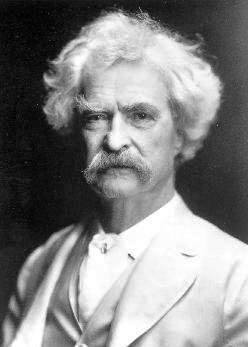 Most people in Britain, Canada, Europe, USA
and elsewhere appreciate the writings of Samuel Langhorne Clemens otherwise known
as Mark Twain. But it is not generally known that between
1867 and 1910 he spent a total of 187 days in Bermuda. It had a much more
attachment for him than most other places in his eventful life. While here,
he lived on the mainland - Main Island - of Bermuda (see Bermuda
Islands). He rented his Bermuda home, he did not buy any
Bermuda Island or any other local real estate.
Most people in Britain, Canada, Europe, USA
and elsewhere appreciate the writings of Samuel Langhorne Clemens otherwise known
as Mark Twain. But it is not generally known that between
1867 and 1910 he spent a total of 187 days in Bermuda. It had a much more
attachment for him than most other places in his eventful life. While here,
he lived on the mainland - Main Island - of Bermuda (see Bermuda
Islands). He rented his Bermuda home, he did not buy any
Bermuda Island or any other local real estate.
Under this pen name, Clemens etched irrevocably into American and world literature his own unique stamp of language, substance, style and home-spun wit. Born in the frontier town of Florida, Missouri on November 30, 1835, his boyhood was spent in poverty in Hannibal, Missouri, on the Mississippi River. He began to write seriously at the age of 12, shortly after his father's death in 1847. His circumstances and lifestyle were such that he could not go to an expensive school or attend college. Instead, as a teenager, he was apprenticed to a printer, then joined his brother Orion's newspaper the Hannibal Journal, for which he wrote copy and became familiar, via assimilation, with some of the frontier humor of the time, such as George W. Harris's Sut Lovingood yarns and other works of the so called Southwestern Humorists.
In adulthood, he was a little man with unruly red hair, a huge drooping moustache, drab and sober clothes, with a distinctive rolling gait and a gentle Southern accent.
From 1853 to 1857, Twain visited and worked as a freelance writer and printer in New York, Philadelphia, St. Louis, and Cincinnati, corresponding with his brother's newspapers under various pen names After a visit to New Orleans in 1857, he learned the difficult art of steamboat piloting. He found his enduring pen name, Mark Twain, after a stint as a steamboat captain on the Mississippi River where the term "mark twain" identified the mark at which the water depth was at 12 feet, a depth safe enough for the boat to pass through. It was an occupation he followed until the beginning of the US Civil War effectively closed the river to commercial traffic. But it supplied the background for his Old Times on the Mississippi (1875), later included in the expanded Life on the Mississippi (1883). In 1861, Twain journeyed via stagecoach to Carson City, Nevada, with his brother Orion, who had been appointed territorial secretary. He made several unsuccessful attempts to mine silver and gold in the region and then returned to writing as a correspondent for the Virginia City Territorial Enterprise. He began signing his humorous and imaginative sketches under the pen name of Josh, but early in 1863 he adopted the now famous name Mark Twain, which he borrowed from the phonetic sound of the call, in local dialect, of a typical Mississippi leadsman's yell meaning that the river water over which a steamboat passed was two fathoms (12 feet) or more deep, therefore safe for a steamboat to navigate.
Twain went to San Francisco in 1864. He achieved a measure of national fame while based there, with his story The Celebrated Jumping Frog of Calaveras County (1865), after being referred to in jocular fashion as the Wild Humorist of the Pacific Slope. A trip to Hawaii in 1866 furnished articles for the Sacramento Union and, on his return to the mainland, materials for the first lecture in what then became for him a long and successful career as a public speaker. The following year he traveled to the Mediterranean, the Holy Land and Bermuda.
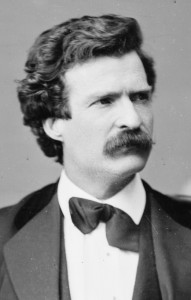
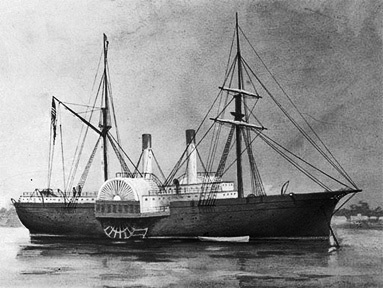
 His first Bermuda visit, in November
1867, is of special interest. Mark
Twain, under his real name, was a passenger on the SS Quaker City,
1,800 tons, see photograph at right, powered by steam and sails. She had
73 passengers, was a converted US Navy warship which during the US Civil War had
helped to impose a Union blockade of Southern ports. She had left New York City
on June 8, 1867 for the Mediterranean, Black Sea and Holy Land. Her first call
was at Horta in the Azores on June 21-23, then Gibraltar and points east. She
arrived back in New York on November 19, via Bermuda. It
was from Bermuda, because of its newly-established telegraphic facilities, he
dispatched letters to San Francisco's Alta California news journal. In their
revised form (1869), they were his The Innocents Abroad, his impressions
of all the places he had visited on this voyage, which won him virtually
immediate international attention .In it, he wrote of his immediate liking for
Bermuda after the ordeal of his trip:
His first Bermuda visit, in November
1867, is of special interest. Mark
Twain, under his real name, was a passenger on the SS Quaker City,
1,800 tons, see photograph at right, powered by steam and sails. She had
73 passengers, was a converted US Navy warship which during the US Civil War had
helped to impose a Union blockade of Southern ports. She had left New York City
on June 8, 1867 for the Mediterranean, Black Sea and Holy Land. Her first call
was at Horta in the Azores on June 21-23, then Gibraltar and points east. She
arrived back in New York on November 19, via Bermuda. It
was from Bermuda, because of its newly-established telegraphic facilities, he
dispatched letters to San Francisco's Alta California news journal. In their
revised form (1869), they were his The Innocents Abroad, his impressions
of all the places he had visited on this voyage, which won him virtually
immediate international attention .In it, he wrote of his immediate liking for
Bermuda after the ordeal of his trip:
“Days passed — and nights; and then the beautiful Bermudas rose out of the sea, we entered the tortuous channel, steamed hither and thither among the bright summer islands, and rested at last under the flag of England and were welcome. We were not a nightmare here, where were civilization and intelligence in place of Spanish and Italian superstition, dirt and dread of cholera."
He penned the famous phrase that Bermuda was a paradise but one had to go through hell to get there. It was because ships' voyages made him sea sick. He hated ships but had no other means of crossing seas and oceans. This, his first Bermuda visit, was over a period of four days. Twain viewed the enormous rubber tree (still there) in the grounds of Par-la-Ville Park, in front of where the Bermuda Historical Society now stands. It had been the town house of Postmaster William B. Perot, who laid out the gardens in the mid 1800s. Mark Twain pretended to be disappointed with the rubber tree. He complained - with a twinkle in his eye - that it did not bear a crop of hot water bottles and rubber overshoes! He was noted for his humor and consideration for others. He became Bermuda's most famous visitor by far, so much so that several busts of him remain in Bermuda, plus a famous local hotel named a prestigious suite after him. He used the 1867 voyage to introduce his readers to the history of Bermuda, a British colony that for purely coldly profitable reasons had openly and massively supported the Confederacy in the American Civil War and given the North's Consul in Bermuda a consistently hard time with often open hostility directed against him. As a result, Bermuda was a place few Americans wanted to visit in the post-war years. More than any other person or entity, it was he and he alone who introduced Americans, via his "Atlantic" writings of 1877 and later, of traveling to Bermuda for its own distinctive long-term charms not its short-term American Civil War history and not just for a short summer vacation but for an extensive visit over several months in America's often bitter winter but Bermuda's balmy winter where there was never any snow and the climate was much more invigorating than in the Caribbean 1,000 miles to the south.
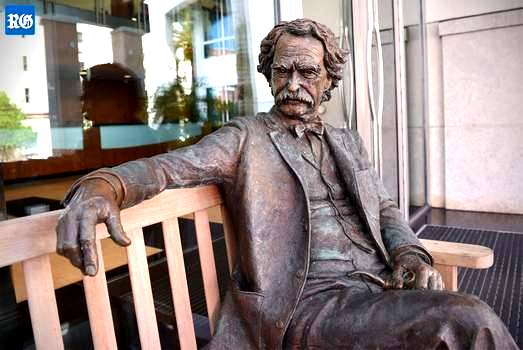
Photo at right: Twain in Bermuda statue
In 1870, Twain married Olivia Langdon of Elmira, New York. As a married man and established writer, his far ranging wanderings by himself ceased for an appreciable period and his lifestyle became more Eastern than Mid-western or Western. After serving briefly as editor and part owner of the Buffalo Express, he moved to Hartford, Connecticut, in 1871, abandoning journalism in order to devote his full attention to serious literature. His Hartford home at Nook Farm is an amazing piece of architecture well worthy of a visit by anyone whether or not they appreciate Twain's work. There, and during summers in Elmira, he produced Roughing It (1872), an account of his Western years; The Gilded Age (1873, with Charles Dudley Warner), a satire of get rich quick schemes and political chicanery; the new pieces for Sketches, New and Old (1875); and Tom Sawyer (1875), his classic tale of boyhood. He had a triumphant lecture tour of England in 1973.
He played a major literary and quasi-political role in the tumultuous presidential election of 1876 in Florida and more so than any politician represented what he called the Gilded Age, a period of new machines, mushrooming cities, proliferating railroads, robber barons, printing presses, streetcars, strikes and suffragettes; the whole nine yards of American life in the Victorian era.
1877. Mark Twain made his second visit to Bermuda, this time accompanied by his friend the Rev. Joseph Twichell. They stayed four days in a private boarding house. The trip resulted in Twain’s 15,000-word sketch "Some Rambling Notes of an Idle Excursion" which was published in four installments in the Atlantic Monthly from October 1877 through January 1878. During this visit, he became impressed by the status of black Bermudians who enjoyed basic Human Rights freedoms and liberties still missing in his homeland despite the outcome of the Civil War a quarter century earlier.
An European sojourn in 1878-1879 inspired, in 1880, A Tramp Abroad. Also that year, on hearing of the death on August 17 in Norway at the age of 70, of one of his favorite composers, Ole (Bournemann) Bull, one of the greatest 19th century violinists and a seminal figure in Norwegian music composition, Mark Twain wrote, in admiration: "If Ole Bull had been born without arms, what a rank he would have taken among the poets! Because it is in him, and if he couldn't violin it out, he would talk it out, since, of course, it would have to come out! "
Twain continued his writings with The Prince and the Pauper (1882), his first historical novel. He completed Life on the Mississippi in 1883 and, after establishing his own firm, Charles L. Webster and Company, published in 1884 what became his masterpiece, Adventures of Huckleberry Finn. He later turned to history again in the allegorical satire A Connecticut Yankee in King Arthur's Court (1889), his powerful indictment of political and social injustice.
He achieved worldwide fame during his lifetime as an author, lecturer, satirist, and humorist. His editors and publishers made sure his every whim was satisfied. He had the appeal and temperament of a 19th century rock star. His speaking engagements were sell-out affairs. His short stories were the talk of Boston and New York. He was unquestionably the most influential writer in America. More than any other writer of his day he captured the voice and spirit of a country only beginning to realize its cultural and political strength. He was the first American writer to become a celebrity, the first to incorporate the distinctive colloquialisms of his native dialect, the first to catch the pathos or tragic comedy of frontier life. Uniquely, he tapped the conditions that distinguished the New World from the Old. His words were eagerly devoured by readers across the Atlantic. Only Charles Dickens, Twain's late hero, had a greater international reputation. Prominent later writers, among them Ernest Hemingway and William Faulkner, declared his works such as Adventures of Huckleberry Finn as major influences on 20th century American fiction.
Twain was far more adept as a writer than as a businessman. Financial problems began to plague him and eventually prompted Twain to move to Europe in 1891, just after finishing The American Claimant (1892). In 1894, following the failure of his publishing company and of the typesetting machine in which he had invested heavily, Twain had to declare bankruptcy. During this period he turned out a number of works, generally inferior to his best: The Tragedy of Pudd'nhead Wilson (1894), Tom Sawyer Abroad(1894), Personal Recollections of Joan of Arc" (1896), and Tom Sawyer, Detective (1896).
In 1895, to help recoup his losses, he embarked on a world lecture tour, later described in Following the Equator(1897). His writings of the late 1890s and 1900s became more pessimistic than ever. Although his financial situation became more healthy, further stress and sorrow came with the deaths of Twain's eldest daughter Suzy in 1896 and of his wife in 1904. His The Man That Corrupted Hadleyburg (1898) and What Is Man? (1906) are scathing examinations of human nature. Yet they imply that proper understanding of human motivations can result in progress. Recent writings about Twain, such as the Mark Twain Papers series, suggest that the period during which he was thought to be less productive and more morose was not at all the wasteland earlier assumed.
From his first visit in 1867 to
his final departure in 1910, Twain bequeathed Bermuda with a treasure-trove of
quotes that have appeared on travel guides and hotel brochures ever since. Twain
described Bermuda as the Islands of the Blessed where British decorum and
cleanliness prevailed; a place where snow-white houses peeped from dull green
vegetation and he could relax among respectable people. Before he was invalided
from Bermuda he told friends "you can go to heaven if you want to, I'd
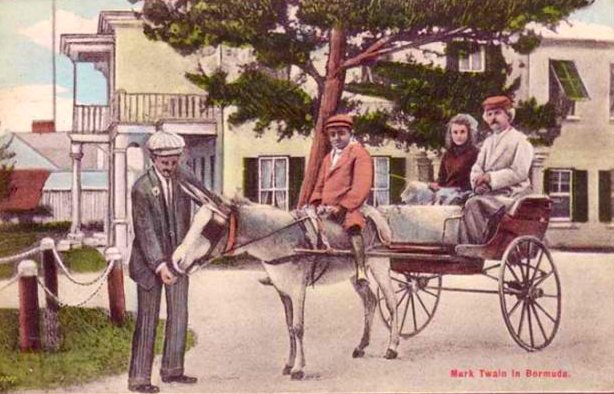
rather stay here". A particular pleasure of his was to take a cart out on
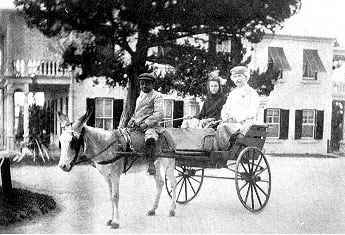
quiet Bermuda lanes, pulled by his favorite Donkey whom he named Maude. On hot
afternoons he often went to the broad verandah of the Princess Hotel by Maude
and cart and once there made sure he was given liquid refreshment of his
favorite Scottish "whiskey" (which he insisted on spelling the Irish
not Scottish way). Twain particularly liked the fact that unlike in the USA
Bermudians of a darker complexion invariably treated him with a certain
military-like respect, a custom probably derived from British Army units then
stationed in Bermuda and once so numerous there they had recreated most of
Devonshire Parish. Before he died, he made sure to place an order for a good
supply Bermuda lilies to be sent to surround his coffin. This last Bermuda
request was duly honored.
 He
described Bermuda as his "Happy Little Paradise. Bermuda
is the right country for a jaded man to loaf in. There are no harassment; the
deep peace and quiet of the country sink into ones body and bones and give his
consciences a rest." In his later years he regarded Bermuda, his second home and spent all the time
there he could because it was his nearest foreign English-speaking escape from the USA and troubles that often dogged him there. In Bermuda, he wrote or was inspired to
write several of his most significant and last literary pieces; played miniature golf;
contributed to petitions including the banning of the automobile in Bermuda; and
entertained some of his famous literary and political friends including his great friend
Woodrow Wilson (before he became President of the USA).
He
described Bermuda as his "Happy Little Paradise. Bermuda
is the right country for a jaded man to loaf in. There are no harassment; the
deep peace and quiet of the country sink into ones body and bones and give his
consciences a rest." In his later years he regarded Bermuda, his second home and spent all the time
there he could because it was his nearest foreign English-speaking escape from the USA and troubles that often dogged him there. In Bermuda, he wrote or was inspired to
write several of his most significant and last literary pieces; played miniature golf;
contributed to petitions including the banning of the automobile in Bermuda; and
entertained some of his famous literary and political friends including his great friend
Woodrow Wilson (before he became President of the USA).
He also actively promoted Bermuda as a tourist and social paradise and found time to involve himself significantly in fund-raising activities for local institutions such as the then infant Bermuda Cottage Hospital (now the large and well equipped King Edward VII Memorial Hospital).
There are several statues around Bermuda in his honour, including one in the lobby of the Bank of Butterfield in Hamilton, on the right after entering from Reid Street. The most prominent Bermuda memorial bust of him is proudly displayed on the front entrance of XL Capital's Bermudiana Road headquarters. Mark Twain was there several times.
Given his unique contributions to Bermuda and its tourism market and the folks from the USA who came to Bermuda to see him and stayed at the hotel on his recommendation, the hotel named the exclusive Mark Twain Suite after him. A bronze statue of him used to sit in the lobby, can now be found at the Masterworks premises.
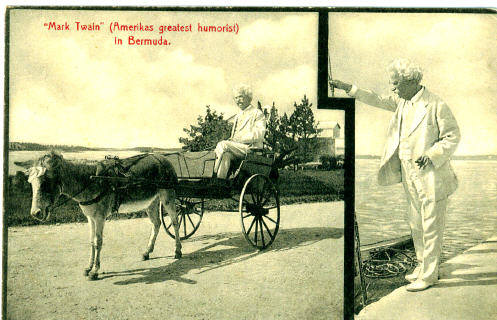
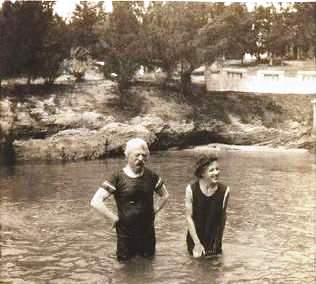
Twain in Bermuda. Two views. On a donkey and by the sea.
Published as postcard # 25 by William Weiss & Co, photographers and Kodak dealers. Printed in Germany, hence the German spelling of America.
In the installments of his articles sent to American magazines and periodicals he gave perceptive insights of an island that had been solidly on the side of the Deep South in the USA Civil War. He crafted a social system as uniquely suited to its particular needs as its architecture. It was a vivid and detailed pen portrait of a Victorian but relaxed Bermuda and it elevated the genre of travel writing to an art form because he concentrated on the people of Bermuda he met and got to know rather than the places of Bermuda he liked. He knew he had found more treasures exploring the human soul than in sightseeing attractions.
He liked it that on the ships he used to steam to Bermuda, as soon as they reached the city of Hamilton they attracted well dressed and well spoken blacks, local farmers and exporters just like their white fellow countrymen, who gave passengers lining the railing details of the prices their onions were getting in New York. Also, Twain spent much of his time being introduced to other aspects of Bermuda in virtually every parish by an engaging young black entrepreneur who owned and operated his own donkey trap as a kind of public taxi. He got to know and enjoyed experiencing a thriving black culture then very much more at ease than now with its older white equivalent. It had hallmarks of industry, self respect, independence of thought and freedoms in action, the likes of which he did not think were in the USA, or were not allowed there at the time. Only in his final few months, when he became exhausted easily, did Twain and his Bermudian driver limit their drives to mornings only. In the first decade of the 1900s among the many famous visitors at his rented Bermuda home were a US president-to-be and, like Twain, another somewhat eccentric character, New York Judge Warren W. Foster. Like Twain, he too waxed enthusiastically about Bermuda, in a booklet republished in about 1910 with cover title Bermudas: Orphan Islands of the Atlantic, with a subtitle of ‘Bermuda, Land of Sunshine and Flowers.’
 Although
not there in person at the time, Twain was outraged when the first ever automobile in Bermuda, owned by the American newspaper
magnate James Gordon Bennett, arrived on the latter's luxurious, coal burning, steam yacht
"Lysistrata." It
anchored in Hamilton Harbor in March, 1906. It didn't matter to Twain that James Gordon Bennett's name and publishing empire carried
prestige everywhere. (It was the organization which in 1871 had commissioned the young American
journalist, Henry Morton Stanley, to go find the distinguished British explorer and
missionary, Dr David Livingstone, who disappeared into Central Africa without a trace. Several months into his mission, Stanley duly found Livingstone in a little village on
Lake Tanganyika, outstretched his hand and spoke his famous greeting: "Dr
Livingstone, I presume?").
Although
not there in person at the time, Twain was outraged when the first ever automobile in Bermuda, owned by the American newspaper
magnate James Gordon Bennett, arrived on the latter's luxurious, coal burning, steam yacht
"Lysistrata." It
anchored in Hamilton Harbor in March, 1906. It didn't matter to Twain that James Gordon Bennett's name and publishing empire carried
prestige everywhere. (It was the organization which in 1871 had commissioned the young American
journalist, Henry Morton Stanley, to go find the distinguished British explorer and
missionary, Dr David Livingstone, who disappeared into Central Africa without a trace. Several months into his mission, Stanley duly found Livingstone in a little village on
Lake Tanganyika, outstretched his hand and spoke his famous greeting: "Dr
Livingstone, I presume?").
Bermudians were entranced when Mr. Bennett's beautiful motor car was landed. They watched in awe as the proud owner's uniformed combined chauffeur and mechanic swung the crank handle at the front of the vehicle and the engine roared into life on the City of Hamilton dock. It was an automobile worthy of the prestige of the Bennett family. At the turn of the century, horseless carriages were being manufactured by a number of American companies. Bennett could have purchased an economy car from one Henry Ford whose manufacturing company had been launched in 1903. He could have selected a more expensive one, for example, a Packard, as manufactured by James Ward Packard; or an Oldsmobile, from the stable of Ransom Eli Olds. But Bennett looked to Europe. There, the French were producing the Peugeot (as they do now), Renault (also as they do now) and De Dion Bouton. It was the last mentioned, for its distinctive features, which he purchased.
It bumped noisily over the unpaved roads of the town while amazed Bermudians gawked wide eyed from every window and droves of panting schoolboys raced behind it. It traveled at an average rate of 15 miles an hour, much faster than any horse and carriage in Bermuda could reach and sustain. Schoolboys loved it but there were many others who were not amused; whose horses were frightened, or who had nightmares that "horseless carriages" would drive away very important visitors like Mark Twain.
 They were right. It was exactly the
kind of vehicle that Mark Twain and his friends did not want to see in Bermuda, to spoil
their image of Bermuda as a motor-less Eden.
They were right. It was exactly the
kind of vehicle that Mark Twain and his friends did not want to see in Bermuda, to spoil
their image of Bermuda as a motor-less Eden.
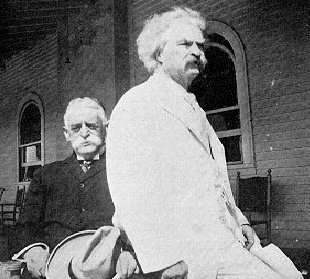
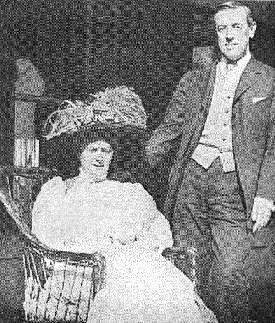
In 1906 these friends were led by Woodrow Wilson, then President of Princeton University but poised to launch his political career in earnest. He was recuperating in Bermuda from an injury incurred earlier which left him temporarily without sight in his left eye.
According to an article from the Chicago Daily Tribune, March 17, 1907 entitled "Mark Twain Seeks Place to Wear White", Mark Twain headed to Bermuda that day for "summery climes" and was quoted as saying he was "in search of rest, British humor, and an opportunity to appear logical in March in a white suit." On the same day, Woodrow Wilson and his special friend Mary Allen Hulbert Peck, who had clearly enchanted Wilson, set out to enjoy a vacation in Bermuda. Interestingly, Twain had met earlier the wealthy industrialist Thomas D. Peck who was married to Mrs. Peck. He and Twain became the best of friends. He was one of the most frequent daily callers at Twain's "Bay House" Bermuda home, often to ask Twain to join him in games of miniature golf British style, on a putting green. They both enjoyed this relaxing exercise immensely. There is no record of them playing on a regular golf course as none had yet been developed in Bermuda.
But when Bermuda was invaded by Bennett's noisy, smelly motor car, their golf gave way to a more urgent cause. They drafted a petition to the Bermuda Legislature demanding that motorized vehicles be totally banned in Bermuda. It read in part that it would be a fatal error to attract to Bermuda the extravagant and sporting set who made so many other places entirely intolerable to persons of taste and cultivation. It was a direct reference to Bennett, his yacht and the automobile it carried.
Wilson and Twain lobbied local legislators extensively to ensure the success of their petition. It was effective. It was helped hugely by the fact that in 1908 the first bus on the island was a 12-seater. It frightened a horse, causing a doctor to be tossed to the ground. That incident is believed to have been one of the catalysts - Mark Twain in Bermuda was another - that led to the passing of a law that would ban all motor vehicles from Bermuda's roads for nearly 30 years. Early in 1910, the Bermuda Legislature resolved to evict motor vehicular traffic from Bermuda's roads. More than three decades would pass before any more motor cars were allowed to make an appearance on Bermuda's roads.
In March 1908, when electricity was introduced to an initially small group in Bermuda by the Bermuda Electric Light Power and Traction Company Ltd, it is believed Mark Twain was one of them, at his Pembroke house.
Twain hoped
for several more trips to Bermuda in 1907 after his return from Oxford, England
that summer. But they did not come about, until January 1908, when he
asked Ralph Ashcroft to go with him on a 7-day visit.
It was at that time Twain met Upton Sinclair, author of The
Jungle (1906), which had received huge acclaim. Twain's engagements then
included having dinner with Mrs. Peck and Woodrow Wilson. He also formed a
friendship with Elizabeth Wallace, dean at the University of Chicago who had
vacationed in Bermuda.
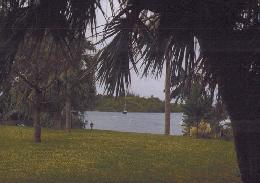
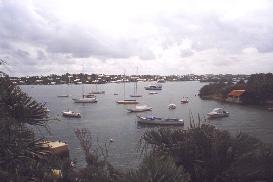
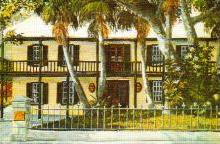
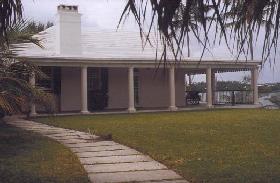
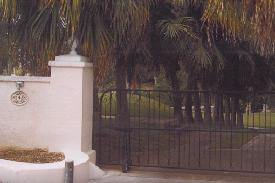
Color photographs above by author Keith A. Forbes
Bermuda and what it was doing to him obviously weighed heavily on his mind because not long after he and Ashcroft returned to the USA, Twain again returned to Bermuda, this time with Henry H. Rogers, Rogers’ son-in-law William Benjamin, a valet of Roger's and Isabel Lyon. On this occasion, from February 24 through April 11, 1908, Twain spent 47 days in Bermuda.
 On Christmas Eve 1909, his youngest daughter Jane (Jean)
Clemens died in her bath at their Connecticut home after an epileptic seizure. She was
only 29 years old. It affected him severely and was a major reason why he returned to
Bermuda yet again. Surrounded by Henry Rogers and other stalwarts, mostly American, he spent some of
his twilight hours in Bermuda voicing pessimistic views of mankind, or reading aloud the
poetry of another one of his friends, the great British writer and poet Rudyard Kipling.
It was in Bermuda at this time that he prepared his article The Turning Point in My Life
for the magazine Harper's Bazaar.
On Christmas Eve 1909, his youngest daughter Jane (Jean)
Clemens died in her bath at their Connecticut home after an epileptic seizure. She was
only 29 years old. It affected him severely and was a major reason why he returned to
Bermuda yet again. Surrounded by Henry Rogers and other stalwarts, mostly American, he spent some of
his twilight hours in Bermuda voicing pessimistic views of mankind, or reading aloud the
poetry of another one of his friends, the great British writer and poet Rudyard Kipling.
It was in Bermuda at this time that he prepared his article The Turning Point in My Life
for the magazine Harper's Bazaar.
The house where he spent most of his time was Bay House, at 4 Old Slip Lane, on the left and nearly at the end of a private and tranquil access road off Pitt's Bay Road in Pembroke Parish HM 06 within easy reach of the island's capital city of Hamilton. A coastal property facing and sloping gently down to the waterfront of Hamilton Harbor, it is still known as Bay House and remains where it was, exclusive and private. It faces west, with extensive grounds going right down to the sea and lovely uninterrupted views of nearby small islands in the Great Sound.
 On numerous occasions at Bay House in
Bermuda and at their home, Mark Twain was a regular
friend and popular
guest, at historic Wistowe in Flatt's, of Mr. Charles Maxwell Allen, then Assistant
(later confirmed as) Consul General of the USA,
his wife,
Mrs. Marion
Schuyler Allen. (Later, their son, daughter-in-law and
granddaughter Helen Allen became closely associated with Mark Twain’s dying
days).
On numerous occasions at Bay House in
Bermuda and at their home, Mark Twain was a regular
friend and popular
guest, at historic Wistowe in Flatt's, of Mr. Charles Maxwell Allen, then Assistant
(later confirmed as) Consul General of the USA,
his wife,
Mrs. Marion
Schuyler Allen. (Later, their son, daughter-in-law and
granddaughter Helen Allen became closely associated with Mark Twain’s dying
days).
At his first cricket game in Bermuda, accompanied by his host Mr Allen, Twain made mischievous remarks, deliberately peppering his host with silly questions. The exasperated host eventually shot back that wickets were for the umpire to sit on when he got tired. Twain later wrote about the game in an article published in The Strand Magazine.
In the 1860s, Allen had been a friend in Bermuda of another expatriate, the English artist Edward K. James. Allen had served as President Abraham Lincoln’s wartime consul in Bermuda in 1861 and stayed on after the war. In 1888, Twain was saddened to learn of the death in Bermuda of his old friend Allen who had so ably represented the Union in Bermuda during the US Civil War — at a time when local sympathies tended toward the side of the Confederacy. His fight against the use of St George’s by blockade runners trading with the South made the outset of his 27-year service in 1861 a miserable one. In the end, however, Mr Allen came to love Bermuda, and served until his death. He was buried in the grounds of St Mark’s Church where his remains still exist. His grave was later visited by Twain.
Twain was also a regular visitor for meals and drinks at the Princess Hotel near Hamilton. Some of his friends stayed there.
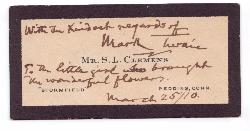
It is believed Twain regularly walked from Bay House to the Tucker Sister's Tea Room at Barr's Bay Park (now the park area immediately west of Albouy's Point) passing the Faulkner House, 108 Pitts Bay Road, on his way and chatting with the little girl who lived there, Nettie Smith. Judith Wadson, the granddaughter of Nettie Smith, now owns and operates Aggie's Garden & Waterside Cafe located in the same house. "My grandmother was an only child and would hang out on the stoop in front of the house and got to know Mark Twain as he passed by. They would go on walks together and she would bring him Bermuda roses," said Ms Wadson. One of Nettie Smith's most prized possessions was a black-rimmed calling card - see attached graphic, left - that Twain left for her one day when she wasn't home when he passed by. On the card a handwritten note said "for the little girl that used to bring me flowers."
Mr. Allen did not return to the USA after the Civil War. He remained in Bermuda as U.S. Consul until his death in 1888. He and his wife, who died in 1909, are buried in the cemetery of St. Mark's Church in Smith's Parish, Bermuda.
Until 1999, the manuscript was suppressed, partly because Twain's daughter Clara Gabrilowitsch and Albert Bigelow Paine - Twain's official biographer and business manager - felt that such an intimate portrait might reveal some unpleasantness about Twain. In fact, many academics might not know and certainly many others do not that such a chilly exchange of letters passed between Clara and Mrs. Allen, including the former forbidding the latter to print the memoir, that Mrs. Allen went ahead and did so anyway, in London instead of in the USA - beyond the reach of Clara.
Also, Clara (said by Mrs. Allen to be still on honeymoon in Europe when her father died more than seven months after her wedding but in fact still in Germany because her husband was under contract there at the time) thought that the general public might think his own family had neglected him in his final sad months. It is certainly true that he was lonely and heartbroken in the USA, first from the death of his eldest daughter Olivia Susan (Susy) in 1896 at the age of only 24, then his wife Olivia in 1904 when she was 59 years old and then the tragic death of his daughter Jane (Jean) Clemens over Christmas 1909 when she was 29. So he turned to the more tranquil surroundings of Bermuda and the company and gracious hosting mostly of the Allen family for a respite from all his woes and tragedies.
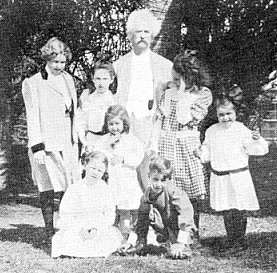
Mrs. Allen wrote that it was largely out of affection by Twain for their young daughter Helen (another - older - daughter was Edith Wistowe Allen and much later Patty Allen Chaplin was the Allen's granddaughter in law) that she and her husband got to know him so well. She noted how he found young girls more interesting than boys. Perhaps it was because all his children had been girls. He told her that boys ought not to exist until they were men. Mrs. Allenrelated one occasion that greatly amused her, her husband, Twain and her daughter. On an old pleasure steamer, they all went to see the flagship of the Royal Navy, H.M.S. Euryalus, visit Bermuda. They were confronted by a naval longboat full of fierce looking pirates, armed to the teeth and gesticulating wildly - off duty midshipmen having a bit of fun. They swarmed over the pleasure steamer, forced two officers to walk the plank in full regalia, hauled down the British flag and replaced it with the skull and crossbones. Twain chuckled for many minutes.
Another very special Bermuda event for him was his visit in 1908 to the Crystal Cave. He had heard of the feats of Carl Gibbons and Edgar Hollis, two teenage boys searching thoroughly for a lost cricket ball hit very hard and far and expensive to replace, who had accidentally discovered a deep hole. They explored it in hope of finding the ball. What they discovered was a scintillating natural wonder that was to have major repercussions on Bermuda's tourism industry, the Crystal Cave in Hamilton Parish. It was opened to the public three years later. When the Wilkinson family, owners of the property since 1884, were told of this discovery, they wasted no time in setting off to explore the entrance and to find out how deep it went. Bernard Wilkinson, the fourteen-year-old son of Mr. Julian Wilkinson, was lowered into the hole by his father using a strong rope tied to a tree. Bernard descended 140 feet with a lamp from a bicycle to light his way. What he found was beyond his or the Wilkinson family's wildest dreams. It was an underground world of delicate splendor with magnificent crystal formations of every size and shape surrounding a clear lake 55 feet deep. Twain was likely the very first visitor to see the profusion of pristine white stalactites, soda straws and helectite formations above the cave.
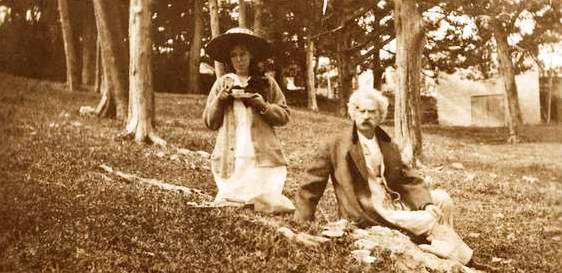
Mrs. Allen has mentioned how he usually spent his mornings with his books, manuscripts and writing materials at hand and a pile of cigars or pipes, not cigarettes. Bay House had its share of smoke and both Mrs. Allen and Helen must have been very tolerant. Twain usually relaxed in a kimono and slippers before luncheon. His room was on the ground floor of Bay House. It had a door opening on to the verandah which surrounded the house. The lawn was just a step down. Sometimes he would go outside, enjoying his pipe. If it was nearly noon, with Helen returning from school, they would meet in the garden then come in for a pleasant chat.
She and her mother warned him they would take his picture. One day they did, much to their delight and his pretended embarrassment. One morning, he had a very serious bleeding of the nose. The entire family, with their maids and valet, brought wet cloths for his relief. Twain made a joke out of it by suggesting to Helen that she run quickly to get a pencil and paper to take down his last words. On another occasion, Twain read the family extracts from Tom Sawyer and commented that many scenes from it were taken from his own life, like the whitewash scene, cat and pain killer. Sitting in the garden in a sunny spot, he was well wrapped up. He sometimes came home early from an afternoon drive and at night used a vaporizer which his friend Woodrow Wilson, then President of Princeton University, recommended for him. But the Allen family found it difficult to get him to take proper care of himself.
Twain liked the company of young women in Bermuda, after 1905 when his beloved wife Olivia died. During their courtship Mr Twain wrote to his future wife: "Even if you prove to me that you have the blemishes you think you have, it cannot appall me any, because with them, you will still be better, and nobler, and lovelier than anyone I have known." He called her Gravity and she called him Youth. They were married for 34 years before Mrs Clemens's death in 1904. After his grieving process eased, he referred to young ladies in Bermuda as his Angelfish, after an Aquarium Club he formed after seeing angel fish swimming in Bermuda His Angelfish were all given Angelfish pins he had made in the USA. They filled a gap in the life of an elderly gentleman, especially for one who lost both his wife and one of his daughters not very long after each other. He missed them terribly. He had been a novelist who had made children and youngsters special people in his stories. He was an avid correspondent with his Angelfish, who he called pretty and sweet and innocent dear young creatures to whom life is a perfect joy and to whom it has brought no wounds, no bitterness and few tears. The Angelfish, whom he always treated with perfect civility and with never any motive that would be suspect today, helped fulfill his aspirations of being a grandfather. They often accompanied him on his Bermuda outings. In 1908 he wrote: "I had reached the grandpapa stage of life; and what I lacked and what needed, was grandchildren, but I didn't know it. I am the richest man that lives today, for I select my (Angelfish) grandchildren, whereas all other grandfathers have to take them as they come, good, bad or indifferent." The Angelfish were his Bermudian surrogate grandchildren.
In his 1907 visit to Bermuda, he depended greatly on his secretary, Miss Isabel Lyon.
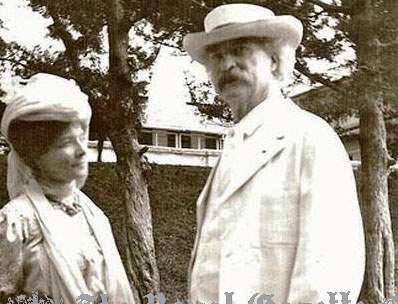
Twain with Isabel Lyon, Bermuda 1907
In his 1909 visit to Bermuda he was accompanied by his biographer Albert Bigelow Paine. Twain wrote him a poem which read in part: "Ah, Paine will come with me just once again; only once again; and after a time and two times and half a time he will go down the stairway that looks upon the sea and lo, thenceforth the places that knew him once will know him no more for ever". Twain was forecasting his end.
After his heart attack of March 22, 1910 he slept very little and his shortness of breath became more pronounced. One night, he said how he knew how poor Livy - his dead wife Olivia - must have suffered, from the same difficulty. He was always thinking of her and near the end spoke of her constantly, as if he was reaching for her, to feel her near. It is said he wrote a paper in Bermuda during his final visit to Bermuda. The first part, written on March 6, 1910, is a joking contract offering the daughter of his host on the Island, Helen Allen, $2.40 to believe "everything he says hereafter." The contract was signed by Ms Allen. The second part was also written before he left the Island, believed to be between April 8 and April 11, 1910, selling back the original contract, and explaining that he was leaving the island because "experienced parties" believed that his ill health would be worsened if he remained in Bermuda. In the last line, he writes that he did not want to die, "a proppity that don't give a dam for cold storage nohow." It was his last visit to Bay House. His return journey to America was agony for him. He was so weak he could not be dressed. The Allen family ensured he was carried in a chair to the tender and escorted him to the vessel Oriana. But he revived himself enough to tell the Allen family about some books he particularly wanted them to have. He was considerate to the last. He was slipping away from the bonds of humanity, to rejoin the majority of his family. On April 21, 1910, less than a year after his last visit to Bermuda, he died at his permanent home in Redding, Connecticut, at the age of 75, from angina pectoris, what he called his "tobacco heart." He barely had time to settle his affairs. So iconic of Bermuda had Bermuda Easter lilies become by then that when Mark Twain, that peerless lover of Bermuda, died in 1910, the Brick Church on Fifth Avenue in New York City was decked with Bermuda lilies for his funeral. Bermudians received the news the next day with great distress. The bad tidings had come via the local telegraph office he had used so frequently to cable his publishers in the USA with his articles and stories - and then the local and overseas newspapers with their obituaries and related stories. He was remembered him fondly, from his frequent extended visits. Bermuda saluted him as a man who graced Bermuda with his presence.
His literary works have also had a very considerable influence on the compositions of various prominent composers. For example, when the American composer Charles Edward Ives wrote his important symphonic work FOURTH OF JULY, for which he assembled a heterogeneous orchestra and built in a wildly dissonant climax representing the explosion of fireworks so common in a Fourth of July celebration, he noted in a memorandum that it was pure program music - and pure abstract music. He also added this quotation from Twain's "Adventures of Huckleberry Finn": "You pays yer money and you gets yer choice."
In 1945, the American composer Charles Wakefield Cadman premiered his overture HUCKLEBERRY FINN GOES FISHING. It also was inspired by Twain's 1884 literary masterpiece, "Adventures of Huckleberry Finn." And on May 18, 1950, in Bloomington, Indiana, the opera THE JUMPING FROG OF CALAVERAS COUNTY, written in 1949-1950 by the German born American naturalized composer Lucas Foss, enjoyed its first performance. It is based on Twain's "The Celebrated Jumping Frog of Calaveras County." Other composers have drawn on Twain's literary works as inspirations for their musical offerings.
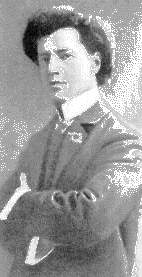 On November 16,
1900, the Philadelphia Orchestra gave its first concert, with Fritz Scheel conducting. Had
Twain been present, he might have been very curious indeed about the piano soloist. He was
the Russian born Ossip Gabrilowitsch, then 22 years old, in his first few months as an
immigrant to the USA. Later, he became a distinguished pianist, conductor and composer. He
studied at the St. Petersburg Conservatory with Glazounov, Liadoff and Rubinstein and at
16 won the Rubinstein prize. He underwent further studies in Vienna with Leschetizky from
1894 to 1896 after which he began touring with considerable success. The Philadelphia
concert occurred some time before Gabrilowitsch met Clara Clemens, Twain's singing,
surviving daughter. Gabrilowitsch then went on to consolidate his USA reputation with a
particularly fine series of orchestral concert programs in New York in 1907.
On November 16,
1900, the Philadelphia Orchestra gave its first concert, with Fritz Scheel conducting. Had
Twain been present, he might have been very curious indeed about the piano soloist. He was
the Russian born Ossip Gabrilowitsch, then 22 years old, in his first few months as an
immigrant to the USA. Later, he became a distinguished pianist, conductor and composer. He
studied at the St. Petersburg Conservatory with Glazounov, Liadoff and Rubinstein and at
16 won the Rubinstein prize. He underwent further studies in Vienna with Leschetizky from
1894 to 1896 after which he began touring with considerable success. The Philadelphia
concert occurred some time before Gabrilowitsch met Clara Clemens, Twain's singing,
surviving daughter. Gabrilowitsch then went on to consolidate his USA reputation with a
particularly fine series of orchestral concert programs in New York in 1907.
On October 6, 1909, in Redding, Connecticut (at just about the time the adjacent photograph of him was taken) Ossip Gabrilowitsch, then 31 years old, married Twain's daughter Clara, with Twain present. Like her father, she appreciated good classical music. She was even contemplating a professional career as a singer, with her fine voice that was reputed to range from contralto to mezzo soprano. But her marriage came first. Little did the happy couple realize at the time that Twain had only seven months left to live. He would have been proud, indeed, had he been able to know what further heights his Russian born son in law - his daughter's first husband - would reach in the world of classical music.
On September 14, 1936, Gabrilowitsch died in Detroit, Michigan, at the age of 58, after a distinguished musical career. He was mostly resident in Munich, Germany, from 1904 to 1914, where he conducted the Konzertverein concerts from 1910 to 1914. Clara went with him often. Between 1912 and 1916 he toured European and American musical centers, giving a series of historical piano recitals to illustrate the growth of the concerto. He was appointed the conductor of the Detroit Symphony Orchestra in 1918, a post which he filled with great distinction until 1935.
He also served as one of the leaders of the Philadelphia Orchestra and as a featured guest with other major American orchestras. He was an esteemed ensemble performer and considered one of the most brilliant and scholarly soloists of his time. His compositions included OVERTURE RHAPSODY, for orchestra; ELEGY, for cello; piano pieces and songs. He endeared himself immeasurably to his European and American audiences.
Mark Twain and the Happy Island. Wallace, Elizabeth. 1913. Chicago, McClug. 139 pages. Illustrated.
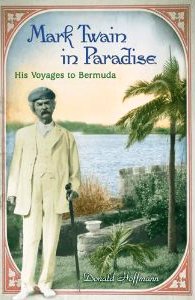
Mark Twain In Paradise – His Voyages to Bermuda. American writer Donald Hoffmann. The special relationship that Mark Twain had with turn of the century Bermuda. University of Missouri Press, 2006.
Twain's End. United States author Lynn Cullen. 2015. Historical fiction. The novel imagines the romantic life between celebrated American scribe Mark Twain and Isabel Lyon, his secretary, drawing on Twain’s writings and letters as well as Lyon’s diary. A keen traveler, Twain first came to Bermuda in 1867 and returned several times thereafter — lingering for months at a time up until his death in 1910. Making eight trips here, Twain once famously quipped: “You can go to heaven if you want. I’d rather stay right here in Bermuda.” Thus, readers of Ms Cullen’s latest book are taken to The Princess Hotel of January 1907, in a Bermuda of horse-drawn transportation on roads of crushed limestone, in which many of the businesses lining Front Street are wooden. Twain reminisces how the Island recalls his birthplace of Florida, Missouri. The chapter closes with a trip to Devil’s Hole, where the author exhorts locals in the shade of a cedar tree to “never, ever regret anything that makes you smile.” Gallery Books, an imprint of publishers Simon and Schuster, available at the Bermuda Book Store, Queen Street.
Banner.jpg)
Authored,
researched, compiled and website-managed by Keith A. Forbes.
Multi-national © 2020. All Rights Reserved