Click on graphic above to navigate the 165+ web files on this website, a regularly updated Gazetteer, an in-depth description of our island's internally self-governing British Overseas Territory 900 miles north of the Caribbean, 600 miles east of North Carolina, USA. With accommodation options, airlines, airport, actors, actresses, aviation, banks, beaches, Bermuda Dollar, Bermuda Government, Bermuda-incorporated businesses and companies including insurers and reinsurers, Bermudians, books and publications, bridges and causeway, charities, churches, citizenship by Status, City of Hamilton, commerce, communities, credit cards, cruise ships, cuisine, currency, disability accessibility, Devonshire Parish, districts, Dockyard, economy, education, employers, employment, environment, executorships, fauna, ferries, flora, former military bases, forts, gardens, geography, getting around, golf, guest houses, highways, history, historic properties, Hamilton, House of Assembly, housing, hotels, immigration, import duties, internet access, islands, laws, legal system and legislators, main roads, marriages, media, members of parliament, money, motor vehicles, municipalities, music and musicians, newcomers, newspaper, media, organizations, parks, parishes, Paget, Pembroke, performing artists, residents, pensions, political parties, postage stamps, public holidays, public transportation, railway trail, real estate, registries of aircraft and ships, religions, Royal Naval Dockyard, Sandys, senior citizens, Smith's, Somerset Village, Southampton, St. David's Island, St George's, Spanish Point, Spittal Pond, sports, taxes, telecommunications, time zone, traditions, tourism, Town of St. George, Tucker's Town, utilities, water sports, Warwick, weather, wildlife, work permits.


By Keith Archibald Forbes (see About Us).

Bermuda-based AIG, briefly Chartis
See:
Bermuda's International Business, including Insurance and Re-insurance Companies
Bermuda Online's Business and Economy Index for applicable Bermuda Business Laws
Bermuda, not an politically independent country but a self-governing British Overseas Territory not part of the UK's involvement with the European Union, has its own Bermuda laws. They, not UK laws, apply in all business, commerce, financial and socio-economic areas. However, in the event of any legal dispute, ultimate legal appeals may qualify for submission to the UK's Privy Council in London. Bermuda has enjoyed a long tradition - since 1947 - of no Bermuda-imposed income or profits taxes or other taxes such as withholding tax, capital gains tax, capital transfer tax, estate duty or inheritance tax payable by a non-Bermudian-owned but Bermuda-based international (exempted) company doing business not in the Bermuda market but beyond Bermuda, or its non-Bermudian shareholders. On request, a written guarantee to that effect will be issued to any exempted company, so-called because they are, as companies not operating in the Bermuda market place but solely beyond Bermuda, exempted until at least the year 2035 from taxes that now apply or may one day apply to Bermudian companies. Today, Bermuda is a major International Business Centre, number 1 in the world as an offshore centre for insurance, in the top three for shipping, investment and other services, for administering, controlling and directing companies but is not and never has been a manufacturing centre, due to its very small size (21 square miles in total land area), tiny resident population (only 64,500) and remoteness (600 miles from the nearest mainland. While many of the world's biggest companies are not incorporated in Bermuda, they nevertheless have offices or some other kind of active presence in Bermuda, mostly for tax avoidance reasons. As an international business centre, Bermuda offers a number of tax advantages to international businesses seeking to lessen their operating and taxation costs providing they operate abroad or with each other and are not competing in the Bermuda market place with Bermudian businesses. Bermuda is also a popular location for registering hedge funds as its legislation allows the flexibility needed by this type of fund. Most are aimed at either high net worth individual investors or institutional investors.
All entities are Bermuda-incorporated limited liability companies (corporations) or partnerships with "Limited" after their name but the latter is not shown below. Their areas of business activity are hugely diversified. Bermuda is one of the very few countries in the Western world to require that all business newcomers to Bermuda need a locally registered attorney or firm of attorneys to undertake their work for them, at very considerable expense, instead of doing so directly, at far less cost, to a relevant Government Department. Newcomers need attorneys to incorporate companies, register aircraft and ships, buy and sell real estate and much more. Attorneys in Bermuda are among the world's most expensive.
Why do so many companies shown below from A through Z incorporate in Bermuda (re-incorporation overseas, a process also known as corporate inversion) when they do little or no business in Bermuda? It is primarily because they can lower their taxes hugely, without giving up the benefits of doing business in their home countries and wherever else in the world they do business directly and indirectly. By moving to Bermuda, their income from outside the USA becomes exempt from American taxes. When an American company, by far the most in number in Bermuda, borrows from its Bermuda-incorporated parent the interest it pays creates a deduction that reduces US taxes and there is no tax on the interest earned by the Bermuda-incorporated parent. British, Canadian, Chinese (hundreds of Bermuda-registered companies' names begin with the word China), European, Norwegian, Russian, Taiwanese and other foreign companies and their subsidiaries can claim similar advantages from their Bermuda-based entities, and thousands do. American corporations that have saved millions and/or billions in US taxes over the years by incorporating themselves and often their operating subsidiaries in Bermuda include American International Group (AIG) with many Bermuda subsidiaries; Chevron (with an even greater number of Bermuda subsidiaries); Cooper Industries; Foster Wheeler of New Jersey; Global Crossing, a Beverly Hills, California telecommunications company; Ingersoll-Rand (which, for the under $30,000 a year it pays Bermuda in annual incorporation fees, saves the business over $40 million in US corporate income taxes); Tyco International; Stanley Works, a major Connecticut-based toolmaker (it estimated its tax bill was cut by $30 million a year).
The regulatory environment is exceptionally favorable to them in Bermuda - so much so that many international businesses, including insurers, from all over the world, even in places such as St. Lucia, West Indies, now have their Bermuda-incorporated and Bermuda-based companies as their registered offices and their companies beyond Bermuda as their subsidiaries. Their reasons to relocate to Bermuda are usually stated more reservedly, as corporate inversions arise out of the USA's own tax code (including a vicious corporate federal income tax rate of 35% on most corporate income earned worldwide which puts US companies at a distinct disadvantage and creates an environment in which corporate executives often find it necessary or advisable to search for tax savings wherever available. Similar but somewhat less onerous taxation policies occur in the UK, Canada, China, Russia and other countries, although these countries usually do not follow the US taxation policy of taxing on world-wide income, only on income earned in their own jurisdictions.
The presence in Bermuda of these Bermuda-registered companies, the Bermuda Government fees they pay in return for not having any Bermuda Government taxes imposed on their income or profits and the profits they earn from their often world-wide business including acting a principal insurers in US and other jurisdictions and in major disasters such as hurricanes, typhoons and special risks, is the single-biggest reason, not tourism which lags far behind, why Bermuda, despite its tiny size of only 21 square miles or 58 kilometers, scores so highly in World Bank and related statistics in Gross National Income and other economic indicators.
Advantages do not include no income taxes (because there is an income tax, called a Payroll Tax, payable by employers and employees, based on employment income) but there are few restrictions as to how Bermuda companies can invest their assets and deploy capital, not to mention the island's close proximity to the largest insurance market in the world, the USA. They are presently free to accept contingent commissions, which are payments to brokers from insurers based on the volume of business steered to them. They are exempted from any other direct income taxes, capital gains and other taxes. They are also excepted from Bermuda's domestic company requirements of being at least 60% beneficially owned by Bermudians. They can trade anywhere in the world except as a local company in Bermuda (They cannot write any business for Bermuda residents, only with other international or exempted companies).
There are more than 18,000 Bermuda-based-and-hosted exempted or international companies (see Definitions below), 2551 local companies, 420 overseas partnerships and 840 other non residents, many with a global business empire. Most popular international companies in Bermuda are investment holding, insurance, mutual funds, commercial trading and shipping. There are also managers, consultants, insurance brokers, natural resources, etc. There are more than 2,700 registered mutual (investment) funds in Bermuda. These comprise some 2,461 investment portfolios with net asset values totaling in excess of $310 billion. Bermuda has over $110 billion invested in just hedge funds, as one of the world's leading hedge fund jurisdictions.
Exempted or international companies, not being majority locally-owned, are not permitted to carry on local business. However, they may deal with other locally based exempted companies without restriction and may buy their locally needed necessities or services from local companies. Examples are the accounting, banking, legal, management and office supply services they buy locally. Exempted or international companies include subsidiaries of 75% of the Fortune 100 and their European equivalents. Only 235 or 3.4% of the internationals have local offices, yet account for 75% of internationals' spending. In insurance and reinsurance, Bermuda ranks with Lloyds of London and New York as a global leader and in some aspects of specialty insurance, outranks them. There are numerous British-UK insurers who have either moved their domiciles to Bermuda or have substantial subsidiaries on the Island.
In Bermuda, commercial and financial services are regulated by category, for example in insurance, mutual funds, investments, trusts, etc
Because, in furtherance of the above, Bermuda has no exchange control, Bermuda does not restrict capital flows in any foreign currency. Bermuda banks routinely service exempted companies in all their banking requirements and offer accounts in Bermuda dollars, US Dollars and as required from further abroad.
As a long-established international offshore business center, Bermuda can provide significant advantages to companies and corporations and partnerships. British UK, US, Canadian and corporate entities from around the world incorporate in Bermuda and use their Bermuda entities to own or control or manage their operations even in their head offices in other parts of the world and/or pay their management and staffing costs in salaries and/or bonuses, while avoiding often heavy taxes in their own countries. The tax authorities in the USA and Britain in particular fail to have the proper corporate tax incentives of their own to keep these corporate entities in Bermuda and place no objections to offshore jurisdictions like Bermuda applying tax-haven-like advantages, but do not hesitate to apply often very vicious tax penalties to individuals who seek the same advantages, with their FACTA-like curbs and restrictions.
Newcomers to Bermuda's corporate scenario, whether entrepreneurs establishing their Bermuda-based entities or their employees both Bermudian and non-Bermudian, like having only half an hour to home or office, golf courses and beaches. Regulatory agencies cannot divulge information. Expatriates have freedom from foreign anti-trust laws. They are not subject to currency control. Unlike Bermudians, they can deal in any currency with any bank local or anywhere and freely transfer funds.
They all have "Ltd" in their official corporate name. Advantages do not include no income taxes (because there is an income tax, called a Payroll Tax, payable by employers and employees, based on employment income) but there are few restrictions as to how Bermuda companies can invest their assets and deploy capital, not to mention the island's close proximity to the largest insurance market in the world, the USA. They are presently free to accept contingent commissions, which are payments to brokers from insurers based on the volume of business steered to them. These factors, along with the current favorable market conditions, have contributed to the robust financial performance of the Bermuda insurance and reinsurance market. They are exempted from Bermuda's domestic company requirements of being at least 60% beneficially owned by Bermudians. They can trade anywhere in the world except as a local company in Bermuda (They cannot write any business for Bermuda residents, only with other international or exempted companies).
2019. August 15. More than 20 per cent of the world’s top 50 largest reinsurers are based in Bermuda or have a significant presence here. In a latest rankings, PartnerRe Ltd is the highest placed Bermudian-based company, appearing at 12 on the 2018 list from ratings agency AM Best. It had $6.3 billion of unaffiliated life and non-life reinsurance gross premiums written, as measured by AM Best’s methodology. The list was released as part of a 74-page Global Reinsurance market segment report published on Thursday. One spot below PartnerRe on the list is Everest Re Group Ltd, with similarly assessed gross premiums written totaling $6.22 billion, while at 14 is XL Bermuda Ltd with $5.21 billion unaffiliated gross premiums written, according to AM Best. RenaissanceRe Holdings Ltd and Axis Capital Group Ltd, also make the top 20, while Arch Capital Group Ltd is at 21. Others on the list include Tokio Millenium Re, Aspen Insurance Holdings Ltd, Validus Reinsurance Ltd, Hiscox Ltd, Chubb Ltd, and Third Point Reinsurance Ltd. A new entry at 47 is Argo Group International Holdings Ltd, while Maiden Holdings, which had been at 40 in 2017, did not make it into the latest top 50. In its report, AM Best called the Maiden Re result the most significant drop. It added: “The drop was driven by Maiden Re’s decision to divest all of its US treaty reinsurance operations, which no longer factor into its premium revenue.” Swiss Re Ltd changed places with Munich Reinsurance Company to top the list with unaffiliated gross premiums written estimated by AM Best at $36.4 billion. AM Best noted that the year-on-year growth in the top 50s total gross premiums written was close to nil, with the 2018 total at $263 billion. There had been growth in 2017, which was driven largely by reinstatement premiums resulting from hurricane losses created by Harvey, Irma and Maria. The combined ratio of the 2018 top 50 was 100.9, reflecting the losses sustained from US hurricanes, wildfires in California and Typhoon Jebi in Japan, however it was a substantial improvement on the collective combined ratio of 109.1 seen in 2017. Bermuda-based reinsurers also dominated AM Best’s subgroup showing the top 15 global non-life reinsurance groups. Again using a measurement of unaffiliated gross premiums written, Everest Re, Partner Re and XL Bermuda were seven, eight and nine, respectively, on the list, with RenRe at 12, and Axis Capital and Arch Capital at 14 and 15 respectively. The list was led by Munich Re. In introductory remarks to the report, Matt Mosher, president and chief executive officer at AM Best, said: “In December 2018, we revised our outlook for the global reinsurance segment from negative to stable. “Reinsurers faced a challenging year in 2018 — following an even more challenging 2017. Typhoon Jebi, California wildfires, and Hurricanes Florence and Michael caused above-average insured losses even as insurers and reinsurers were hoping for a respite after 2017. At a recent panel discussion we held, reinsurance experts agreed that, after the natural disasters in 2017 and 2018, the reinsurance market would be more rational over the near term and that third-party capital investors would maintain their presence in the market owing to differing return expectations and lower interest rates.” AM Best’s market segment report on global reinsurance also features commentary on trends at Lloyd’s, the mortgage market, collateralised reinsurance, Asia-Pacific, Latin America, Middle East and North Africa and sub-Saharan Africa.
2019. July 8. The Bermuda Government has issued draft general principle guidance notes to assist members of the business community in understanding how to satisfy the requirements of the island’s economic substance legislation. The notes also provide guidance regarding how the Registrar of Companies will measure and assess the criteria for meeting the ES requirements. The Economic Substance Act 2018 became operative on December 31, 2018. The purpose of ES laws in Bermuda is to “ensure that Bermuda does not facilitate the use of structures which attract profits but which do not reflect real economic activity that is being undertaken in Bermuda”. The legislation was enacted in the face of pressure by the European Union’s Code of Conduct Group, made up of tax officials from EU countries. Bermuda promised to pass legislation to address the group’s concerns about tax avoidance by multinational companies. Entities incorporated, formed and/or registered in Bermuda that are engaged in a “relevant activity” are subject to the ES requirements. The “relevant activities” are banking, insurance, fund management, financing, leasing, headquarters, shipping, distribution and service centres, intellectual property, and holding entities. An entity will meet ES requirements if it is managed and directed in Bermuda, its core income-generating activities are undertaken in Bermuda, it maintains an adequate physical presence in Bermuda, there are adequate full-time employees in Bermuda with suitable qualifications, and there is adequate operating expenditure incurred in Bermuda in relation to its “relevant activity”. Entities licensed under the Insurance Act 1978 and the Banks and Deposit Companies Act 1999 “are generally considered to operate in Bermuda with adequate substance”, according to the guidance notes. An entity may be subject only to “minimum economic substance requirements”, the notes say, where the entity is a “pure equity holding company” or is a local entity. All entities must file an annual declaration with the Registrar, which will “take a practical approach to the interpretation and application of the ES requirements”. Further, the Registrar “will have regard to the nature, scale and complexity of the entity’s business, and will apply criteria such as ‘adequacy’ in that context.” When considering whether an entity is “managed and directed in Bermuda”, the guidance notes say the Registrar will assess whether the entity holds meetings in Bermuda where strategic or risk management and operational decisions are made, and has an adequate number of senior executives, employees or other persons in Bermuda who are suitably qualified and responsible for oversight or execution of the entity’s core income-generating activities. Those meetings, the notes say, “may include board meetings, managers’ meetings and partnership meetings in the case of companies, LLCs and partnerships respectively, as well as senior executive/management and committee meetings”. The Registrar “would normally expect at least a majority of such key meetings to be held in Bermuda”. However, “it is not always necessary for all such meetings to be held in Bermuda or that the quorum always be present in Bermuda, where the circumstances of the entity reasonably require the holding of some meetings outside of Bermuda (provided that the entity is able to evidence such circumstances)”. The core income-generating activities of an entity in respect to any “relevant activity” must be undertaken in Bermuda, the guidance notes say. Where those activities are outsourced or undertaken by an affiliate of the entity, they must also be undertaken in Bermuda. The requirement that an entity has an adequate physical presence in Bermuda “does not imply a positive obligation on an entity to acquire or occupy premises if no such premises are reasonably required for the business of that entity”, the notes say.
2019. June 11. Bermuda’s captive insurance know-how gives it an edge in an industry that has become increasingly competitive. That is the view of Brady Young, chief executive officer of Strategic Risk Solutions, who added that changes in US tax rules had helped to make onshore US captive domiciles more attractive. “Bermuda’s sustainable competitive advantage is the expertise among it’s service provider and regulatory community,” said Mr Young, who was speaking to Captive International ahead of the three-day Bermuda Captive Conference, which started at the Fairmont Southampton yesterday. “Few if any domiciles have the breadth and depth of knowledge and experience that can be found in Bermuda. Also the accessibility and convenience of Bermuda continues to be attractive to captive owners, especially on the East Coast of the United States.” Mr Young added: “The above bodes well for the more demanding and sophisticated clients who need what Bermuda can provide. The challenge for Bermuda is remaining competitive for those less complex clients who have the option to implement their captive programme in various onshore domiciles.” US domiciles such as Vermont, Utah, Delaware, North Carolina and Tennessee have seen significant growth over the years. A number of states have also been modernizing and updating their captive laws to facilitate new business. Mr Young’s company has offices in Bermuda, the Cayman Islands and Vermont, as well as many other captive domiciles. US tax reform that took effect the start of last year increased the compliance burden for offshore captives, which has become an additional consideration in forming a captive and may drive captives to redomicile onshore, Mr Young added. He added that Bermudian captives have more flexibility than those onshore to do third-party business, an area in which he is seeing more growth. “Many clients continue to like the ability to meet and access reinsurers and excess insurers in the same market at the same time they are doing captive business,” Mr Young said. He added that the Bermuda captive market is seeing some “exciting developments” and is well placed to benefit from the changing landscape of players in the insurance supply chain. “Mature captives are being used to solve new problems such as gaps in cyber-risk programmes and in response to the hardening market to access alternative sources and forms of reinsurance and capital,”
2019. June 6. Bermuda is one of 129 countries and jurisdictions to have agreed on a road map aimed at modernizing international tax rules for the digital age. The Organisation for Economic Co-operation and Development/G20 Inclusive Framework on Beps [Base Erosion and Profit Shifting], of which Bermuda is a member, produced a 40-page document that it hopes will be the foundation to creating a global deal on an outline for tax changes by January next year. The “programme of work” has a particular focus on digital commerce multinationals, who have been able to book profits in low-tax jurisdictions, largely avoiding tax liabilities in the larger economies where most of their users and customers reside. Alphabet, the parent company of Google, has become a poster child for internet giants’ tax avoidance by channeling tens of billions of dollars in profits to its Bermuda entity, which employs no one. The road map agreed by the inclusive framework countries at its meeting on May 28 and 29 will be put to finance ministers of the Group of 20 economic powers next week. The aim is for international agreement on an outline for the overhaul of cross-border tax rules by early next year, with the more technical negotiations over the details to take place in the months after. The document sets out two “pillars”. The first is focused on how to divide up rights to tax a company where the good or service is sold even if it does not have a physical presence in the country. Under the second pillar, if companies are still able to book profits in low-tax jurisdictions, countries could then apply a global minimum tax rate at a level to be determined. The move comes at a time when international pressure is being ramped up on multinational companies using entities in low-tax jurisdictions to reduce their tax bills. Bermuda is one of many jurisdictions to have introduced economic substance rules which will require companies in several target sectors to have “adequate” staff, office space and economic activity, or face penalties.
2019. January 1. Some 711 captives were registered with the BMA, having total captive premiums of $40 billion.
2018. December 18. Economic Substance Act 2018 legislated. MPs on both sides of the House of Assembly vowed to stand united against the “bullying” the European Union yesterday as they passed new rules designed to get tough on international business. Curtis Dickinson, the finance minister claimed the House would back the Bill “holding their noses” as politicians from the One Bermuda Alliance joined those in the Progressive Labour Party to express their displeasure at being forced to amend the island’s laws. Mr Dickinson said: “It is our people’s renowned hospitality to service our tourists and our people’s intellect and professionalism to service our international business clients that enables Bermuda as a country to survive. Some parts of the world are envious of Bermuda’s success and have now openly attacked the core of our economy, our strongest economic leg, our international business industry. I speak of the European Union, who are fuelled by, or use the term egged-on by, non-governmental organisations that believe that if you do not have an income tax regime, then something must be wrong with you, that if your tax regime is consumption-based instead of income-based then you must be the cause of diverting other countries’ tax revenue away from potential use to assist to feed some developing countries and care for refugees, migrants, war victims, et cetera. Such NGOs have clearly won this row for they have convinced policymakers in the European Union to attack all low or no-income tax jurisdictions, including Bermuda. Mr Dickinson was speaking as he tabled a revised version of the Economic Substance Act 2018 during a special sitting of the House of Assembly, held so legislators could beat a year-end deadline for the introduction of laws to combat companies with only a technical base offshore. Economic substance means that companies must show a physical presence, employees and revenue-generating activities. The Bill was tabled after The Royal Gazette revealed that the European Code of Conduct Group was understood to have rejected the original version of the Act, tabled on December 7. Changes included the economic substance requirement which referred to “adequate expenditure incurred in Bermuda”, now changed to specify “adequate operating expenditure”. Bermuda was one of more than 40 jurisdictions that promised to pass legislation by the end of this year to address the bloc’s concerns about tax avoidance by multinational companies. Mr Dickinson said that despite the Organisation for Economic Co-operation and Development’s view that Bermuda was “largely compliant”, or not harmful, the EU decided that low or no-income tax jurisdictions would be branded as non-cooperative unless they submitted to its economic substance requirements. He added that the OECD planned to replace the EU economic substance regime with its own framework but that was still a “work in progress”. Mr Dickinson said later: “I understand that many of us are holding our noses as we say ‘yes’ but Bermuda has been resilient and we’ve always managed to find a way.”
2018. September 5. Member companies of the Association of Bermuda Insurers and Reinsurers employ nearly 16,000 people in Europe and operate in 20 EU member states. The information is highlighted in a release from Abir, based on its annual economic impact survey. The survey found that Abir re/insurers had 15,865 employees in the European region. The top five jurisdictions with the most employees were the UK, with 9,762; France, with 1,148; Ireland, with 1,123; Germany, with 814; and Poland, with 453. Additionally, in Switzerland Abir companies employ 1,011 people. “The European Union is a very important market for Bermuda re/insurers, and our members continue to take on increasing amounts of risk in EU member states,” John Huff, chief executive officer of Abir, said. “Our member companies remain strongly committed to the European market, European ceding companies, and European policyholders.” Bermuda’s regulation regime for commercial insurers was found “equivalent” by the EU to Solvency II in March 2016, one of just two non-EU jurisdictions to hold that distinction. Through equivalence, Bermuda’s commercial reinsurers and insurance groups have access to the EU market, and Bermuda’s financial regulator, the Bermuda Monetary Authority BMA, is recognized as group supervisor for its insurance groups that operate in the EU. BMA supervisors are internationally respected and regularly hold supervisory colleges with international peers, including those from EU member states and the European Insurance and Occupational Pensions Authority (Eiopa)
In Bermuda, all applications for incorporation for either type of corporate entity must be made through a Bermudian law firm - attorney's office. There are quite a few bigger and smaller law firms from which to select. Expect to pay about $600 per hour. They all have websites and a variety of information for new and existing clients.
To have a client or clients in the Bermuda market place, a Bermuda local company, not an international one, will apply. It has to be by law at least 60% beneficially Bermudian (not just someone living in Bermuda but someone who has local nationality, ie Bermudian in addition to being nominally British) owned and managed.
For overseas (not Bermuda market place) clients and dealings, but can sell from Bermuda to clients beyond, an international or exempted company is the vehicle. It does not have to have any Bermudian ownership or management.
But in either case, if management and/or staff are not Bermudian, a Work Permit for each non-Bermudian employee will have to be applied for, at some cost. See http://www.bermuda-online.org/employwp.htm.
Bermuda does not have a direct tax on individual non-employment-rated personal income but levies an employment tax on all employers.
Note that Bermuda-based corporate entities cannot claim any Bermuda tax deductibles on any Bermuda or foreign expenses incurred in setting up or running the Bermuda entity.
Bermuda costs of staffing are appreciably more than in the USA. Cost-of-living is about 380% more than in the USA overall. Economies of scale are not possible here in this 21-square mile island.
Entrepreneurs hoping to set up a Bermuda-registered exempted or international company - one that may not trade or offer any of their services in Bermuda with Bermudians, only with other international or exempted companies - use Bermuda as a base for their international operations. But before doing so, they have to give the Bermuda Monetary Authority detailed questions about their identities and business. They mist list all ultimate, direct and intermediate owners of their proposed company and every individual intending to own at least 5 percent of a company must complete a Personal Declaration (PD) form with their full name, spouse's name, residential address, country of citizenship, passport number and date of issue, date of birth, place of birth, occupation and present employer. They are also asked about their interests in other Bermuda companies, any involvement here or abroad in any bankruptcy proceedings, any criminal offences here or abroad involving fraud or dishonesty. In Bermuda and in any other location where they may be represented as well, their service providers - accountants, lawyers, management consultants, Internet Service Providers, their directors, managements and company secretaries - must also be covered by the "know your client" rule. If they don't get honest answers, they must refuse to act for questionable clients.
Confidential background checks occur. Officials see credentials of corporate applicants. They cooperate with with law enforcement agencies overseas. This is to weed out fugitives from justice, those who evade (as opposed to avoid) taxes in their own countries, money launderers, or others who could be embarrassments. Regulations are in place that help the United States of America find its tax evaders, an extension of the USA and Bermuda Tax Treaty of 1986 subsequently renewed.
Corporate advantages include:
2018. March 23. From this date, all Bermuda companies and limited liability companies, except those that are expressly exempted from the requirement, must establish and maintain a beneficial ownership register at their registered offices (or, with the Registrar of Companies’ permission, a place in Bermuda convenient for inspection by the Registrar of Companies). Similar obligations have been placed on Bermuda partnerships, exempted partnerships and limited partnership as of 23 March 2018. Again, the law provides for a transition period of six months, meaning that such entities have until 23 September 2018 to comply. The law provides for a transition period of six months, meaning that such entities have until 23 September 2018 to comply. Entities that are exempted from the requirement to establish and maintain a beneficial ownership register include those whose shares are listed on the Bermuda Stock Exchange, or other appointed stock exchange; certain financial institutions (including those licensed under Sections 4 or 10 of the Insurance Act 1978 (insurers, insurance managers and intermediaries)); permit companies and certain entities operating close-ended investment funds. The beneficial ownership register must include minimum required information in respect of every registrable person. A registrable person means a beneficial owner or relevant legal entity. A beneficial owner is an individual (or individuals) who owns or controls more than 25% of the shares, voting rights or interests in a company through direct or indirect ownership or, failing that, an individual who has control over the company or LLC as applicable by other means. Where neither applies, the individual who holds the position of senior manager of the company or LLC as applicable is considered to be the beneficial owner. The key is to note that the threshold of share ownership is more than 25%, not at 25%. A relevant legal entity is any legal entity or legal arrangement that would be a beneficial owner if it were an individual. This information must also be filed with the Bermuda Monetary Authority but is not publicly available.
2017. May 22. Bermuda companies will have to update their beneficial ownership details if a proposed new law takes effect. At present, firms are only required to file beneficial ownership at formation — with no obligation to inform island authorities of any changes. Bob Richards, Minister of Finance, said, “Bermuda has been collecting information on beneficial ownership of corporate and legal entities for more than 70 years. n fact, we have been a world leader in this regard and our registry is considered effective and compliant with international standards. In response to growing demands for transparency from the global community, these 2017 amendments are to ensure Bermuda’s regime remains in good international standing for future generations.” The move comes after the Bermuda and UK governments last month signed the UK Exchange of Notes Agreement. The agreement concerns the sharing of beneficial ownership information through a central registry, which has key requirements to meet the internationally accepted Financial Action Task Force standards. The effective date for implementing the terms of this agreement is the end of next month. Now a consultation paper — Proposed Revisions to Beneficial Ownership Disclosures — has been published and the business world has been asked to submit comments as part of a consultation process. The document was prepared by the Bermuda Monetary Authority, the Ministry of Finance and the Ministry of Economic Development and a joint industry session is expected to be announced later this week. Jeremy Cox, CEO of the BMA, said, “The partnership between Bermuda and the UK to upgrade the beneficial ownership register is expected to result in further improvements to the detection and deterrence of serious financial crimes. It is also in line with the authority’s decades-long commitment to creating and retaining a regulatory environment that enables Bermuda to remain world-class in international compliance, and be an appealing centre for highly regarded businesses.” Additional proposed amendments to the legislation include the imposition of an obligation on all companies formed in or operating in Bermuda to maintain a beneficial ownership registry and expansion of the definition of beneficial ownership to reflect the international definition now applicable for anti-money laundering and antiterrorist funding purposes. The aim is to ensure the registry for beneficial ownership will include not only the individual who ultimately owns equity voting shares, but also owners of capital shares without voting rights and include people who have significant control — often referred to internationally as “controllers”. The legal term beneficial ownership means the actual owners of equity in a business, even though title ownership may be in another name. It also covers individuals who directly or indirectly have the power to influence decisions, such as appointment of directors. Similar amendments will be proposed to the filing of beneficial ownership information related to exempted partnerships and limited partnerships.
Payable by all Bermuda-based companies whether local or international.
Shell was also the first to operate a corporate administrative structure for a collection of affiliated international companies outside the City of Hamilton, at Ferry Reach in St. George's Parish. Interestingly, the only other organization today with a similar clutch of international companies also in this Parish is its competitor, Esso Bermuda, with the Exxon group of companies also based at its Ferry Reach head office just down from the Shell building.
These supplement the TIEAs already signed with USA, UK (see above), etc. The tax information exchange agreements are part of a joint campaign by the parties to stop tax evasion and will enable the authorities to access information about anyone seeking to evade payment of tax on income and capital investment and help disclose assets that have not been reported in their home country. Information to be exchanged includes information on beneficial ownership of companies in the whole ownership chain; settlers, trustees and beneficiaries of trusts, and information held by banks and financial institutions. The process will enable tax authorities in Bermuda and all the countries mentioned above to access information about tax evaders and disclose any assets not reported in their home country. Bermuda has received recognition from the Internal Revenue Service (IRS) in the USA and from the UK for its efforts to get onto the Organisation of Economic Cooperation and Development (OECD) "white list."
Bermuda-based but USA-owned or USA-operated companies can sue or be sued in the USA following a US Supreme Court ruling. Also, from 2003, if relocating to Bermuda from the USA or owned by US investors, they may face capital gains taxes in the USA.
But Bermuda is NOT a no- tax zone. Indirect taxes and a direct employment (payroll) tax on an employee's salary of any rank, usually paid in part also by an employer make the cost of living about about 3.8 times more than in the USA and 2.8 times more than in Canada, United Kingdom or Ireland.
Hosts an annual life and annuity conference at the Fairmont Southampton Princess Hotel. Industry chiefs from Europe and North America join Bermuda-based executives. Previous conference focused on the EU Solvency II regulations, which come in to force from 2016 and Bermuda’s ongoing work to comply with the new rules. Other highlights include a presentation by the president of the Society of Actuaries, which has more than 25,000 members in 78 countries. Special sessions will also look at “the future of living longer” and panel discussions featuring industry leaders. BILTIR was set up some years ago to serve as an advocate for the long-term insurance industry.
2017. July 31. Bermuda’s economy benefits to the tune of $79 million in a single year from direct expenditure by members of the Bermuda International Long Term Insurers and Reinsurers (BILTIR) organisation. That is one of the findings of a survey done by the group to assess the impact and make-up of the organisation. BILTIR members manage more than $156 billion in assets. The group was formed in 2011 to serve as a formal association to represent life insurers and reinsurers in Bermuda. The organisation’s primary focus is to advocate for the island’s life and annuity industry. Half of the workforce of the organisation’s member companies are based in Bermuda, and more than 70 per cent of those based locally are either Bermudian or a spouse of a Bermudian. In 2015, BILTIR members spent more than $77.5 million in direct expenditures on the island, including employee costs, payroll tax and rent. Additionally, a further $1.5 million has gone to charitable work and education-based initiatives on the island. BILTIR conducted its survey between November 2016 and March 2017, and it involved 30 of the organisation’s full-time members. “These survey results show that life reinsurance and insurance companies on the island are a strong contributor to Bermuda’s economy as well as the global economy,” said Sylvia Oliveira, director, BILTIR. “Through a collaborative effort, BILTIR acts as a consistent and coherent voice for our members and the industry in Bermuda, representing their varied interests and we look forward to increasing our awareness over the course of the coming year.” The organisation also helps through a math tutorial programme for high school students as they prepare for internationally recognized standardized tests and BILTIR awards an annual $30,000 scholarship to a Bermudian student pursuing a maths-related postsecondary degree. Some 83 per cent of respondents to the survey cover life risks, followed by deferred annuities at 57 per cent, immediate annuities and other longevity risks at 47 per cent, accident and health at 27 per cent and all others at 20 per cent. BILTIR members insure a wide range of risk types across a broad geographic range. Geographic origin of risks insured by member companies include the US at 37 per cent Caribbean and Bermuda at 14 per cent; the UK at 8 per cent, Canada and the EU both at 5 per cent, China at 4 per cent, and Japan at 3 per cent.
2017. March 6. A weeklong aviation safety meeting began in Bermuda today to review ‘reportable occurrences’ in the North Atlantic region. Organising the meeting is the North Atlantic Central Monitoring Agency (NAT CMA), a group that examines “Operational Safety Occurrences” and then reports them to the regulation body International Civil Aviation Organisation (ICAO). The group consists of experts in flight operations, engineering, dispatch, human factors and air traffic control, according to a NAT CMA statement. The bi-annual meeting started today and will continue until Friday at the Bermuda Civil Aviation Authority (BCAA) offices in St George’s. “The purpose of the meeting is to review ‘reportable occurrences’ in the North Atlantic region in order to formulate risk assessments. Examples of such reportable occurrences are: time/speed errors, communication failures, diversions and turn backs,” added the statement. David Nicholas, NAT CMA manager, said: “I selected Bermuda as the destination to hold my last scrutiny meeting before retirement and introduce my successor as rapporteur. This is the first time a NAT CMA meeting has been held on the island and we thank BCAA for hosting us while we discuss and review aviation safety. “We have over 20 participants for the 2017 meeting, including two very well decorated pilots, former operations officers, oceanic air traffic control representatives from across the North Atlantic region and two mathematical analysts.” NAT CMA was established in 1985 and was the first of 13 Regional Monitoring Agencies (RMA). It is based in Prestwick, Scotland and is responsible for maintaining aircraft registration and operational approval of five states: Norway, Iceland, Ireland, Portugal and Bermuda. Director General of BCAA, Thomas Dunstan, said: “We are honored that David selected Bermuda to hold this important meeting and we are extremely pleased to host them at our offices. The island is a fitting host to a safety event of this magnitude because for over 85 years Bermuda has earned a solid reputation internationally for outstanding safety. Since our transition from Bermuda Department of Civil Aviation (BDCA) to BCAA, we have been ramping up our exposure at a number of international events to put Bermuda on the map. With the help of regulation bodies such as the ICAO we are able to ensure that Bermuda maintains the highest safety standards to remain competitive in the industry.” Last March the Bermuda Business Development Agency (BDA) praised the aviation sector for its significant contribution to Bermuda’s economy and strong potential for growth. BCAA generates income through registering both commercially operated and privately owned aircraft. Bermuda was the first Offshore Aircraft Registry and currently has over 750 registered aircraft.
2016. October 10. An oil rig supply firm’s redomiciling to Bermuda last month coincided with ongoing initiatives to strengthen the island’s attractiveness to shipping companies and boat owners. Nordic American Offshore, which operates a fleet of supply vessels in the North Sea, completed its move from the Marshall Islands to Bermuda on September 27. The redomiciling placed the company, which has a market capitalization of $77 million, into the same jurisdiction as its largest shareholder, Nordic American Tankers. Bermuda is the corporate home to a number of major shipping companies, among them Frontline Ltd, the world’s largest oil tanker shipping firm. Kevin Richards, a business development manager with the Bermuda Business Development Agency, said the redomiciling of NAO, and of Ardmore Shipping Corporation in 2014, “show that we can compete with the fastest growing regions in the world”. Mr Richards’s specialized areas within the BDA include shipping and aviation. He has attended a number of shipping and marine finance events this year to network and attract business to the island. He believes Bermuda’s position has been greatly strengthened by giving a level of independence to its ship registry and maritime authority. That happened on October 1 when the Department of Maritime Administration’s status changed and it was renamed the Bermuda Shipping and Maritime Authority. It now operates as a quango, that is a quasi-autonomous non-governmental organisation. Mr Richards said it was important for Bermuda to be on an equal footing with leading jurisdictions around the world from a ship registry point of view. “The new authority is the gold standard for shipping registry. We have vetted what the other jurisdictions are doing,” he said. Bermuda’s ship registry is a Category 1 member of the British Red Ensign Group, supporting a worldwide portfolio of vessels, including large cruise ships, oil, gas and chemical tankers, container ships, bulk carriers, offshore vessels, cruising and megayachts. Mr Richards said Bermuda has much to offer ship owners and operators, including its status as a leading financial centre, its regulatory framework, Know Your Customer process and country-by-country reporting standards. “The most sophisticated shipping companies recognise that. The people in Bermuda are top players; they know why Bermuda is the best place to be.” He said that the on-island access to other sectors, such as insurance and client trust, enhanced Bermuda’s appeal as a jurisdiction for ship owners and operators. Mr Richards added: “The BDA’s ability to talk about other agencies, other industries, and about our entire economy, makes us stand out from our competitors.” He attended last month’s Superyacht Finance Forum in Monaco, presented by Marine Money. The Bermuda contingent at the forum included Lynesha Lightbourne, BDA business development coordinator, and Mark Soares, owner of Bermuda Yacht Services. Mr Soares took the opportunity to speak about new marinas on the island and Bermuda’s appeal to yacht owners and operators. The island’s hosting of the America’s Cup proved to be a talking point. “The America’s Cup resonated with a lot of the audience. People were asking about Bermuda. We have a lot of leads to chase up,” said Mr Richards. Last week he was in New York City following up with “key decision makers” he met at the Marine Money Week event, also in New York, during June. Mr Richards said such events were an opportunity to learn about new trends in tax and registration, as they relate to shipping and boat ownership, and to connect with influencers and advisers to shipping and yacht companies and owners. “It gets us face time to network with key players in the industry and it keeps us top of mind, so that when a new ship is built and it comes time to decide where to have it registered, they will remember Bermuda.” Mr Richards was also to represent the BDA at an air finance round table in New York.
2016. June 28. Legislation paving the way for the creation of a Civil Aviation Authority and a Bermuda Shipping and Maritime Authority was passed by MPs on Friday afternoon. The Bermuda Civil Aviation Authority Act 2016 provides the new CAA with quango status in a bid to boost revenue from the Bermuda Registry of Aircraft. Grant Gibbons, the Minister of Economic Development, told the House of Assembly that the new Act would make Bermuda more competitive in the global aviation market. However, Lawrence Scott, shadow Minister of Transport, expressed a string of concerns about the creation of the CAA, claiming the Bermuda Government was making the CAA answer to the minister. He also questioned why the Minister of Finance should be involved in appointing members of the board. “Government should not have any say over civil aviation,” Mr Scott said. “They are trying to go outside their jurisdiction. This Bill falls short of doing what it is intended to do because the Government is too involved compared to other jurisdictions.” However, One Bermuda Alliance MP Shawn Crockwell explained that Bermuda’s CAA would be based on the UK’s CAA model, in which the authority answered to the Ministry of Transport. Mr Crockwell described Mr Scott’s assertions as “erroneous” adding: “We must put in the proper infrastructure so the authority and the register can grow. The register must operate like a business and Government must be prudent to make sure we do not lose this revenue.” Finance minister Bob Richards told the House that the new legislation was designed to boost revenue to the consolidated fund. Meanwhile, the Bermuda Shipping and Maritime Authority Act 2016 will see the Department of Maritime Administration also given quango status. Dr Gibbons said the Bermuda Shipping and Maritime Authority will help the island compete more effectively in the growing shipping sector. “This Bill is intended to create an efficient, competitive and economically viable shipping registry that can meet the modern-day customer demands as well as the relevant national and international standards,” he added. According to Dr Gibbons, Bermuda presently commands a fleet of 170 ships with more than 13 million gross tonnes. “The revenue earned by the DMA as fees from the registration of ships and other services provides is approximately $5 million annually with a net surplus of nearly $3 million annually.” But compared with other international registries, Dr Gibbons said Bermuda’s tonnage “is rather small, which provides the DMA great opportunity for expansion. With the proposed amendments in this bill, the DMA believes they should be able to compete more effectively and enhance Bermuda’s shipping opportunities. After a number of difficult years, the global economy is now slowly growing and the shipping sector is expected to grow at a rate of 5 per cent per annum. Bermuda needs to be ready to compete and get a fair share of this tonnage.”
See Bermuda Shipping Register
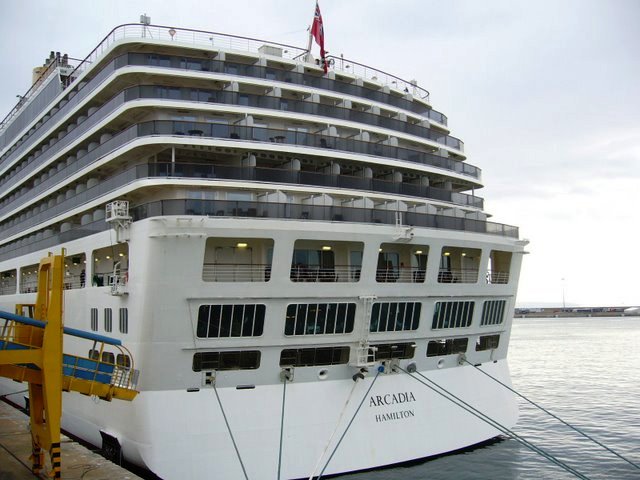
P&O's large cruise ship Arcadia, registered in Hamilton, Bermuda, one of a huge number. All the P&O, Cunard and Princess vessels are also now registered in Bermuda.
Bermuda has had one of each for many years. Because Bermuda has long had an extremely well-developed and successful legal framework for the formation and development of companies, partnerships and trusts and because of them enjoys a good reputation as a successful, credible offshore financial services centre with regulatory integrity, it has also become a favored jurisdiction to register all types of ships and tankers including cruise ships. The Bermuda Shipping Registry, for ships registered in Bermuda, has high internationally accredited standards. The registration process is such that, once surveys of the vessel are completed and the original application is received, registration can usually be processed within a matter of days. Ships registered in Bermuda are “British ships” and fly the undefaced Red Ensign. All such Bermuda-registered ships, including cruise ships are entitled to the worldwide protection of the Royal Navy, of particular interest to cruise lines operating in multiple regions. Cruise ships registered in Bermuda are also able to offer legally valid wedding ceremonies, one reason some have re-flagged their vessels in Bermuda, to take advantage of the at-sea wedding market.
Bermuda is required by the United Kingdom to recruit, at Bermuda Government and therefore Bermuda taxpayers' expense, enough of the highly specialized professionals required for the two registers. Members of the Red Ensign Group — those shipping registers authorized to fly the British flag — must maintain enough in-house shipping surveyors to conduct at least 90 percent of critical safety management inspections of their ships. Bermuda’s complement of qualified ship surveyors must be sufficient to meet 100 percent of the ship inspection requirements, in order to meet international standards. The two businesses are highly profitable for Bermuda. The UK’s Maritime and Coastguard Agency audits Bermuda Department of Maritime Administration (DMA) every four years. Bermuda's Shipping Registry functions as a Category 1, Red Ensign Group Register in accordance with the agreed REG policies. As a category one register, the Island can register vessels of any size or type, but staffing requirements are dependent on the number of ships of various categories on the register. UK authorities could impose limits on the number of ships in Bermuda’s fleet — thwarting plans to expand the business — if the issue is not addressed. A merger between the DMA and Bermuda's Department of Civil Aviation (DCA) is not deemed appropriate. The shipping and aviation registers are serious cash cows for Government. Each of them earns about double the costs of operation and there’s promising growth potential. In early 2013 Bermuda has four full time ship surveyors, compared to other members of the Red Ensign Group like the Isle of Man which has 17, and the Cayman Islands and Gibraltar which have ten each. Of Cayman’s ten surveyors three are based there, six in the UK and one in Greece. A net revenue earner for the Island, Bermuda’s register is expected to cost just under $2 million to operate and rake in over $4 million in the 2013-2014 fiscal year. The Bermuda Ship Register then had 168 ships — 28 passenger ships, 44 Gas Tankers, 16 Oil Tankers, seven Chemical Tankers, 29 Bulk Carriers, 16 Container ships, and another 28 other types of ships. Another 258 yachts are registered here — 14 large commercial yachts and 244 pleasure yachts. In comparison, 1,900 vessels fly the Cayman Islands flag.
Bermuda has a fine safety record, according to a leading European port state control organization. The Paris MoU rates registries each year, based on the number of inspections and detentions in a rolling three-year period. It uses a three-tier classification, a white list for the safest, a grey list for those with average track records and a black list for those considered to carry medium or high risk. The white list of 42 registries for the 2008-2010 period was topped by Bermuda, which recorded 270 inspections and zero detentions. Second-placed Germany had 1,388 inspections and 14 detentions. Sweden, the UK, the Netherlands, France, Denmark, Finland, China and the Isle of Man made up the rest of the top ten. Bottom of the table was North Korea, just behind Libya, Togo and Sierra Leone. Bermuda's international fleet includes many of the world's top cruise ships. In addition to Bermuda-registered ships of all types and sizes from cruise ship to cargo and tanker ships there are also super-luxurious yachts, including the mega yacht Golden Odyssey. Bermuda is part of the Red Ensign Group of shipping registries. The UK's Maritime and Coastguard Agency (MCA) usually gives the Island's Department of Marine Administration and the Department of Marine and Ports a glowing endorsement after they visit. The MCA regularly monitors the Red Ensign Group shipping registers of the UK Overseas Territories and Crown Dependencies to review the quality and standards.
“Seamen” in Bermuda are now known as “seafarers” — and rules for their pay, food and medical care by ship owners have been tightened, under Bermuda laws. In 2012 Bermuda was brought into line with the International Labour Organization’s 2006 Maritime Labour Convention, by Bermuda's Merchant Shipping (ILO) Amendment Act, 2012. Under the legislation, Bermuda’s training of ship inspectors has been augmented by the UK Coast Guard. Inspection work is usually carried out locally — but outsourced when there is too much work to be done.
The Bermuda Civil Aviation Authority operates Bermuda’s Aviation Register (BDCA).
2017. June 2. Mortgaging of Aircraft and Aircraft Engines Amendment Act 2017. Updates to the Mortgaging of Aircraft and Aircraft Engines Act 1999. The island has long been a jurisdiction of choice for aircraft financing transactions. Thus the continued positive outlook in the global aircraft finance sector means that protecting the interests of secured parties over aircraft and engines is crucial. Legislative amendments have further strengthened Bermuda’s position as an offshore leader in the global aircraft finance market. Removed from the earlier act is the requirement that an aircraft or aircraft engine must be owned by, leased or chartered to, or otherwise in the lawful possession of a company incorporated in Bermuda to be made security for a loan. The amended Act, together with ancillary regulations made under the Act, provide for the establishment and maintenance of a register of aircraft mortgages and aircraft engine mortgages. Prior to the amendment, mortgages could only be registered against Bermuda-registered aircraft and aircraft engines if such aircraft or aircraft engine were either owned by, or otherwise in the possession of, a Bermuda incorporated company. The amendments to the Act now allow security for loans or other valuable consideration to be made by qualified registrants over aircraft registered on the Bermuda register (or capable of being registered); and aircraft engines if: (a) the engine is attached to an aircraft registered on the Bermuda register (or attached to an aircraft capable of being registered) or (b) the engine is for such aircraft and is owned by, or leased to, the owner of such aircraft. The Amendment Act follows amendments that were made to the Air Navigation (Overseas Territories) Order that took effect on January 1, 2015. The amendments expanded the list of persons and corporations eligible to register an aircraft on the Bermuda register of aircraft to include Commonwealth citizens or nationals of any European Economic Area state; bodies incorporated in any other part of the Commonwealth and having their registered office or principal place of business in the United Kingdom or any other part of the Commonwealth; and undertakings formed in accordance with the EEA state having their registered office, central administration or principal place of business within the EEA. However, there still remained a Bermuda policy that continued to stipulate that a Bermuda-registered company was required in the structure for the purposes of registration. It was the removal of the policy at the end of 2015 that resulted in parties being in a position to take advantage of the amendments. On July 27, 2016, Royal Assent was received in respect of the Bermuda International Interests in Mobile Equipment (Cape Town Convention) Act 2016. The International Institute for the Unification of Private Law, commonly known as Unidroit, has now confirmed that the Cape Town Convention on International Interests in Mobile Equipment and the Protocol to the Convention on International Interests in Mobile Equipment on Matters Specific to Aircraft Equipment will be extended to Bermuda, effective January 2018. The Cape Town Convention facilitates aircraft finance by standardizing transactions involving moveable property with respect to “aircraft objects” (airframes, aircraft engines and helicopters) by the creation of an electronic international registry of “international interests” that are recognized by those states that have implemented the Convention and to provide various default remedies to a creditor (including in the context of insolvency) should the need arise. These latest initiatives by Bermuda underline the importance to the island of having a modern legislative framework to facilitate aircraft financing transactions.
The island’s registration marks are seen as neutral and “low profile”, while also recognized as high standard and internationally accepted for both commercial and private aircraft. Unlike in the USA, where all US-registered aircraft have an N mark, Bermuda registration is seen as being less obvious. Many jurisdictions including the USA maintain a log of registrations, which is easily accessible, plus flight details, while the Bermuda registry, unlike its registry of companies, is not available to the public. In certain jurisdictions, you can go on to the internet and you can get all the information about who owns the aircraft. Members of a British or other aircraft-owning or leasing Royal family or other high-net-worth individual worried about kidnapping or being shot down and all the publicity this would generate do not want that known, so they register their aircraft holdings in low-profile Bermuda. Members of the British Royal Family are believed to have done this. In mid 2016 there were around 770 aircraft registered with Bermuda’s VP-B and VQ-B marks, with 135 of those registered private aircraft. In Bermuda, the name of the company in which the aircraft is registered only appears on the certificate of registration, however this information is not publicly available on the Bermuda Department of Civil Aviation website. The Bermuda register and the certificate of registration issued in respect of the aircraft will record certain descriptive particulars relating to the aircraft, the date of its registration and the name of the company in which the aircraft is registered. All other records relating to the owner and the aircraft are treated in confidence by the BDCA. The biggest growth in registrations in recent years had come from Russia and former republics of the Soviet Union. Lenders for aircraft purchases are more comfortable with a stable legal system and financial regulation of Bermuda compared to other jurisdictions. Also, aircraft maintenance logs for Bermuda=registered aircraft are in English, which helped with resale value. The Cape Town Convention, designed to provide an international legal framework for the financing and leasing of items like aircraft and aircraft parts like engines and airframes, and acknowledged in July 2016 by the Bermuda Parliament and Senate, would help Bermuda remain a high flyer in the aircraft world. Bermuda will continue to be used as a centre for financing. For big banks, they want the certainty about their financial interests that comes with the Cape Town Convention. There are 71 signatories to the convention — if Bermuda was not a party to it, it would be seen as a disadvantage compared to other jurisdictions.
The BDCA is rated as a Category 1 Aviation Regulatory Authority by the US Federal Aviation Administration. The Bermuda registration marks VP-B and VQ-B with two subsequent letters are seen as neutral marks of high standard. Aircraft are registered in either the private or commercial categories. It is easier for Russian airfraft to register it here than in the US because Bermuda's registry is not as big, the wait is not as long; and the reason they buy older planes is they have to pay a hefty duty on any foreign built aircraft, so the older the plane the less the tax. Many of the small airlines who register aircraft here buy older planes for the first few years of operation while they build their company and then trade up to newer models. Bermuda has an aged aircraft program in place for all aircraft older than 14 years. They undergo more scrutiny and maintenance. The Bermuda program is similar to what the US Federal Aviation Association has in place.

Aircraft over Bermuda
The group is made up of insurance and reinsurance industry professionals who have all obtained, or are on the path to obtaining, the Chartered Property Casualty Underwriter professional designation.
There are clear distinctions between companies owned by Bermudians and operating in the local marketplace and "exempted companies" not owned by Bermudians and not operating in the local marketplace. Exempted Companies and Partnerships - otherwise known as International Companies, Continuation or Permit Companies and Partnerships - are international because they:
2019. June 23. An amendment to economic substance laws was passed in Parliament on Friday. The was passed without objection by MPs in the House of Assembly. The Bill will mean that entities that are tax resident in another jurisdiction will not fall within the scope of the regulations, provided that they are not on the EU “blacklist” of non-cooperative jurisdictions for tax purposes. Non-resident entities that conduct relevant business under the Act will need to state where they claim to have tax residency as well as provide supporting evidence. The Economic Substance Act 2018 becomes applicable to existing entities on July 1. The legislation took effect for new companies last December 31. The amendment was tabled and approved in the same session of Parliament. Dennis Lister, the Speaker of the House, said that he did not want to see the practice happen regularly. Curtis Dickinson, the Minister of Finance, said that the move was sometimes needed “in order to get the people’s business done in a timely fashion to minimise harm”. He added: “In this instance, we sought to do as much.” Mr Dickinson said that the issue was one of “national urgency”. He added: “If we don’t do something, the potential ramifications for the Bermudian people and the Bermudian economy are significant.” Mr Dickinson told MPs that the absence of the exemption in Bermuda’s legislation put the country “at a serious commercial disadvantage relative to all of our competitors”. He added there was a “serious risk that up to 20 per cent of Bermuda’s registered entities” might move to a competitive jurisdiction if the exemption was not put in place. Leah Scott, the Deputy Leader of the Opposition, agreed that the amendment was needed. But she added: “We’re playing catch up to try and get ahead.” Ms Scott said that Bermuda should never have found itself on the European Union’s tax blacklist. She added that if the person responsible for the blacklisting had worked in the private sector “they would have been walked out the door”. Ms Scott said that is was “unacceptable” that Bermuda was “on the back foot because of a human mistake”. She added: “We have jurisdictions that have legislation that is effective. We have legislation that is onerous and is nowhere near what is in the other jurisdictions.” Patricia Gordon-Pamplin said that it was important that Bermuda accept “our share of responsibility” for the situation it is in. The One Bermuda Alliance MP added: “We have to stop overlooking incompetence when we see it and call it for what it is — because our jurisdiction is being harmed as a result of the things that have been done or overlooked. We should be saying this is not acceptable.” Michael Scott disagreed that Bermuda is trying to “claw our way back”. The Progressive Labour Party backbencher said: “We’ve never had to scramble back.” He added that the “legislative glitching” which caused Bermuda to be placed on the blacklist was a “rare occurrence”. Mr Scott said: “The speed with which we have recovered is testament to the strength of the jurisdiction and our prowess.” David Burt, the Premier, said that Bermuda would have to be responsive to regulatory shifts. He added: “As global rules change, we will have to change as well.” Mr Burt said that the Government would have liked to bring the amendment earlier, but that it was not possible due to the timing of an Organisation for Economic Cooperation and Development forum. He added: “It is that simple.” Mr Dickinson said the two-month blacklisting was “clearly not ideal” and no one wanted to experience it again. He told the House: “We have to decide as a country whether we are going to move beyond it and figure out how we move forward in a constructive way, or whether we’re going to allow this to be the equivalent of a shackle around our ankles.” Mr Dickinson said later that he made commitments to the industries that he would make relevant amendments to the economic substance legislation “to ensure that Bermuda is not placed at a competitive disadvantage”. He added: “The process for us making amendments to this legislation has been divided up into two general phases. The first phase is to address those things that needed immediate fixing, and the second being all of the other issues, in due course we will work towards resolving those differences.”
Most focus on international activity. To protect local business interests, the Bermuda Government will not normally allow the formation of an exempted company in banking. However, some quality international banking organizations may, under certain circumstances, apply to form an exempted company for international or multinational general trust, investment and executorship activities. By qualifying as exempted companies, these corporate entities are not subject to any restrictions on foreign ownership. They can be either 100% owned by non-Bermudian interests or anywhere from 100% to 80%. Bermudians cannot hold more than a combined 20% interest in any one exempted company or partnership.
This will change wholly in 2017 when certain upmarket local hotels are given a license by the Bermuda Government to operate casinos. Then, least a trio of major hotels present or planned will be licensed by the Bermuda Government to operate casinos for non-local guests. But for the last 400 years Bermuda deliberately has NOT allowed businesses in online or offline gaming or gambling businesses, except for the game of Crown and Anchor, stacked in the dealers' favor, at annual local Cup Match games. Other jurisdictions that do allow gambling have profited hugely from it though, so much that the Bermuda Government now allows visiting cruise ships, previously denied access by their passengers and crew to their casinos while in Bermuda waters, to open their casinos to cruise passengers on those ships.
Non-Bermudians, including Bermuda-domiciled permanent residents present and future, should note local companies or any other type of local trading entity must, as a general rule, be beneficially owned by Bermudians. The 60-40 rule explained in more detail later on applies to all forms of local business, whether sole proprietorships or working on a consultancy basis. Such entities operate in the local marketplace and as such are NOT "exempted" or international companies. Their legal requirement is that they must be at least 60 percent beneficially both owned and managed by Bermudians, meaning that non-Bermudians, including all those born in Bermuda but with neither parent being Bermudian and all non-Bermudian registered permanent residents including those married to Bermudians who have lived in Bermuda and been married to and living with that Bermudian for less than ten years and have not yet been given Bermuda Status, are limited to a maximum of both an individual and a collective 40% holding. To avoid non Bermudians controlling local companies through pyramiding or secret agreements, corporate shareholders of local companies must themselves be 80 percent owned by Bermudians to qualify as Bermudian owners. They include local accounting, banking and legal firms and support services. However, of late there have been some notable exceptions to this 60-40 rule, namely in banking, where neither of Bermuda's two biggest banks are majority Bermudian in terms of overall shareholding or management; similarly in telecommunications, and more.
Non-Bermudians, specifically including registered Bermuda-domiciled permanent residents should note that while this 60-40 rule applies to them as it relates to all local market trading enterprises, it does not apply in the case of non-local, in other words, international entities. They may become minority (up to but no more than 40% individually or collectively per company) managers of a local trading entity, subject to Bermuda Immigration work permit approval. They may incorporate, or manage, or have an investment interest in, without any such 60-40 restriction, a Bermuda-based but overseas-dealing international company or any other non-local business entity. Presently, there is no website that lists all the eligible forms of business and the laws for PRC holders in terms of conducting business in Bermuda.
Some examples were, in 2015:
Wellesley House, 2nd Floor — 12,831 sq. ft. Asking rent from $60 per sq ft per annum, with Service Charge $23 per sq ft per annum.
IAS Park Building, 1st Floor — 10,000 sq ft. Asking rent from $33 per sq ft per annum, plus Service Charge (including Electricity and Bermuda Government Land and Corporation of Hamilton Taxes) of $16.51 per sq ft per annum.
The traditional, and the most frequently used, method for an overseas company to establish a presence in Bermuda is to do so by incorporating a Bermuda subsidiary. But there is an alternative, a Permit company. Normally, an overseas company — a body corporate incorporated outside Bermuda — shall not engage in or carry on any trade or business in Bermuda. However, in some circumstances, it is possible for an overseas company to trade in or from within Bermuda, provided it obtains a permit (“Permit”) issued by the Minister of Finance (“Minister”) under the Companies Act 1981, as amended (“Act.”) Overseas companies can apply for a Permit where it is not necessary or expedient to establish a new Bermuda company. Overseas companies often apply for Permits, rather than following the more traditional method of incorporation, to form insurance branches, insurance intermediaries — or to form a hub for such diverse uses as acquiring, developing, exploiting and licensing intellectual property outside Bermuda from within Bermuda. The application procedure for an overseas company to obtain a Permit is relatively quick — normally taking three to five days to complete — and is based loosely on the procedure relating to the incorporation of an exempted company in Bermuda. There are various specific requirements that are not generally required on an incorporation — for example, the intention of an overseas company to apply under the Act to become a permit company (“Permit Company”) must be advertised in a local newspaper and such advertisements should specify the company’s name and the trade or business that it proposes to engage in or carry on in Bermuda. The application must include the name and address of its proposed principal representative in Bermuda, who is a statutory officer required under the Act, and of its proposed local bankers (if any). Documents required in support of the application include certified copies of the company’s constitutional documents, its latest audited financial statements and, where appropriate, personal and financial references for the directors and beneficial owners of the company, which will provide the prescribed particulars of the company. The Permit Company will be subject to such conditions as the Minister may think fit to impose and such conditions will be specified in the Permit. For example, a Permit may require that the company have one or more directors ordinarily resident in Bermuda. A Permit Company is usually required to inform the Minister of any change in its beneficial ownership. Any application for a Permit must also disclose the reasons for the overseas company seeking to obtain a Permit as opposed to incorporating an exempted company. Overseas companies obtain a Permit for a number of reasons — some of the reasons given, which the Bermuda Monetary Authority has approved, include that it is more efficient for the mind and management of a company to operate outside of its home jurisdiction and in Bermuda; Bermuda’s favorable business and economic environment and the stable and efficient regulatory framework of Bermuda; Bermuda’s reputation as a leading jurisdiction for (re)insurance business and its favorable regulatory regime. In such instances, such companies often give the reason of using their branch to source business through Bermuda; Bermuda’s sovereign rating; and that the overseas company is required to be licensed as an insurer or insurance intermediary in more than one country, for various reasons relating to the overseas company’s home jurisdiction. An overseas company will also be required to obtain a Permit if it is deemed to be carrying on business in Bermuda either by the overseas company or on its behalf. As a general matter, the issue of whether an overseas company requires a Permit is a question of fact to be determined in the light of those activities that are, or are intended to be, carried on by or on behalf of an overseas company, in or from within Bermuda. Once a Permit Company has been established, it will be carrying on its business and will only be permitted to do so in the same manner as an exempted company, ie outside Bermuda from a place of business within Bermuda or with other exempted undertakings. A Permit Company is also subject to many of the same provisions of the Act as an exempted company. In addition, those Permit Companies that are registered as an insurer or as an insurance intermediary or other regulated entity in Bermuda — either under the Insurance Act 1978, as amended, or otherwise — will be subject to the same regulatory regime and scrutiny as exempted companies registered in the same manner. While generally, it is more likely that an overseas company will wish to form an exempted company in Bermuda, it is worth considering establishing a Permit Company as an alternative. Ultimately, many of the reasons for obtaining a Permit are similar to those supporting the incorporation of a subsidiary in Bermuda: to take advantage of Bermuda’s favorable business and economic environment and the stable and efficient regulatory framework of Bermuda. However, the main differentiating feature is where an overseas company considers that it is not necessary or expedient to establish a new Bermuda company.
Maintained by Bermuda's Registrar of Companies with only very basic details (name of company, date of incorporation and ID number) freely available to the public.
Bermuda shares its register of ownership of companies with the UK’s National Crime Agency. Bermuda already shares information on beneficial ownership with Britain’s tax authorities within 24 hours of a request — but has extended access. The move reflected Bermuda’s long-held commitment to deterring money-laundering and financial crime. The NCA has always had access to Bermuda’s central register via its longstanding criminal co-operation arrangement, but this had involved certain time-consuming procedures. The new agreement notes that the NCA can now directly approach the Bermuda central register authorities, who maintain the register on behalf of the Minister of Finance, and includes expressed reference to our leading status as the only British Overseas Territory to have a continually updated central register already in place.
The move follows a request from the NCA for faster access to ownership information in the wake of the release of the massive leak of millions of pages of law firm documents contained in the Panama Papers. British police officers were frustrated by delays which could stretch to months in getting information. Bermuda — unlike other offshore jurisdictions — had held a register of beneficial ownership for about 70 years. The register, although not public, was open to overseas authorities investigating allegations of crime or tax evasion. Only certain officials of the Bermuda Government have access to the above.
A company incorporated in Bermuda or to which the Companies Act 1981 otherwise applies, can apply to be registered under the Segregated Accounts Companies Act 2000 (Act). A segregated accounts company (SAC) is able to hold certain assets and liabilities in a separate account fire walled from the assets and liabilities of the SAC itself (the SAC’s own account is usually referred to as the “general account”) and the assets belonging to its other segregated accounts. In order for a company to achieve legal separation of its general account and its segregated account(s) it must be registered as an SAC with the Registrar of Companies (ROC) and comply with all relevant laws and regulations governing the operation of an SAC. SACs are commonly used in the insurance sector, for special purpose vehicles, and in the areas of financial guarantees, and securitisation & derivatives structures. The Act is the principal legislation governing SACs in Bermuda, however, an SAC must also comply with other legislation applicable to its structure, for example the Companies Act 1981 and/or the Insurance Act 1978. Documentation and contracts entered into by an SAC are often governed by the laws of a jurisdiction other than Bermuda. In this situation, a bi-location governing law clause should be added that ensures any aspects of the document dealing with the segregated account nature of the SAC are governed by Bermuda law and the Act. To register as an SAC, a company must apply to the ROC. If the company is engaged in insurance business (as defined in the Insurance Act 1978) then the company may proceed direct to application to the ROC. If it carries on business other than insurance business, it must first obtain approval from the Minister of Finance (Minister). If the company has conducted business prior to its application to become an SAC then, unless the Minister directs otherwise, the application must be accompanied by a statutory declaration of the company directors setting out, among other things, a true and accurate statement or description of the assets and liabilities of the company and any pending material transactions. Unless the Minister directs otherwise, the creditors of the company must be notified of the application and the directors’ statutory declaration must either confirm that no creditor will be prejudiced or confirm that the creditors of the company have consented to or been given adequate notice of the registration of the company as an SAC. The ROC may impose conditions on the registration of the company and can require that the company use the abbreviation (SAC) in its name after registration. In addition to its annual reporting obligations and compliance requirements under the Companies Act 1981 and any other relevant legislation (e.g. Insurance Act 1978, Bribery Act 2016) the Act provides that an SAC must comply with other requirements, including:
The ROC can remove a company from the register of SAC companies thus causing it to cease holding such status. If a company wishes to cease being an SAC it must submit a written request to the ROC. An SAC provides companies with an alternative to the cumbersome group structure that is traditionally used to protect assets from risks associated with other aspects of the business. The SAC structure is more flexible and can be less expensive to set up and maintain. However, there are risks associated with utilizing an SAC. Not all jurisdictions have legislation in force that corresponds to the Act, and so there is a risk that the Act may not be upheld or recognized in jurisdictions other than Bermuda. A slight variant on the SAC, the incorporated segregated accounts company (ISAC) would be an entirely new type of entity adopting aspects of the traditional limited company and SACs. Not in existence in Bermuda, it is envisaged that an ISAC structure would afford each segregated account separate legal personality, a key change from the current model.
Effective March 24, 2016. This means the European Union considers the standard of the island’s insurance regulation to be equivalent to its own. In November last year, the European Commission recommended that Bermuda should be considered as in line with the tough new insurance rules being adopted across the 28-country bloc. A 90-day consultation period that gave member countries and the European Parliament the chance to have their say has now passed. On March 4, the EC’s delegated decision on Bermuda’s equivalence with Solvency II was laid out in detail in the Official Journal of the European Union. Now that 20 days have passed since the date of publication in the Journal, confirmation of Bermuda’s new status is complete. Solvency II equivalence means that commercial insurers and reinsurers based in Bermuda will not be competitively disadvantaged when they do business in the European Union. The news represents a significant achievement for Bermuda’s financial-services regulator, the Bermuda Monetary Authority, which has worked and lobbied for more than six years to achieve the goal. In an interview today, Jeremy Cox, chief executive officer of the BMA, paid tribute to his “tenacious team”, as well as the industry leaders and politicians who had helped to make it happen. A full story on the interview will appear in Monday’s Business section of The Royal Gazette. The BMA also released its 2016 Business Plan today. In his introduction, Mr Cox stressed that equivalence confirmation did not mean the BMA would suddenly have a lot of spare time on its hands. “Securing equivalence was clearly a major achievement, a powerful example of what can be accomplished with a strong, tenacious team that embarked on the road to equivalence in 2010,” Mr Cox said. But equivalence is an interim objective, rather than an end in itself, and should be viewed in the wider context of our vision and strategic goals.”
Bermuda complies and benefits. Solvency II refers to a European Union Directive (2009/138/EC) relating to insurance regulation. Solvency II became effective on 1 January 2016 and provides new rules with respect to capital requirements, governance, risk management, and disclosure in relation to insurers and reinsurers. The regulatory changes resulting from the implementation of Solvency II include, but are not limited to, the following three pillars:
• How insurers quantify their liabilities and assets, including the way a company reserves funds to satisfy policyholder claims.
• How the structure and management of insurance businesses are governed, enabling insurers to identify, quantify, monitor, successfully manage and report risks to which they are exposed.
• Ensuring that robust reporting and disclosure rules are in place to foster transparency for insurers reporting on their business.
Following a demonstration of interest from the Bermuda Monetary Authority (BMA), the Bermuda Government's regulatory agency for Bermuda-registered insurance companies, the European Commission tasked the European Insurance and Occupational Pensions Authority (EIOPA) in 2010 to provide a preliminary assessment of the BMA’s supervisory regime. The goal was to have EIOPA determine whether the BMA’s supervisory regime satisfied the general criteria for third-country equivalence (i.e. non-EU member state equivalence). In an effort to gain equivalence, the BMA has, over a period of six years, fortified and revised its approach to insurance regulation in such a way as to bring the regulation of Bermuda’s commercial insurers (ie those registered as Class 3A, 3B or 4, C, D or E) in line with Solvency II. In several follow-up reports, EIOPA advised that Bermuda’s regulatory framework for commercial insurers was broadly equivalent with the Directive, paving the way for formalization of equivalence. This came in the form of a delegated act adopted by the European Commission on November 26, 2015 (Delegated Act). The Delegated Act came into force on 1 January 2016 (subject to a three-month review period by the European Parliament and European Council), and grants full equivalence to Bermuda for an unlimited period. In summary, the Delegated Act is essentially the EU conveying that they acknowledge the Bermuda commercial (re)insurance and group supervisory regimes to be equivalent to that of the EU, and on that basis, Bermuda (re)insurers and groups are free to conduct business in the EU without additional regulatory requirements/burdens. The BMA’s approach to insurance regulation is not strictly EU-centric. International regulatory input is derived, in part, through membership in various international standard setting bodies relating to insurance regulation such as the International Association of Insurance Supervisors (IAIS), the International Organisation of Securities Commissions (IOSCO), and the Group of International Insurance Centre Supervisors (GIICS). The BMA has also entered into a multilateral memorandum of understanding with, and is a charter member of, the International Association of Insurance Supervisors (IAIS). Locally, the BMA is able to derive input from a variety of sources including insurance and reinsurance companies, law firms and other organisations such as the Association of Bermuda Insurers and Reinsurers (ABIR), the Bermuda International Long-Term Insurance and Reinsurance Association (BILTIR), and the Bermuda Insurance Management Association (BIMA) to name a few. With the Delegated Act passed and in-force wef January 1, 2016, Bermuda registered (re)insurance companies and groups are able to conduct business freely within the EU, and on an even playing field with existing EU insurance companies. As the economic output of the EU represents a quarter of the global economy (measured in terms of GDP), ease of operations for our (re)insurers and groups in the EU is an important asset, one that many competing offshore jurisdictions are without.
Banner.jpg)
Authored,
researched, compiled and website-managed by Keith A. Forbes.
Multi-national © 2020. All Rights Reserved