
Click on graphic above to navigate the 165+ web files on this website, a regularly updated Gazetteer, an in-depth description of our island's internally self-governing British Overseas Territory 900 miles north of the Caribbean, 600 miles east of North Carolina, USA. With accommodation options, airlines, airport, actors, actresses, aviation, banks, beaches, Bermuda Dollar, Bermuda Government, Bermuda-incorporated businesses and companies including insurers and reinsurers, Bermudians, books and publications, bridges and causeway, charities, churches, citizenship by Status, City of Hamilton, commerce, communities, credit cards, cruise ships, cuisine, currency, disability accessibility, Devonshire Parish, districts, Dockyard, economy, education, employers, employment, environment, executorships, fauna, ferries, flora, former military bases, forts, gardens, geography, getting around, golf, guest houses, highways, history, historic properties, Hamilton, House of Assembly, housing, hotels, immigration, import duties, internet access, islands, laws, legal system and legislators, main roads, marriages, media, members of parliament, money, motor vehicles, municipalities, music and musicians, newcomers, newspaper, media, organizations, parks, parishes, Paget, Pembroke, performing artists, residents, pensions, political parties, postage stamps, public holidays, public transportation, railway trail, real estate, registries of aircraft and ships, religions, Royal Naval Dockyard, Sandys, senior citizens, Smith's, Somerset Village, Southampton, St. David's Island, St George's, Spanish Point, Spittal Pond, sports, taxes, telecommunications, time zone, traditions, tourism, Town of St. George, Tucker's Town, utilities, water sports, Warwick, weather, wildlife, work permits.

By Keith Archibald Forbes (see About Us).


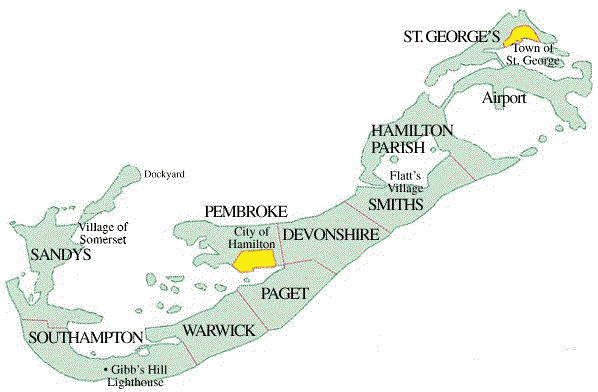
There are schools in every one of the nine Bermuda Parishes.
Bermuda is a tiny (21 square miles or 56 km), isolated (600 miles due east from the nearest mainland, North Carolina, USA, and 3500 miles from the UK) island group. The educational system here is completely independent of the systems of any foreign country such as the United Kingdom, USA or Canada or beyond. Unlike in far larger countries with significant multi-cultural populations and cultural and educational facilities and laws and faculties to match, no laws or facilities of any kind exist (because there is no or insufficient demand for them) in Bermuda for non-English-speaking children to be taught while at school in any language other than English. Newcomers working in Bermuda from countries where English is not the official language with a young child or children should note that all schools in Bermuda are taught in English only.
All education, whether at a Bermuda Government funded or maintained and taxpayer-supported school (a public school) or private school (not taxpayer-supported but with fees paid by parents) is administered and controlled by the Bermuda Government's Ministry of Education, 7 Point Finger Road, Paget DV 04, P. O. Box HM 1185, Hamilton HM EX phone (441) 236-6904. Fax 236-4006, Bermuda. Application forms for teaching posts at Bermuda Government-operated public schools (bit not for private schools) can be obtained from that website. All enquiries about education in Bermuda not shown in this file should be directed to the Ministry of Education, not to this author.
All teachers in Bermuda, whether Bermudian or married to one or an expatriate (foreign, non-Bermudian) teacher on a contract, are required to apply successfully for and hold a valid licence from the Bermuda Educators Council (BEC). There are about 700 public school teachers. All expatriate teachers who may be given initial one year contracts with a Bermuda public or private school should know they may not always be renewed (see Work Permits for non-Bermudians) as preference is always given to similarly qualified Bermudian teachers. They should also make a point of reading Newcomers to Bermuda also Bermuda Cost of Living - and Bermuda motor vehicle private transportation costs, all substantially higher than in USA, Canada and UK, etc.
Teachers at Government schools are expected to become members of the Bermuda Union of Teachers (BUT), at Seventy Two Teachers' Place, 72 Church Street, Hamilton HM 12. P. O. Box HM 726, Hamilton HM CX. Phone (441) 292 6515. Fax (441) 292 0697. Founded February 1, 1919. In 1964, it combined with the Teachers Association of Bermuda (see book The Teachers Association of Bermuda (1949 to 1964). Any accredited and qualified teacher at any private school in Bermuda can also become a member of BUT if they wish.
Non-nationals accepting teaching posts in Bermuda from the United Kingdom should note that unlike in the UK there are
The Bermuda Educators Council Act came into effect in July 2002. It improves standards in the profession and increases the esteem in which teachers are held. It sets the framework for registration, not for licensing, but as a result all Bermudian and imported teachers - not those in an administrative role - will now have to be licensed.
The Education Amendment Act 2003, among other things, sets the stage for the regulation of home schools.
Education in Bermuda is compulsory for all children from 5 to 16. It is free for parents of students at Government schools, namely primary schools, middle schools, senior schools and special schools - all day schools - comprising preschools, junior, special and secondary schools - administered by Bermuda's Ministry of Education. It is NOT free for parents of students at local private day schools (there are no local boarding schools in Bermuda).
Newcomers with children of school age can choose whether to enroll them in a Government or private school, in Bermuda or overseas.

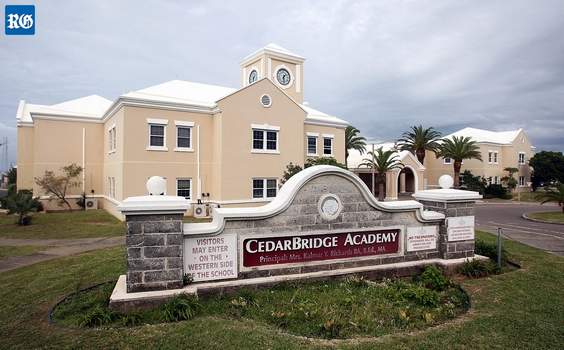
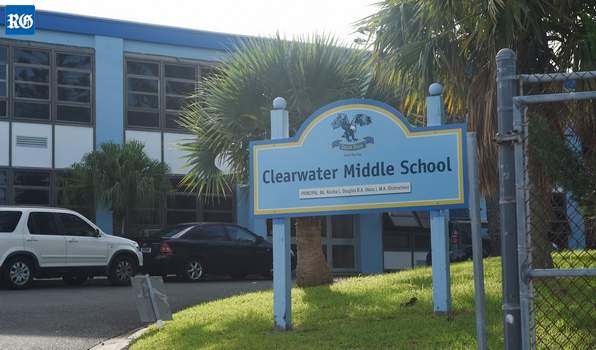
Ministry of Education. Taxpayer-funded, unlike private schools which are not. The mission of Government-owned or maintained schools, also known in Bermuda as public schools, is the provision of an environment in which each student may develop academic, practical and physical skills; practice critical and creative thinking; exemplify aesthetic, social, moral and spiritual values which characterize a secure, self-confident individual who is capable of constructive participation in the community and effective functioning in an age of change, with life-long, self-directed learning.
All teachers in the government schools are eligible for membership in the Amalgamated Bermuda Union of Teachers, which negotiates salaries and conditions of service. All principals in government schools are eligible for membership in the Association of School Principals, which similarly represents their interests. Programmes of professional development, salaries and conditions of service for teachers and principals have been continually improved. Negotiations on these terms of employment take place every two years and their outcome is confirmed in published agreements with the Government.
Questions about any government schools should be directed to the Ministry of Education at telephone (441) 236-6904 extension 3659 or 3660.
Government grants for primary education began in 1816. The government educational system of today derives, however, from the Schools Act 1879 and is based on the traditional British pattern. The Education Act 1949 established the right of all children within what was then the compulsory school age (7 to 13) to receive free primary education. By 1969, the compulsory school age had been expanded to 5 to 16 and all children within that age are entitled to free primary and secondary education. In 1985 the Education Act was amended to entitle children to remain in secondary school up to the age of 19 years in order to complete the secondary programme.
The government system comprises a number of primary schools, access to which is determined mainly on the basis of proximity of residence to a school. The system at secondary level consists of a fewer number of schools, is selective and is divided between academic and general schools. Principals of the secondary schools select pupils on the basis of performance in an examination taken at the end of the primary school stage and of parental preference. Technical and prevocational education is provided in the general secondary schools. Provision is also made for the education of children with special needs in six special schools, which have been in operation for more than 20 years, and in special programme classes, which have operated for more than 10 years, in regular primary and secondary schools. Special education provides a continuum of services appropriate to the range of special needs of the students concerned. Free education is provided in a number of pre-schools for four-year-old children. Curriculum guides at all levels have been in place for several years. At the pre-schools, the curriculum objectives are related to social, cognitive and motor development, as well as to language, mathematics, social studies and science. The Government has restructured the educational system in order to remove selectivity from the secondary level and to provide equal access to the curriculum for all students. The system has three levels - primary, middle and senior secondary. Since May 2010 the Bermuda Public School System has adopted the UK's Cambridge International Curriculum as the basis for teaching English, Mathematics and Science in the government primary, middle and senior schools. The Cambridge Curriculum has four phases, each of which dove-tails into the next, beginning with Primary (age 5-11), Lower Secondary (11-14, equivalent to a Bermuda Middle School). Middle Secondary (14-16, equivalent to S1 and S2) and Upper Secondary (16-19).
Bermuda College, see by name below.
Adult Education School, see by name below.
Bermuda Independent Schools Association (BISA): Since September 2014. Private school heads have banded together to form BISA to enable better collaboration and representation. Heads of the six different private schools agreed to form it BISA as a forum for the heads to share issues of professional interest and to consider developments in education in Bermuda. The association seeks to become a recognizable entity through which the views of the independent schools in Bermuda can be represented to the community, the Government and to other agencies.
Not state or government - for children of all ages and two private schools which offer early primary education. These institutions receive no government funding. The Government has the authority to determine the examinations to be taken in such schools, as a means of ensuring appropriate academic standards there.
Some are both preparatory (primary) and secondary. Business newcomers being located to Bermuda on work permits from the UK or Europe, or the USA and Canada, and who bring a child or children with them, should note that Bermuda is not an European Union country and does not follow any of the EU's laws or requirements, or those from the United Kingdom or USA or Canada. For example, there are no Dutch or French or English or American or Canadian schools. Local private or independent schools have a fundamentally different educational philosophy and a much higher standard overall than local public schools. They train their students to sit for and pass American, British, Canadian and European university qualifying programs which are internationally recognized. Several also offer an additional year, a Grade 13 equivalent, for academically gifted students to enter university with the equivalent of a sophomore year achieved. These schools charge tuition costing thousands of dollars a year per student. Nevertheless, all are running at full capacity and several have substantial waiting lists.
Applications for teaching positions in Bermuda Private Schools should be directed by airmail solely to the specific school concerned in Bermuda.
2020. April 17. Public school pupils will restart remote learning on Monday, the Minister of Education said. Diallo Rabain explained that senior schools would continue to instruct pupils on “essential curriculum for each of the courses students are currently taking”. He added: “Preschools, primary and middle schools will focus learning activities on content and skills that have already been taught.” Mr Rabain said that focus for the three levels would be “academics, physical activity and student wellbeing”. He added that parents would be given details on what principals expected of pupils today. Mr Rabain said print copies of learning materials would be provided for pupils without access to the internet. He said that the Covid-19 lockdown had meant that notification to parents of enrolment decisions for pupils due to start primary, middle and senior schools in the autumn had been delayed. He added that parents would be notified of decisions electronically rather than by letter. Mr Rabain said that parents of primary pupils would receive an e-mail on May 5 and parents of middle schoolchildren would be advised of decisions through PowerSchool on May 12. Parents of senior school pupils would be informed on May 7, also through PowerSchool. Mr Rabain said that middle and senior school pupils who were to sit Cambridge IGCSEs and A-level exams in June would “still be positioned to have grades awarded for work completed in these courses”. He added that principals and teachers had discussed the possibility of changes to graduation requirements with the ministry. Mr Rabain said that a decision on the recommendations would be passed to pupils and parents by the end of next week. He added that the deadlines for Ministry of Education scholarships had been extended until May 7. Mr Rabain said that work was also under way to make the awards application process easier for pupils. A survey was to be conducted of scholarship applicants to find out how the Covid-19 crisis had affected their studies, and will “help to better support applicants and eventual scholarship recipients”. He said 61 survey responses had already been received.
2020. April 8. Teachers have been told to work with only what they are given by the Government in an escalation of a dispute over salary deductions for industrial action. The Bermuda Union of Teachers made the call in a letter to members sent at the weekend. The letter said: “Any employee would be within his or her expectation that the employer would provide the necessary tools to complete the assigned work — it would be totally irresponsible to expect anything less. This means that no one can be required to use their personal resources for the completion or engagement of any work relating to his or her job, which should be provided by the employer.” The letter was sent to union members last Friday. The move came after Nishanthi Bailey, the BUT president, last week slammed a decision to dock the wages of teachers who took part in industrial action at four schools in February. Kalmar Richards, the Commissioner of Education, told Ms Bailey that teachers at Dellwood Middle School and Elliot, Northlands and Victor Scott primary schools were to be docked wages over the industrial action, which started during the week of February 17 and continued for several days. Ms Bailey said that the notification from the Government of the plan “came last week during this time of national uncertainty, contributing to heightened emotions” amid the Covid-19 pandemic. She added: “Even during this time, where each day we are faced with the unknown, and, as a community, there has been a commendable demonstration of flexibility as we all do our part to support each other to bring a sense of calm to an uneasy situation, our employers are standing by the policy of when there is no work, there is no pay.”
Ms Bailey told members that the BUT had withdrawn its “support of and collaboration” with the ministry and Department of Education until there was a U-turn on the cuts to salaries. She said: “We wish you a productive week as you readily return to work on April 6 with the resources you have been provided to carry out your tasks.” Ms Richards said yesterday that the industrial action “saw teaching and learning services stop for a total of 720 students”. She added: “The parents of our students were impacted as one school closed without notice.” Ms Richards said that teachers had been reminded at the time of the Government’s policy of “no work, no pay”. She added: “They were in breach of the union agreement, and advised of avenues in their collective bargaining agreement whereby they can have their concerns addressed. Despite this, they still chose to continue with their meetings and not carry out their responsibilities.” Ms Richards said that, as well as a decision to delay the wage deductions until the summer, “further accommodations” had been extended to teachers. She explained: “Over the next two weeks we have revised schedules for school staff and suspended the remote learning programme during the week of April 13.” Ms Richards said that the Government appreciated the work of teachers and school staff during the Covid-19 pandemic. She added: “During the week of March 23, when we launched a remote learning strategy, our school staff demonstrated a commitment to students by engaging them in a variety of remote learning activities.” Ms Richards said in a letter to parents and guardians last Friday that the Covid-19 pandemic had led to “an incredibly challenging time for the entire public education family and the wider community”. She added: “I was to thank you for your patience and understanding as we have dealt with this unprecedented situation.” Ms Richards said that parents would be kept informed on developments and told when schools would be reopened. She highlighted that a “recovery period” would be set up for the first week pupils were back in the classroom to help them transition back to normal school life. Diallo Rabain, the Minister of Education, added that the Easter break for pupils would be extended to include this week and that teachers and principals were to work remotely and plan for the reopening of schools.
2020. March 15. Bermuda is too small for signature schools to have a solitary focus, the education minister announced. Diallo Rabain said the island was “not of the scale” where planned signature, or specialized, schools would be able to concentrate on “one speciality”. He added: “All of our schools, we recognise, will have to have multiple things that our students will be able to get involved with — and you may have duplicates in various schools, depending on the amount of students that actually want to do that.” The comment came during debate on the budget for the Ministry of Education in the House of Assembly on Friday. Cole Simons, the shadow education minister, questioned Mr Rabain on how pupils would be instructed. He asked: “How are we going to determine within the signature schools what we’re going to offer? How are we going to arrive at the optimum curriculum that is going to be followed?” Mr Simons said: “These questions need to be answered so that, when it’s opened, we know it’s fit for purpose and that the community will embrace it.” He also asked Mr Rabain for the time frame to phase out middle schools and open signature schools. Mr Rabain said that all signature and specialist schools would have “core academic tracks”. The minister explained: “Everyone that goes to these schools, there will be a core track that they will have to follow in order to qualify to graduate. All of them will come out with a high school diploma — whether they engage in any of the speciality topics that are offered at the school or not.” He said that the schools would also have music, performing arts and physical education programmes. Mr Rabain said that the people of Bermuda had come up with the ideas for Plan 2022 — the Government’s blueprint for education. He added: “Now that we are getting ready to implement those long term, adaptive strategies, we need to be able to go back and say ‘What is it that you want? What is it you would like to see within our schools?’” Mr Rabain said that it was also “imperative” that educational changes “be in tune” with workforce development to support the needs of Bermuda’s job market in the years ahead. He added: “That is the type of data that will structure what needs to be offered within our schools, outside of the regular things that we know that we are going to need.” It was announced last week that international firm Innovation Unit Australia New Zealand had been selected to help rebuild the public education system. The contract will start later this month and run until at least the 2021-22 school year. Mr Rabain said “an estimated $950,000” had been budgeted for work by the firm this year. David Burt, the Premier, said last month that the pledge to phase out middle schools was the “signature promise” of the Government in its election platform in 2017. He added: “I am cognizant that I cannot go back to the polls unless I deliver on my signature promise.” Mr Burt added that he had been assured by Mr Rabain that the next school year would be “the last school year of our current system”.
2020. March 5. Proper job descriptions for teaching assistants have been signed off by the Department of Education. The Bermuda Union of Teachers said it hopes the move will lead to salary increases for classroom assistants and educational therapist assistants. The BUT spent 20 years battling for the job descriptions to be formally recognised, before an agreement was reached last month. A union spokesman said today: “All parties signed off on the job descriptions on Wednesday. Our discussions with the Department of Education have finally borne fruit, and we are optimistic that this group of often overlooked educators will, at long last, get the acknowledgement, respect, and compensation they deserve.” The BUT praised executive Joezine Butterfield, who has been “in the trenches fighting for paraeducators and ETAs for many, many years”. The spokesman said: “A job well done Sister Butterfield. Your persistence and determination have been an inspiration to this union throughout this struggle. We now look forward to this long-suffering group being furnished with a salary increase as per management services. We’d also like to acknowledge the positive work put in during this joint effort between the BUT and the Department of Education. This illustrates in vivid colour that collaboration and commitment is possible going forward.”
2020. March 3. An Opposition proposal to set up a Cabinet sub-committee to pave the way for an education authority is irrelevant, the education minister has claimed. Diallo Rabain added that another suggestion for the introduction of an assistant director for maths was made even though pupils already benefited from a specialist in the subject. Mr Rabain said: “The idea that a Cabinet sub-committee needs to be formed to lead education is laughable if the suggestion wasn’t so sad. “As we are moving to a system that removes political interference in education and introduces educators and persons of that calibre to lead education, I’m literally shocked that we would still have this suggestion. But if you go back to their election manifesto of 2017 they said the same thing.” He was speaking in the House of Assembly last Friday after Patricia Gordon-Pamplin, the Shadow Minister of Finance, delivered her Reply to the Budget for the new financial year. Ms Gordon-Pamplin said that the Opposition One Bermuda Alliance recommended the establishment of a Cabinet sub-committee to include the Premier and several ministers to “provide immediate active oversight and support” to make sure that Bermuda’s educational needs were delivered. She added: “One of the committee’s immediate priorities would be to lay the foundation for the exploration and development of an educational authority, which will remove the politics from education and provide consistent professional and accountable leadership to our public education system.” But Mr Rabain told MPs: “We have a suggestion here in the book, ‘we also offer a recommendation that the ministry have a dedicated assistant director of math education and a qualified supporting team to drive the delivery in conjunction with the Bermuda Council of Teachers of Mathematics. Guess what? When the One Bermuda Alliance came in, and when someone retired, they froze the post. There’s an important post within the Department of Education called the educational officer for math, that was frozen for five years under that government. All of a sudden now they have the solution, let’s bring one of them in. We already have a math consultant here that is improving our grades. We have one that ... was originally brought here by the Bermuda Council of Teachers of Mathematics two years ago and he is now on island and he is working with our teachers and our maths grades will show improvement and they’re already showing improvement.” Mr Rabain said the move was made after requests from teachers. He told the House: “When I see and read suggestions of more committees to study education this just makes me sigh. It makes me sigh because this Government is moving ahead with much needed school reform.” The minister said he was pleased that the OBA backed Plan 2022, the multiyear blueprint for the public school system. He added: “I will hold them to that statement because I have repeated in this House on several occasions we need to work together to ensure that education gets to where education needs to be because a sound education system supports Bermuda and benefits Bermuda as a whole. We are assembling educational development teams that include non-government persons to move education forward. We don’t need any more empty political promises that lead to no improvement. We’ve seen that already ... we’re going to do things much differently. When they want to extend their hand to say they will assist with education I take them for their word and I welcome them in because we are going to change education in Bermuda. We will phase out middle schools, we will return to a two-tier system and we will return the Bermuda public education system to the glory that it showed when I was in school, when all of us were in school and we produced quality graduates.”
2020. March 2. Failure to fix education in Bermuda would be a disservice to the trailblazers that came before, an honouree at a Black History Month celebration said. Gil Tucker said: “If we don’t fix education, I believe we will have disappointed our ancestors and failed our future generations. “We will have missed the true spirit of Black History Month.” Mr Tucker was speaking at an event to mark Black History Month at the Hamilton Princess & Beach Club on Saturday night. He was recognised along with fellow honouree Ruth Thomas. Mr Tucker was the only black pupil in his class throughout his years at Saltus Grammar School. The former chairman at professional services firm EY today serves as the board chairman at the private school in Pembroke. He told event attendees that any changes to education must be made with a single focus in mind: “What is in the best interest of the students.” Mr Tucker said: “We cannot leave this to the politicians. They can’t do it. We have to help them and show them how important it is to us. We have to demand change.” Mr Tucker said that while it was nice to relive the past, focus must be concentrated on the future. He explained: “I don’t think black history is just to recount and revisit the tragedies, triumphs of our ancestors. I think it’s a way to celebrate the doors that those journeys have opened and to showcase the possibilities now afforded to generations today.” Mr Tucker said that the work and achievements of black Bermudians that had come before had been difficult. He added: “We cannot use ‘it’s hard’ as an excuse. “It was hard for Dr [E.F.] Gordon, it was hard for Gerald and Izola Harvey, and Vera Commissiong and the Progressive Group. It was hard — but they did not shy away from doing it. We just can’t use hard as an excuse.” Mr Tucker said the event also served as a reminder of the “obligation to keep moving forward. We can do things like name streets after our heroes, we can name buildings after our heroes, but I believe the best way to honour them is to prepare our generation with the tools necessary to fix the challenges that are rapidly coming. It’s to prepare them so that they can soar to future heights.” Mr Tucker said that the best way he knew how to prepare people for the future was through education. He added: “We need to change education.” Mr Tucker told attendees that he had served on a committee related to Bermuda’s new airport that “caused an awful lot of passion in our community”. He said: “If we can get that passionate over an airport, then we should be able to get passionate over the education of youth.” Ms Thomas, a teacher and education administrator, said that many Bermudians were familiar with the achievements of Black American pioneers. However, she added: “We know precious little about our very own people.” Ms Thomas said that Bermuda’s black history was “fully woven into our island’s history”. She added: “We have been major threads in the weaving of our island’s cultural tapestry. We were the first to insert diversity into the culture. We brought some colour to this island.” Ms Thomas helped create Bermuda’s first government preschools and became the education officer responsible for early childhood education in 1972. She was also the island’s first cultural affairs officer and has worked for years on the preservation of Bermuda’s history and traditions. Ms Thomas urged people to “tell your stories. Nothing is unimportant. If you think you are too small to make a difference, just try sleeping in a room with a light out with a mosquito. Tell them the history, tell them the stories. Don’t just be keepers of the stories, pass them on. Until the lions have their own stories, the stories about them will always glorify the hunters.”
2020. February 26. A former board chairman at two public schools has defended Bermuda’s education system after economists claimed it had failed children for decades. Leonard Santucci said he feared that Peter Everson and Robert Stewart did not carry out an “objective assessment” of the system because it failed to take account of major differences between public and private schools. He added: “I’m not of the opinion that you can criticize the public education system without an accurate critique; there’s no reference to private education.” Dr Santucci, a pastor, a former chairman of the board at CedarBridge Academy and at Dellwood Middle School, explained: “The major difference between public and private education is that the public school system is obligated to take in any and all special needs children, irrespective of their level of academic attainment or ability. Sometimes the performance numbers become skewed when they’re doing assessments because you have students who cannot take the assessment and it will negate the overall standing of the class or year group or school, but that doesn’t apply to the same extent in the private schools.” Dr Santucci was speaking after Mr Everson told The Royal Gazette last week that successive governments had failed to provide “good and robust” education in the public sector “together with encouraging the appropriate skills training and retraining for adults”. Mr Everson said: “We have more than enough well-paid jobs, but the reality is that many able-bodied Bermudians have been failed by the public education system.” Mr Stewart, a former teacher, claimed that the government educational system had been “a disgrace” for about 30 years. Dr Santucci said that the economists’ conclusions “smacked of elitism”. He added: “They’re not referencing private school education, so they’re looking from an ivory tower and it appears as if they’re favoring persons who would be the beneficiaries of private school education. Private school education means that families will be required to have a financial outlay of $15,000 to $25,000 per student, per year.” Dr Santucci said that many in Bermuda suffered from a lack of opportunity in the international business arena. He added: “The other thing that concerns me is there are people who are not employed in the international business sector, and other sectors as well, because of what I call exclusionary hiring practices. Many jobs are already gone before they’re advertised, people can identify people, and it’s a challenge for the Government from the perspective that it’s difficult for the Government to regulate some of these employment practices because the employers know that they have economic muscle. My concern is, as good economists, they should be acknowledging some of these very points that I’m highlighting.. I’ve studied education in Bermuda for the last 40 years. The product is good. It can still be improved but it should not be presented as if private school education is acceptable and public school is not, as if private school education is flourishing and public school is not. I’m a product of the public school system and we have a number of Bermudians who go on to great heights.” But Mr Everson said on Monday that his comments referred to all jobs, not only “top jobs. There are more than enough jobs already paying above a living wage for all Bermudians in the workforce. We all recognise that some children face substantial challenges. What we have failed to do as a community is to help the children overcome those challenges. This has nothing to do with public versus private schools. It is about taxpayers not getting value for their very large investment in public education. Employers in Bermuda actively seek out Bermudians to employ. Sadly, too many who have graduated from the public school system lack basic proficiencies in maths and English.” Mr Stewart claimed: “To say that a reason for the failure of public schools is that public schools are obligated to take any and all students while that is not the case with private schools is to imply that such students do not perform well because they are poor. This is patently absurd as academic aptitude is not inherited from a big bank account. In addition, many public schoolchildren perform as well as those from the private system. What I think occurs is that teachers and administrators are not held to the same exacting standards as that which exist in the private system. The private schools are wholly dependent on providing a good education otherwise parents will decline to send them there. They either do a good job or parents will tell them to get lost. In the public system there is little incentive for both administrators and teachers to meet the wishes of parents, although many do. Their concern is the wishes of the Ministry of Education and of the Bermuda Union of Teachers.” He added that private schools operated like businesses and if parents were dissatisfied they took their custom elsewhere. Mr Stewart said: “With public schools, if the parents are not satisfied with the quality of education, they are basically told by the Ministry of Education to lump it or leave it.” A Ministry of Education spokeswoman said earlier that the Department of Education would continue to “implement strategic priorities and areas of action” identified in Plan 2022, “the blueprint for what the Bermudian public wants from our education system”. She added: “Everything the ministry and department is currently doing is tied to Plan 2022, and we will follow this blueprint as we transform education to improve teaching outcomes and provide our children with the best education experience.”
2020. February 21. The loss of TN Tatem Middle School is “like a death”, a former teacher said yesterday. The teacher, who asked not to be named, said that current and former teachers were “heartbroken” by the decision to permanently close the Warwick public school. She said: “There have been teachers who cried. It’s a sad, sad time. We love our school. It is an amazing school.” The teacher, who said that there was a “legacy” that surrounded TN Tatem, continued: “It is a huge Warwick icon. There’s now a huge hole in Warwick. There’s a huge part of Warwick Parish missing now.” Diallo Rabain, the education minister, announced yesterday that the school had been permanently closed. The teacher said that turnout for consultation meetings was low because involved parties believed the decision to permanently close the school was a foregone conclusion. They added: “It was them just going through the motions. It was just a façade.” Mr Rabain insisted at a press conference yesterday that the decision was not a foregone conclusion. Mr Rabain explained: “We committed to a consultation. The decision could have gone either way.” On the plan to accommodate all public middle school pupils in four middle schools, the teacher said: “It’s not in the best interest of our children to have 25 students in a classroom. It is not best practice.” The Bermuda Union of Teachers did not respond to a request for comment by press time yesterday.
2020. February 21. TN Tatem Middle School has been permanently closed. Diallo Rabain, the education minister, said all of the island’s public middle school students will now be accommodated in four middle schools. Mr Rabain held talks with staff from the Warwick public school and middle school principals in separate meetings at CedarBridge Academy on Wednesday. He said that a meeting with TN Tatem parents was cancelled “due to lack of attendance”. The minister told a press conference: “The decision is being communicated to them today in writing. They will also be invited to send any questions about the decision to the ministry.” He said the four remaining schools could cope with the move because of a decrease of enrolment in the public school system, meaning staffing levels and physical space would be adequate. However, a former TN Tatem teacher said that it was not “in the best interest of our children to have 25 students in a classroom”. Mr Rabain was also guarded on whether more public schools would be closed in the future. He said that the closure decision came after a “difficult process for many in our community, including students, staff, parents and alumni”. Mr Rabain said that a total of 25 people had turned up for five consultation meetings held between November 8 and December 20, last year. The ministry received 53 responses on a 29-page consultation document released last November, which said that a temporary closure had shown middle school pupils could be accommodated in the other four middle schools. It added: “Enrolment at the time of the temporary closure, as well as the continued system-wide decrease in enrolment, indicate that TN Tatem Middle School is no longer required to serve as a middle school.” A decision on the school had been expected by January 29, but was delayed by a grievance last month. The minister explained: “I decided to delay making a decision on TN Tatem until I was able to consider the points in the grievance that were specific to the consultation. This helped to ensure that the consultation process was fair, and that any decision taken would be in the best interest of the Bermuda public school system.” Mr Rabain said that the ministry and education department would develop a “detailed implementation plan”, that focused on enrolment of current Primary 6 pupils, reinvestment of resources, transition and integration of pupils and staff, transportation, and “honouring the Warwick community and history”. He added: “The department will engage first with principals in order to develop the implementation plan. However, there will be opportunities for input from other critical stakeholders in the coming weeks. Once the implementation plan is finalised, it will be made public and regular progress updates will be given.” Mr Rabain said that the school building would now fall under the Ministry of Public Works. He added: “They will be the ones to decide what happens.” Lieutenant-Colonel David Burch, the Minister of Public Works, said earlier that proposals included a boxing ring, a carpentry shop, after-school programme and a cookery and baking kitchen for budding entrepreneurs. Albert Wilson, who served as the president of the school’s Parent Teacher Student Association until last year, said that he hoped the building would be used for the benefit of children in the community, going forward. Mould concerns forced pupils and staff to be relocated to Clearwater Middle School, in St David’s, for several weeks beginning in December 2016. The school was closed again over mould problems last April. Mr Rabain said in May that pupils would not return to the school after their summer break. He said at the time that work to tackle the mould and other issues would take at least ten months to complete and cost $3 million. An online petition to block the permanent shutdown of the school, launched on website Change.org, was signed by more than 150 people. The school, originally called Warwick Secondary School, first opened its doors in 1967, at Warwick Camp, with 120 pupils. It moved to its current location, on marshland at the foot of Pearman’s Hill, one year later. It was renamed and reorganized as Spice Valley Middle School in 1997, and renamed TN Tatem Middle School in 2006, for the school’s founding principal Thomas Neville Tatem. Lucille Parker-Swan, Mr Tatem’s daughter, said yesterday that seeing her father’s name on the building had always given her a “warm feeling”. She said that her father had been honoured when the school was renamed for him, but he was motivated by his work as an educator, rather than accolades. Ms Parker-Swan said that her father would “100 per cent” back changes to public education that benefited pupils. Cole Simons, the shadow education minister, backed the decision to permanently close the school. He said: “It was clearly a sick building and the safety and health of staff and students should be paramount.”
2018. February 18. The future of a mould-plagued middle school closed last year will be revealed tomorrow. Diallo Rabain, the Minister of Education, will meet staff from TN Tatem Middle School, in Warwick, at a meeting at CedarBridge Academy to announce his decision. The meeting was confirmed in an e-mail seen by The Royal Gazette. It said that Mr Rabain “would like to meet with you to inform you in person ...” The meeting is one of three planned for tomorrow — separate talks are to be held with parents of TN Tatem pupils and middle school principals. The ministry released a 29-page consultation document last November as it considered the permanent closure of TN Tatem. The document said that a temporary closure had shown that middle school pupils could be “accommodated in the other four middle schools. Enrolment at the time of the temporary closure, as well as the continued system-wide decrease in enrolment, indicate that TN Tatem Middle School is no longer required to serve as a middle school.” The ministry said that if a decision was made to keep the school closed a “significant portion” of the school’s budget would be reinvested in other middle schools, and that no TN Tatem staff would be made redundant. The document added a decision on the school would be announced by January 29. Lieutenant-Colonel David Burch, the Minister of Public Works, told MPs in the House of Assembly last November that several proposals for the school were under consideration. He said these included a boxing ring, a carpentry shop after school programme, and a cookery and baking kitchen for budding entrepreneurs. The ministry announced last October that talks would be held with parents and teachers over the potential axing of the school, which was closed over mould problems last April. Mr Rabain said last May that pupils would not return to the school after their summer break. He said at the time that work to tackle the mould and other issues would take at least ten months to complete and cost $3 million. An online petition to block the permanent shutdown of the school was launched on website Change.org. It had more than 150 signatures last night.
2020. February 18. Dellwood Middle School pupils are expected back at their desks this morning after teachers took industrial action yesterday, when two long-term substitute teachers had their positions discontinued more than a month early. Parents were summoned to Dellwood just after 2pm to collect their children after teachers held an emergency meeting. A Bermuda Union of Teachers spokesman said last night: “The action was triggered and informed by the sudden termination of two long-term substitute teachers, who had been contracted to be at DMS until March 27.” The BUT spokesman continued: “Staff were outraged at the strain this shocking and unwarranted early dismissal put upon the remaining staff and acted in solidarity with their beloved colleagues. No staff member at DMS could understand the sudden dismissal of the contracted individuals as their job performance was never in question at the school and they were very much still needed in the classroom.” The spokesman added: “The BUT commends the staff of DMS for their resolve in the face of what can be described as almost abusive behaviour by the ministry and we will support our members in similar endeavours at every turn. We are a reasonable union and we will not stand for our members being treated unreasonably.” One parent outside the school, who asked not to be named, said that he received a call from his child about the early closure. The man added: “The principal is with the kids in the assembly hall. That’s as much information as I have been given at this point.” A spokeswoman for the Ministry of Education confirmed that action “short of a strike ... led to the interruption of classroom instruction and early dismissal of students from the school”. She added: “The Department of Education has reached out to the Bermuda Union of Teachers and the Department of Labour Relations to bring an immediate resolution to the action taken by teachers. The action today has unfortunately hindered the students’ learning at Dellwood and we are working to resolve the situation. She added: “The department will issue a notice regarding when the school will reopen.” The BUT spokesman said: “We look forward to working with the Ministry of Education towards a speedy resolution of this matter.”
2020. February 18. Parents at Dellwood Middle School have raised “grave fears” over staff and scheduling problems and their impact on pupils. But a spokeswoman for the Department of Education said the school had “surplus staff”. The school’s PTA executive said that there was a “lack of communication between the various administrative layers within our public school system that hinders a productive teaching environment for our children”. It added that executive members had met with Diallo Rabain, the Minister of Education, Tina Duke, the school’s principal, Dellwood teachers, and Department of Education representatives in response to the events. The statement said: “We have voiced our grave fears over scheduling and related manpower issues and their impact on student learning, with the principal and most recently the staff. We share many of the same concerns.” Pupils at the Pembroke school were dismissed shortly after 2pm yesterday after teachers took industrial action. A spokesman for the Bermuda Union of Teachers said that the action was triggered by the “sudden termination” of two long-term substitute teachers. A spokeswoman for the education ministry confirmed that action “short of a strike ... led to the interruption of classroom instruction and early dismissal of students from the school”. She added that the Department of Education had reached out to the BUT and the Department of Labour Relations in a bid to “bring an immediate resolution to the action taken by teachers”. The PTA executive said that it took “a degree of comfort” in Mr Rabain’s immediate response to Monday’s events, “in particular the hand of conciliation extended by the minister to bring resolution to this matter, at least until the school year has ended”. The group added that it had seen the release issued by the BUT and that it respected the union’s right to “protect its members”. But it added: “For clarity, however, it is necessary to state, as parents, our common interest in this matter is to support the teachers in ensuing the scheduling and related human resources are congruent for the remainder of the school year. We strongly believe the issue warrants working with the minister, department, the commissioner, principal and teaching body in good faith in the days ahead. We therefore look forward to working with these parties towards immediate resolution to these concerns so that our children can return to the best teaching environment that can be provided, given the circumstances.” The PTA executive said that an impasse would not solve the problem and asked all involved to resolve the issues “as soon as possible in the best interest of our students”. A Department of Education spokeswoman said that children “must come first and be at the heart of all adult decisions”. She added: “Dellwood school is adequately staffed and the principal and the scheduling team at Dellwood are presently working on the master schedule with the aim of making necessary adjustments based on what is best for children.” The spokeswoman said that Dellwood in fact had “surplus staff”. She explained: “This is due to the fact that the department wanted to ensure that TN Tatem teachers were employed for September 2019.” The spokeswoman added of the concern of the PTA executive on impacted pupils: “The department has received no data or evidence from the school about this, prior to yesterday.”
2020. February 18. Bermuda’s public education system has failed for decades to equip schoolchildren with the skills to qualify them for top jobs, economists have claimed. Peter Everson and Robert Stewart said the problem went back through at least six governments. Mr Everson, a businessman and former president of the Chamber of Commerce, said that recent economic policies designed to tackle the high cost of living and low wages were “wrong and doomed to failure. Pursuing them will cost us several years before we right our course and the primary group to suffer will be the younger members of our community, because they will be left with an ever-larger debt to be repaid from a weaker economic base. Our generation has failed them repeatedly and it is time that we fixed the problems or get out of the way.” Mr Everson said that if the focus shifted to training provision, struggling Bermudians could earn more and economic conditions for Bermudians could be improved. He explained: “Bermuda has always had more jobs than people, and so the key requirement of the education system is to provide all Bermudians with the appropriate skills to fill the most productive roles they can. For at least the past 25 years, the United Bermuda Party, Progressive Labour Party and One Bermuda Alliance governments have all failed in this most important task — providing a good and robust public education together with encouraging the appropriate skills training and retraining for adults. The primary reason why Bermudians are dissatisfied with their current economic position is that they cannot earn enough money. We have more than enough well-paid jobs, but the reality is that many able-bodied Bermudians have been failed by the public education system.” Diallo Rabain, the Minister of Education, committed to “challenging the status quo” when he introduced Plan 2022 more than two years ago and a government spokeswoman said Saturday that the blueprint continued to be followed in efforts to “transform education to improve teaching outcomes”. Mr Everson has extensive experience of public service, including stints on the boards of the Bermuda Tourism Authority, the Bermuda Hospitals Board and the Association of Bermuda International Companies. Mr Everson explained: “The tale of two Bermudas is correct, but perhaps, not as politicians would have us believe. There are those of us who do get by and who do earn enough to survive and more. Sadly, there are also those who were failed by the education system and have had inadequate resources made available to them to recover and seek out jobs that would provide for a good wage.” He claimed that “cries for change” had been ignored and highlighted the Review of Public Education, or Hopkins Report of 2007 and the resignation of the late Mark Byrne as chairman of the Board of Education in 2009 because of what he said was a lack of “political will” to improve the system. Mr Everson also highlighted last year’s call from the BermudaFirst advisory group for an independent education authority. Mr Rabain said in November that the Government was considering that recommendation. Mr Everson added that the island’s children must be able to “communicate with people from different backgrounds and cultures” in a world where jobs were “portable” between countries. Mr Everson said: “By failing them so early in their learning, we are harming them. We must stop and seek a better way. We cannot continue to have education policy determined by insiders who have ingrained biases towards the status quo. We have too few Bermudians to pay our debts. To handicap some of our children by not providing them with the fundamental skills to participate fully in our community is unforgivable. If we do not change our thinking, the two Bermudas of the future will be between those Bermudians who have the skills to move overseas and those who do not.” He was backed by Mr Stewart, a former teacher, who said: “For the past 25 to 30 years, probably longer ... the government educational system has been a disgrace because the politicians have not paid any attention to improving the system. If people don’t make very much money because they’re badly educated, the people to blame are the politicians.” Mr Stewart, who is the author of two books on the island’s economy, claimed “two Bermudas”, outlined by David Burt, the Premier, when he was the Opposition leader in 2016, was a “fiction. It’s a strategy to divide people into supporters and opponents. It’s a childish mechanism, it doesn’t stand up to any scrutiny from anybody who’s got any financial knowledge. Clearly, there are people in Bermuda who do reasonably well and people who do reasonably badly and there are many people in between, the majority of Bermudians, I think, are in between.” A Ministry of Education spokeswoman said on Saturday: “The Department of Education’s Plan 2022, a community-driven and community-based strategic plan, is the blueprint for what the Bermudian public wants from our education system. The Department of Education will continue to implement strategic priorities and areas of action identified in Plan 2022. Everything the ministry and department is doing is tied to Plan 2022, and we will follow this blueprint as we transform education to improve teaching outcomes and provide our children with the best education experience.” The Royal Gazette also asked a number of economic experts, including Craig Simmons and Robert Stubbs, to look at the idea of “two Bermudas” and its potential impact in the run-up to the annual Budget, due to be delivered on Friday.
2020. February 4. Teaching assistants have been given hope of a pay rise after their job descriptions were finalised by the Bermuda Union of Teachers. The BUT said it was “reasonably optimistic” that a wage increase for para-educators and educational therapists would be announced in the Budget later this month. The union said it has been pushing for better pay for the group for the past 17 years, but had struggled to make their case while their role in the education system was not properly recognised. A spokesman said: “The Bermuda Union of Teachers is proud to announce that, after 20-plus years of struggle and negotiation, para-educators and educational therapist assistants have seen a full job description finalised. This is a small step towards justice and fair-mindedness for a group that has laboured under unacceptable and tenuous conditions for decades on end now — front line workers who represent an absolutely indispensable cog in the Bermuda public education system.” The spokesman said the union was “determined to have our para-educators and ETAs recompensed at a rate that is fair and reflective of their considerable contribution to the daily functionality of each and every school in Bermuda”. He continued: “Our negotiations for a pay raise for this group have plodded on for some 17 years now and there is no reason for our employers to continue to question their value to our students, staff and, ultimately, our entire society. With this in mind, we are reasonably optimistic that the repeatedly promised move to an increased pay band for paras and ETAs will be reflected in Government’s 2020-21 fiscal budget for education in Bermuda.” The union also pledged to push for annual contracts for Bermudian paraeducators and educational therapist assistants. The spokesman said: “As always, the BUT will fight for what’s right for our members, ensuring that all stakeholders get the very best the Bermuda public education system can offer. If the Government sees fit to implement new requirements for employment, then compensation scales must be reflective of these new measures. This is logical, fair, and decent, which is the kind of treatment this union has always sought, demanded and expected for our members.”
2020. January 4. The finalists in a competition to find the island’s top teacher were announced yesterday. A total of ten teachers are in the running for the Outstanding Teacher Award 2020, organised by the Bermuda Education Network and picked from a field of almost 40. Becky Ausenda, the executive director of BEN, said the finalists were picked on criteria that included teaching expertise, leadership skills and contribution to the community. She said: “We created this award for all public school educators in order to send the message that your hard work and dedication does not go unnoticed. To be a finalist means that you have been recognised for outstanding work and are held in high esteem by your colleagues.” The finalists are Denise Booth from West Pembroke Primary School, Liz Braithwaite from Port Royal Primary School, Gina Cann from Paget Primary School, Hosang Clarke from CedarBridge Academy and Diamond Outerbridge from The Berkeley Institute. Also in the running are Lugenia Payne from Southampton Preschool, Lisa Siese from Somerset Primary School, Christene Wilson James from Sandys Middle School, Ajene Webb from Dellwood Middle School and Kamilah Weeks from Dalton E Tucker Primary School. Ms Ausenda said that Ms Siese and Ms Outerbridge had been selected as finalists for the second time. The award is sponsored by Axa XL with support from the producers of the song Proud to Be Bermudian. Carol Parker Trott, the communications and marketing director at Axa XL, said: “As education is the fundamental foundation for future success, Axa XL is proud to support this award which recognizes the importance of public school educators to our community. Congratulations to all the finalists for your commitment and contributions to public education.” Finalists will be observed in their classrooms by BEN’s nominating committee during January and will attend a fundraising dinner at the Hamilton Princess & Beach Club on January 25, when the winner will be announced. The top prize will be $1,000 and the runners-up will each receive $500. All proceeds will go towards BEN’s programmes to improve public education. These include the Horizons programme which provides learning experiences for teachers and pupils at eight public primary schools, summer learning opportunities for children who struggle with reading and a range of teacher events including a health retreat in August.
2019. December 16. In November 2019, a cohort comprised of six Department of Education staff and teachers attended experiential STEAM (Science, Technology, Engineering, Art, Math) training at three award-winning schools in Wake County, NC. Schools who hosted the Bermuda cohort included Wake STEM Early College, Reedy Creek Middle School Center for Digital Sciences, and Brentwood Elementary School of Engineering. This professional development opportunity is directly aligned with the Government’s Platform and Strategy 2.9.5 of Plan 2022, which places STEAM Education as a priority. The Department cohort participated in classroom sessions where teachers served as facilitators of the learning process. The cohort also spent time actively learning about:
Department of Education Gifted and Talented Education Officer, Luann Wainwright-Dill commented, “Although defined differently in each school, the focused approach to STEAM drove a consistent approach to teaching and learning standards. Students, all the way down to Kindergarten, demonstrated ownership of their learning. This experience was invaluable for myself and other Department of Education staff as we work to expand the STEAM curricula in our Bermuda Public Schools. I am encouraged by the knowledge we were able to glean from this experience and we look forward to providing an in-depth overview of our learning to senior leaders at the Department of Education.” In the 2019-20 Budget Statement, the Ministry of Education allocated $770,000 to continue the deployment of STEAM programmers at the Primary School level. This is inclusive of professional development training for teachers., updating the social studies curricula, and expanding literacy programmes.
2019. December 4. An acting principal has been appointed at Clearwater Middle School. Lisa Swan, the former principal of Heron Bay Primary School, will assume the role on January 1, after the retirement of Garita Coddington. Ms Swan was principal of Heron Bay from 2015 to 2017, before becoming Assistant Director of Student Services for the Department of Education. She also served as deputy principal at Francis Patton Primary School for a year from 2014. She previously worked as a special-education teacher, school psychologist and assistant principal in the United States.
2019. November 19. An independent education authority for Bermuda’s schools is under consideration, the House of Assembly heard last Friday. Diallo Rabain, the Minister of Education, said the Government was exploring a recommendation made in the Future State Report from the BermudaFirst advisory group. Mr Rabain said: “After reading the report and discussing at length with the BermudaFirst representatives from the education committee and reviewing the recommendations, it is clear to us, it is clear to me, that some decisions need to be made and these decisions will indeed be difficult ones. To this end, the recommendation of an authority is under consideration by this Government. Breaking the status quo of the last 25 years is important, but difficult with the challenges that we have to face, challenges like re-purposing schools and realigning our infrastructure. We must recognize that perhaps it’s time for these types of decisions to be removed from Opposition political op-eds, to be removed from ministers standing in front of microphones, to a state where a non-political entity can and will move forward to do what is best for our children.” The Future State Report — commissioned by David Burt, the Premier — was unveiled in September. It recommended the creation of an “independent authority for public education that is responsible for the performance management of educators and researching and implementing a holistic public education system ... that facilitates optimum student success”. However, Mr Rabain said that any suggestion that an education authority would mirror the Bermuda Tourism Authority model was “far from the truth”. He added that the move was not a foregone conclusion but was “being discussed”. The education minister pointed out that the “bulk” of recommendations on schooling in the Future State report were covered in Plan 2022, the Department of Education’s strategy for public schools. He said it was well known that the Government intended to phase out middle schools and explained that his ministry was evaluating submissions made in response to a request for proposals from local and overseas organisations to help reform the school system. The minister added: “While our plans to phase out middle schools and revert to a two-tier system are in train, this cannot be done without the uncomfortable conversation that needs to be had around the re-purpose of our entire school system. This needs to be done to allow us as a country to provide our students with the best schools, the best teachers and ultimately the best chances of getting everything that they need in order to achieve success.” He told MPs that there were 4,587 pupils in Bermuda’s public school system — about 2,000 fewer than 20 years ago. The minister explained that the average number of pupils per primary school was 122, but that five of the island’s 18 primaries operated with fewer than 100 students. Mr Rabain said: “If we took all of the students we have in primary schools now and created two classes per primary school from P1 to P6, of 16 students each, we would only need 11 out of the 18. That leaves us with seven schools that are unneeded. That equates to around $12 million in resources that can be piled into the remaining 11 schools.” The minister explained that he did not have a desire to close schools, but that it was necessary to be prepared “for these types of conversations”. Mr Rabain said that a recommendation in the report for a scheme of principal certifications was under way, with certifications expected to start in January. He added: “We will now see actual performance appraisals done for principals, something that hasn’t been done in close to 20 years.” The minister said that a school improvement initiative tackled the report’s recommendation that schools should have to prove how children are supported and encouraged to achieve. He explained that the programme included a form for principals to detail their school’s performance and improvement measures, which will be published online for pupils and parents to check.
2019. November 15. The principal of a middle school is to resign next month, The Royal Gazette can reveal. Garita Coddington said that her last day as principal of Clearwater Middle School in St David’s would be December 31. News of the resignation came in a letter written by Ms Coddington to parents of Clearwater pupils on Wednesday. Ms Coddington added: “Until such time, I will continue to work with the school’s leaders and staff to ensure that they are in the best possible position to maintain the smooth and efficient day-to-day operations of the school.” She said that her resignation was made with “gratitude and mixed emotions”. Ms Coddington added: “After 20 years of dedicated service in the Bermuda public school system as a change agent, educator, role model, advocate and principal, I have decided to serve my fellow Bermudians in a different capacity.” She said that it had been “an honour and privilege” to have been an educator. Ms Coddington said that she was “most proud of the positive and trusting relationships” that she had forged with pupils, teachers, parents and the public. Ms Coddington was reassigned to Clearwater after TN Tatem Middle School, in Warwick, where she also served as principal, was closed due to mould and other health and safety issues last year. She said that she had enjoyed being a part of Clearwater school. Ms Coddington added: “It has been an honour to work with the dedicated colleagues who work hard to put the needs of students at the forefront. My short time as your leader has been memorable. You embraced me as the incoming leader and have been very supportive. For this, I am so grateful.” Ms Coddington did not respond to a request for comment yesterday. A spokeswoman for the education department said officials were “not aware that Ms Coddington planned to announce her resignation to students, parents and staff” on Wednesday. She added: “The department’s protocol for handling matters of this kind is to finalize a proper roll-out plan for a replacement and include that information in an official announcement emanating from the office of the Commissioner of Education. The department assures students, parents and staff that officers in the Department of Education are working diligently to have a principal in place for January 2020.”
2019. November 13. The merger of pupils and staff from two middle schools into a single space has created “total mayhem”, a teacher has claimed. The insider said that the plan for the transfer of teachers and pupils from TN Tatem Middle School to Dellwood Middle School was “inadequate”. The source added: “Not only was the integration plan for students inadequate, but the integration of the teaching staff was more inadequate.” TN Tatem, in Warwick, was closed in April due to mould and other health and safety problems. The teacher, who asked not to be named, said that there were not enough resources such as printers, copiers and wi-fi, as well as desks and chairs, at Dellwood, in Pembroke. The source added: “It was just total mayhem. No forethought was put into the logistics of basically moving an entire school into another school that was oversubscribed already. Teachers were just thrown to the wolves in a callous and non-thoughtful manner with no regard to the impact that would be felt.” The insider said that a shortage of classrooms meant that some teachers were forced to “lug resources between four to five different classrooms and disrupt the planning of the teachers who those classrooms belong to”. Tina Duke, the Dellwood principal, and Nishanthi Bailey, the president of the Bermuda Union of Teachers, did not respond to requests for comment. Mike Charles, the BUT’s general secretary, declined to comment. A Dellwood Parent Teacher Student Association representative said: “The PTA executive has nothing to say to the media on the matter.” Kalmar Richards, the Commissioner of Education, said that relocation of TN Tatem teachers to Dellwood had meant that teachers had been forced to share classrooms. But she added: “The overall format was based on a student-first model, with the most important variable being the quality of teaching and not the ownership of classroom space. With this model, core teachers are given ample planning time so that if they are using a shared space they can allocate personal and team planning time accordingly.” Ms Richards said that the DoE had organised a team to help with scheduling at the school. She added: “The recommendations were shared with the Dellwood leadership team, which has the ultimate responsibility of the schools’ schedule.” Ms Richards said that all school staff had access to computers and phones and that all school printers were working. She added that a full internet upgrade at the school had also been completed. But Cole Simons, the shadow education minister, said that the Ministry of Education “urgently” needed to deal with teaching conditions at Dellwood “caused by a poorly planned merger with TN Tatem”. Mr Simons said in a statement released last week that teachers at the school felt “stress caused by cramped quarters and lack of proper IT equipment”. He added that he had been told that the integration plan for merging pupils and staff from TN Tatem into Dellwood was “woefully deficient”. The MoE last week released a 29-page consultation document on whether to close TN Tatem for good. The document said that the temporary closure of the school “has shown that public middle school students can be accommodated in the other four middle schools. Enrolment at the time of the temporary closure, as well as the continued system-wide decrease in enrolment indicate that TN Tatem Middle School is not longer required to serve as a middle school.” It said that if the decision was made to keep TN Tatem closed, a “significant portion” of the school’s budget would be reinvested in Bermuda’s other middle schools. The document added that no TN Tatem staff would be made redundant if a decision was made to close the school permanently. But it said: “A decision has not yet been made and will only be made following consultation with stakeholders and after all of the consultation responses have been considered.” The public can register its views through an online consultation form or by e-mail to educationconsultation@moed.bm. Responses can also be hand delivered to the MoE headquarters at Church Street, Hamilton. Three consultation meetings will also be held, all at CedarBridge Academy. A meeting for public school staff members will be held on November 19 from 4.15pm to 6.15pm. Members of the TN Tatem community will have a meeting the following day from 6pm to 8pm. Members of the public can attend a meeting on November 21, also from 6pm to 8pm. The public consultation period will last until December and the decision will be announced by January 29 next year.
2019. November 8. The Ministry of Education announced the launch of a consultation on T.N. Tatem Middle School. The Ministry is consulting on whether or not to close T.N. Tatem Middle School permanently. The consultation document is being sent to critical stakeholders and is available on the Ministry of Education website.
2019. October 30. Test results that showed the worst average score by public primary school pupils in maths in eight years were a shock, the head of a professional council for teachers admitted yesterday. Rebeka Sousa, president of the Bermuda Council of Teachers of Mathematics, said that the latest Cambridge Checkpoint result for Primary 6 children, rated as “poor”, was dispiriting. She added: “I think that as a maths educator you are disappointed in seeing these kind of results because you want all of our students to be successful.” Ms Sousa was speaking after the Cambridge Checkpoint results for the 2017-18 and 2018-19 school years were released on Monday. They showed that the average score by P6 children in academic year 2018-19 was 1.9, rated as “poor”. The previous lowest score, 2.2, was recorded in 2015-16. But Ms Sousa said that the test result was just one indicator of pupil progress in the subject and that Bermuda relied “too heavily” on it. She added: “You can’t just base it on this one result, this one day, this one test.” Ms Sousa said that the best way to ensure pupil success in maths was to examine how it was being taught. She added: “We want our teachers to look at mathematics from the perspective that it is about problem-solving, it is about critical thinking, it is about communication. Mathematics is a language, and we need to become more proficient in that.” The annual Cambridge assessments were designed to rate Primary 6 and middle school year 3 pupils on the three core subjects, English, maths and science. The Cambridge system uses scoring from zero, rated “very poor”, to 6, graded “excellent”. Scores from 3 to 4 are classified as “good”. Scores of between 2 and 3 are rated “OK”. Scores from 1 to 2 are “poor”. Llewellyn Simmons, the Director of Academics at the education ministry, said all pupils were expected to score 3 or better. Cole Simons, the shadow education minister, said that the Ministry of Education should “better utilise and support” the BCTM to help boost the Cambridge Checkpoint results. He said: “This organisation is comprised of dedicated and committed mathematics teacher from across all of our schools and they, on their own dime, take the initiative to study math pedagogy and to find more effective ways to teach mathematics.” Mr Simons said the BCTM was “doing a great job” to provide professional development and support to maths teachers, despite “very little resources and financial support from the Ministry of Education, despite the Ministry’s nod of approval”. He highlighted a speech made by David Burt, the Premier, at the opening night of the Progress Labour Party’s delegates conference on Monday, where Mr Burt talked about the need to challenge the status quo. Mr Simons said: “That same priority should be entertained when teaching maths in Bermuda. And this journey should be embarked upon with the input and support of the BCTM and its members. We cannot continue on the same well-trodden path and expect different results.” Diallo Rabain, the Minister of Education, declined to comment yesterday. Mr Rabain was asked several questions about the Cambridge Checkpoint results. He was asked if he was satisfied with the test for results and what they told him. Mr Rabain was also asked whether the average score for Primary 6 pupils in mathematics indicated an increased problem and if there were any reasons for the low score.
2019. October 28. The average score by public primary school pupils in maths in 2018-19 was the worst in eight years, it was revealed yesterday. The latest Cambridge Checkpoint score for Primary 6 children was 1.9 — rated as “poor”. The previous lowest score recorded by Cambridge Checkpoint experts was 2.2 in academic year 2015-16. The latest results released by the Government showed that the average P6 scores dropped in maths, English and science from the 2017-18 school year to the last school year. The annual assessments are designed to rate Primary 6 and middle school year 3 pupils on the three core subjects. The Cambridge system uses a scoring system from 0, rated “very poor”, to 6, graded “excellent”. Scores from 3 to 4 are classified as “good”. Scores of between 2 and 3 are rated “OK.” Scores from 1 to 2 are rated as being “poor”. Llewellyn Simmons, the Director of Academics at the education ministry, said all pupils were expected to score 3 or better. The results showed that the average P6 pupil grade fell in all three subject areas from 2017-18 to 2018-19. The average pupil score in all three subjects also failed to hit the ministry target of 3 or better in the last school year. The average P6 score in English dropped to 2.7 in 2018-19 from 3.3 the year before. The average science score fell to 2.3 from 3.4 over the same period. The average pupil score in maths slipped to 1.9 in 2018-19, ranked as “poor”, from 2.4 in 2017-18. But public middle school pupils showed improvement in all three areas over the same period and beat the ministry target of 3 or better. The average M3 score in English went up to 3.5 in 2018-19 from 2.7 the previous year. The average score in science was 4.1 in 2018-19, up from 2.9 the year before. The average pupil score in maths jumped to 3.1 from 2.1 over the same period. Kalmar Richards, the Commissioner of Education, said that the results “clearly indicate the strengths and areas of improvement for the system”. She added that a meeting was held last month with “school leaders” to review the results and work on improvements. Ms Richards said: “Maths is an area that requires dedicated attention and intervention. School leaders will address the improvement needs for mathematics in their instructional leadership practices and in their school improvement plans.” She added that the school improvement plan had been restructured. Ms Richards explained: “It now requires each school leader to focus specifically on targeting improvements for reading, writing and mathematics.” Dr Simmons said that teachers were “expected to hold individual tutorial interventions for mathematics”. He added that they also had to use DreamBox Learning, an online software provider that focuses on maths education, “as an intervention”. Mr Simmons said: “The Department of Education is in consultation with Adam Unwin-Berrey, the regional curriculum leader for mathematics in the Midlands and Northern England, and his team from the Academies Enterprise Trust to build on the work he has started with primary schools around mathematics.”
2019. October 18. A meeting for parents to discuss a proposal to axe the TN Tatum Middle School was scrapped last night after only one turned up. Two separate meetings — one for teachers and another for parents — were planned to discuss the future of TN Tatem Middle School. Lisa Smith, the interim director of the Board of Education, led the closed-doors meeting with teachers at Bermuda College. About two dozen teachers turned up for the event. Several teachers, who all asked not to be named, spoke to The Royal Gazette after the meeting. One woman said that teachers at the Warwick public school wanted it to remain open. She added: “We need to get together and put together a proposal that makes sense.” But the woman, who highlighted the Government’s plan to phase out middle schools altogether, said that she was not optimistic it would be reopened. She added that the education of pupils from TN Tatem who are now at other schools had suffered. The woman explained: “It’s overwhelming for one school or even two schools to accommodate all the students.” Another teacher questioned if the views of teachers would be considered by the Government or if the consultation was only about “going through the motions”. The Ministry of Education announced last week that a consultation process would be carried out to determine the future of TN Tatem, which was shut in April due to mould problems. A ministry spokeswoman that meetings would be held with “critical stakeholders” before public consultation. She said: “The purpose of this pre-consultation period is to share information and obtain valuable feedback from parents, staff, principals, union representatives, boards of governors, and students, where possible.” She added that information gathered this month would be used to help steer the formal consultation process, which is expected to start next month. Diallo Rabain, the Minister of Education, announced in May that the school would be closed for this academic year. He said at the time that work to tackle mould and other problems would take at least ten months to complete and would cost $3 million.
2019. October 17. Money saved from the potential axing of TN Tatem Middle School should be reinvested in education, a One Bermuda Alliance senator said yesterday. Dwayne Robinson, the OBA Senate spokesman on education, said that the closure of the Warwick school would create “considerable savings”. He added: “These must be reinvested in better support for our teachers and giving schools the equipment they are still lacking.” The future of the closed school will be discussed at two meetings today. The Ministry of Education announced last week that a consultation process would be carried out to determine what would be done with the school. School staff were invited to a meeting today at 4pm at Bermuda College. A further meeting with parents will be held at 5.30pm. Mr Robinson said that the possible closure of the school “has seemed inevitable for some time and does not come as a surprise”. He added: “Being built on marshland has given rise to numerous and ongoing issues that both the Progressive Labour Party and OBA have grappled with.” Mr Robinson said the possible closure “offers some opportunities”. He added: “In our Budget Reply this year we said, ‘With a declining youth population, rationalization of infrastructure will allow more funds to be dedicated towards teacher hiring and development. The Hopkins Report focused its findings on quality of teaching, reforming the ministry and strategic management’.” Mr Robinson said that more information was needed on the “master plan” for all public schools. He asked: “Given the declining school population, what are the minister’s intentions? It is all very well having a meeting for the TN Tatem parents, but when will the minister roll out his plan to the public?”
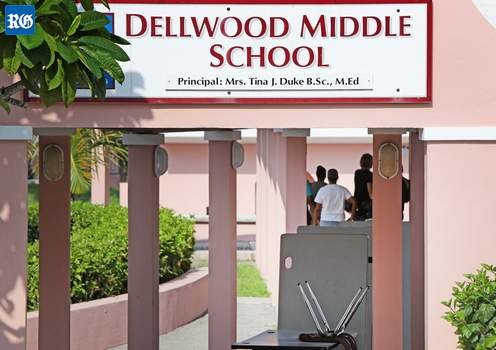 2019.
October 12. Concerns raised by staff at Dellwood Middle School are being
addressed, according to a government spokeswoman. Staff at the school had
indicated in a letter sent on Monday that they are working to rule over issues
“related to staffing, instructional areas, supplies, IT and the physical
facility”. A spokeswoman for the Department of Education said work to repair
damage caused by Hurricane Humberto are ongoing, as are efforts to fill vacant
posts. She said: “Teachers at the school expressed concerns that they have had
to cover art, math and social studies classes while three teachers are
identified to fill the posts. The department has advised that substitute
teachers have been secured for the school until the art teacher is confirmed;
the social studies teacher returns next week; and the math teacher arrives on
the island after the October break. Teachers also expressed concerns that some
of them have had to share classrooms. Technical officers from the Department of
Education met with the Dellwood school leadership to review the school schedules
and adjustments to the schedules are currently being carried out to alleviate
challenges experienced as a result of shared instructional spaces.” Ceiling
repairs in the design and technology room have been completed and an air
conditioner in the server room has been serviced. Meanwhile a damaged window in
the business room has been secured and a replacement window has been ordered.
All other air-conditioning units that were identified as inoperable have been
assessed and replacement parts will be installed between Monday and Friday.
Government has also worked to address a series of complaints about IT at the
school. The spokeswoman said:
2019.
October 12. Concerns raised by staff at Dellwood Middle School are being
addressed, according to a government spokeswoman. Staff at the school had
indicated in a letter sent on Monday that they are working to rule over issues
“related to staffing, instructional areas, supplies, IT and the physical
facility”. A spokeswoman for the Department of Education said work to repair
damage caused by Hurricane Humberto are ongoing, as are efforts to fill vacant
posts. She said: “Teachers at the school expressed concerns that they have had
to cover art, math and social studies classes while three teachers are
identified to fill the posts. The department has advised that substitute
teachers have been secured for the school until the art teacher is confirmed;
the social studies teacher returns next week; and the math teacher arrives on
the island after the October break. Teachers also expressed concerns that some
of them have had to share classrooms. Technical officers from the Department of
Education met with the Dellwood school leadership to review the school schedules
and adjustments to the schedules are currently being carried out to alleviate
challenges experienced as a result of shared instructional spaces.” Ceiling
repairs in the design and technology room have been completed and an air
conditioner in the server room has been serviced. Meanwhile a damaged window in
the business room has been secured and a replacement window has been ordered.
All other air-conditioning units that were identified as inoperable have been
assessed and replacement parts will be installed between Monday and Friday.
Government has also worked to address a series of complaints about IT at the
school. The spokeswoman said:
2019. October 9. Water issues at the island’s schools after Hurricane Humberto have been fixed, according to the Department of Education. A Government spokeswoman said this morning that school tanks were chlorinated and checked between September 24 and 26. She said: “In the wake of Hurricane Humberto, the Department of Education advised students to bring drinking water to school while all school water systems were checked. The department has confirmed that all water system checks are complete, and students and staff have resumed use of school provided drinking water as normal.”
2019. September 13. All public schoolteachers should be internationally certified as part of a proposed sweeping reform to education, a new report has urged. Inaction to make “radical change” to the education system would be the “most significant missed opportunity” in Bermuda’s history. The stark warning came in the Future State Report unveiled yesterday. The 31-page document was created by the BermudaFirst think-tank and is the second phase of its national socioeconomic plan. The group recommends that an independent authority be created to be “responsible for the performance management of educators and researching and implementing an holistic public education system that is appropriately sized/structured, resulting in a learning environment that facilitates optimum student success”. Nine specific recommendations for the authority are identified. They include:
In the report the group envisions a “world-class public education system that produces student outcomes where our children can successfully compete in the global marketplace and our citizens are lifelong learners”. It adds that the reformed education system “must be based on accountability for outcomes”. The report says: “Despite the best efforts to date, we have under performed, and one glaring reality is the portion of our population that is unable to compete for existing job opportunities, much less present themselves as candidates for emerging 21st-century work. If we fail to act decisively now, our passivity will be viewed as the most significant missed opportunity in the history of the island.” The group says the Department of Education “is part of the problem”. The report explains: “A common criticism of the DoE by the many government-sponsored reviews is that the public education system lacks accountability at all levels and that the department lacks leadership, as well as a vision for improving public education. It follows that our public education system lacks the wherewithal to address the challenge of preparing our students for further study or the working world. The existing public education and workforce development systems are not up to the task of meeting the needs of learners in a technologically driven 21st-century Bermuda. The authority must be progressive, agile and based upon accountability for educators and students. This radical change is required, since tinkering with the existing school system for the last several decades has not — and there is no reason to expect that this approach will produce the results we deserve. The ineffective bureaucracy, lack of agility to adjust to externally and internally generated change and the ongoing politicization of public education all combine to resist substantive progress. These root-cause systemic factors are the reason why BermudaFirst believes it is imperative that a radical shift transforming our oversight of public education to an independent authority is the change we must make.” The group argues the authority would “deliver improved student outcomes, better quality classroom instruction and site-based leadership combining to make Bermuda a globally recognised education jurisdiction. The authority, with revised hiring practices, a strong focus on performance management and a streamlined accountability structure, would be able to build mutually beneficial partnerships with all stakeholders who have a commitment to enabling our children to achieve and participate equitably in a growing sustainable economy. Turnover in ministerial leadership” must be reversed. We are hopeful that the Government will commit its resources and political will to this challenging task. The window of opportunity is now; each day of delay makes the journey of change more formidable.”
2019. September 10. All of Bermuda’s public schools welcomed pupils back today for the start of the new academic year. A spokeswoman for the Ministry of Education said: “All Bermuda public schools were open and safe to receive students today.” But she added that there were staff vacancies at some school levels. The spokeswoman said that two art, two music and one physical education teacher were needed at the primary school level. She added that one math and one foreign language teacher were still needed at the middle school level. The spokeswoman said: “The Department of Education has experienced staffing challenges in filling vacancies for music and art teachers at the primary level, and in securing math teachers at middle and senior school levels. In the interim, in cases where there is a staff vacancy, a trained and qualified substitute teacher has been provided. Staff recruitment is set to commence by the end of September 2019 for placements for September 2020. She added that the island’s 10 preschools and Dame Marjorie Bean Hope Academy, in Devonshire, had a full complement of staff. The spokeswoman said: “With the current staffing complement, the Ministry and Department are confident that all schools are positioned to proceed full-speed ahead with teaching and learning for the 2019/2020 school year.” Diallo Rabain, the Minister of Education, and DoE staff welcomed pupils and staff back to school today.
2019. September 7. Work has been carried out at West End Primary School to remove floor tiles as a precaution in case they contain asbestos. Air samples have also been taken and are being sent overseas. Last night the Ministry of Education confirmed that during an inspection on Wednesday some tiles were found to be coming up from the floor in a storeroom at the school. The next day the health department and Bermuda Water Service visited the school, on Scott’s Hill Road, Sandys. “After some discussion, it was decided that the best course of action was to remove the tiles in question in case they contained asbestos. Air samples were also taken. All works and samples collected were carried out due to the visual inspection finding,” the Ministry of Education said in a statement. “The tiles in question were removed and the floor was encapsulated, removing all possibility of asbestos being present. This work was completed on Friday.” The ministry said ceramic tiles are scheduled to be laid today, and air samples are being sent “overseas as per standard protocol”. It also emphasised that the abatement work was a precautionary measure solely based on visual inspection. Parents and staff will be formally notified on Monday, and the ministry said it is confident the school will be safe to receive students and staff on Tuesday. The ministry’s statement came after two photographs that appeared to reveal asbestos work at the Sandys school were sent to The Royal Gazette yesterday. The first, bearing a Ministry of Health letterhead and dated September 4, showed a permit for asbestos abatement at the school, located on Scott’s Hill Road. It said that AMR Services was authorized to start asbestos abatement on that day and complete the work by yesterday. The permit, signed for the chief environmental health officer, added that the work would tackle the “lifting and replacement of loose vinyl floor tiles. An Asbestos Abatement Completions should be issued after a satisfactory inspection has been performed by Occupational Safety & Health.” The second photo showed what looked like a plastic tented area that had the permit taped to it. Teachers have already expressed concern over safety after the discovery of asbestos at Prospect Primary School, in Devonshire, and Clearwater Middle School, in St David’s, earlier this summer. A ministry of education spokeswoman confirmed on Tuesday that work on asbestos had been completed on three areas inside Prospect Primary. She added at the time that work to tackle asbestos at Clearwater continued. The spokeswoman explained: “Some additional abatement works were needed, in one area of the cafeteria.” She said in an update yesterday that Prospect Primary and Clearwater “are expected to be open on Tuesday as scheduled”. The spokeswoman added that abatement work at Prospect Primary had been completed and that school staff had been back inside the building. She said: “The abatement work has also been completed for Clearwater.” Questions about a whether a back-up plan was in place for pupils and staff should Prospect Primary and Clearwater not be opened went unanswered.
2019. September 6. Scores from an annual pupil assessment should be used to guide maths teaching in public schools, the head of the teachers’ union said yesterday. Shannon James, the president of the Bermuda Union of Teachers, said that the results of the Cambridge Checkpoint assessment “should be used to move the system in a certain direction”. Mr James added: “Out of this ,there needs to be action steps, a concise plan, professional development, coaches, funding and resources to ensure that our maths competency improves.” He was speaking after it was revealed last week that a third of public primary schools were ranked as poor in maths based on average pupil scores on the Cambridge Checkpoint assessments for 2015 to 2017. Mr James said it was “sad” that the results of the annual assessments had “become something of a political debate”. He added: “The test itself is diagnostic — it is a doctor’s visit, per se.” Mr James said that a plan had been developed in 2015 and that there was a team of subject specialists, including a maths specialist, who had been “making strides in implementing a concerted maths effort. That programme was cut and the content specialists were disbanded. Too many times we chop and change with programmes when we need to let this diagnostic test guide us into the direction that we need to go and follow up with a concerted effort to ensure that excellence in delivered. We have the expertise; we need to ensure that it is put to use and that we do what needs to be done to improve our math skills.” The detailed Cambridge Checkpoint results were released after a public access to information request from The Royal Gazette. Bermuda’s annual assessment rates Primary 6 pupils on English, maths and science. The Cambridge system uses scores from 0, ranked “very poor”, to 6, graded “excellent”. The Pati request asked for the average pupil score, by school, in the three subject categories. The average pupil score in each of the three subject areas in each year was added together and divided by three to get the average pupil score over the three-year period. The exercise found that the average pupil score in maths at six of the island’s 18 primary schools scored below 2 — labelled “poor”. The results of the 2018 and 2019 Checkpoint exams have not been released publicly, but were sought in the Pati request. A Department of Education employee said this week “that the information is unavailable until in has been released by the minister”. A spokeswoman for the Ministry of Education earlier said that the results for both years would be released next month. Cole Simons, the Shadow Minister of Education, said that he understood that the results of the 2018 and 2019 assessments had been given to some principals and teachers. Mr Simons said it was “bizarre” that the results had not been made public by Diallo Rabain, the education minister. He added: “Given that we are now at the beginning of the 2019/20 school year, one would have thought that we should have the 2018 and 2019 Checkpoint results in full and published by now.” Mr Simons said that it was “crucial” that pupils and teachers “know where they stand”. He added: “The longer the Minister of Education delays the complete release of these assessment results, the more our students’ performance is possibly compromised and the more they are left behind.” Mr Simons said that Mr Rabain would deserve praise if the test results showed pupil improvement. He added: “If the performance results are not as positive as they ought to be, the minister should use this as an opportunity to address the areas which need support, and also, give our teachers the tools required for them to produce student plans, and teaching tools and resources, which will enable them to secure improved student outcomes, and place them on par with their international colleagues.”
2019. September 4. Work to tackle asbestos at another public school was completed over the long weekend, an education ministry spokeswoman confirmed last night. However, the spokeswoman said that it was “anticipated” that Prospect Primary School would be ready to welcome pupils for the first day of school, on Tuesday. She added that a report had been received over the weekend, that work was needed in three areas of the Devonshire school. The spokeswoman said: “Abatement works have since been completed and the Department of Education is awaiting a final certificate of completion, from the Department of Health.” She added the certificate was expected to be received “on or before” Friday. The spokeswoman said that extra cleaning was also needed in parts of the school. Teachers from Prospect Primary were sent to nearby CedarBridge Academy yesterday to prepare for the start of the new school year, instead of their own school. The spokeswoman said the move was made “in the interest of the health and safety of teachers”. She added that government officials had yesterday met the principal and school staff to update them on the Prospect Primary building and answer questions. The spokeswoman added that parents of children at the school would be given an update by today. She said that work to tackle asbestos at Clearwater Middle School in St David’s continued. The spokeswoman explained: “Some additional abatement works were needed, in one area of the cafeteria.” She said that the affected area had been sealed off and that teachers had completed preschool activities, in the building, yesterday. Teachers will be in off-site professional development sessions today and tomorrow, and they are expected to be back at the school by Friday. She said that Government representatives had also met the principal and school staff from Clearwater, for a progress report on the asbestos abatement work. The spokeswoman added that parents of Clearwater pupils would get an update today. She said: “It is anticipated that students will be welcomed at Clearwater Middle and Prospect Primary on Tuesday.” The confirmation from Government came after two sources told The Royal Gazette that asbestos had been found at Prospect Primary. Shareka Tucker, the president of the Parent Teacher Association at Prospect Primary, said she had not been told anything about asbestos at the school. She added: “I wasn’t aware of the situation.” Diallo Rabain, the Minister of Education, was sent several questions about the school yesterday. He was asked where and when the asbestos had been found, and if parents had been alerted to the problem. He did not respond by press time. Mr Rabain announced last Friday that the “majority” of public schools would be ready for teachers and staff today. He said that “all but two” schools had been given the all-clear and that he expected an update, about the two schools, before the end of that day. Mr Rabain added: “The results that we are waiting for, is indication that the schools have been cleaned, and set up properly, for the teachers.” He apologised, last month, to parents and staff at Clearwater, and admitted they had not been told of work to tackle asbestos “in a timely fashion”. Mr Rabain added: “It is our aim to be transparent and forthcoming, with all information in regards to school facilities and work being conducted, that relates to health and safety. Protocols are being put in place to ensure that the Ministry has all parents’ correct e-mail addresses and contact information, to allow for notices of this nature to be sent out quickly and efficiently.” Prospect Primary was given the all-clear after asbestos work was carried out in 2013. A spokesperson for the education ministry said at the time that asbestos had been found in the adhesive used to stick tiles to the floor.
2019. August 31. It was unclear last night if a school hit with an asbestos problem will be able to open for the new school term (starting September 3). Diallo Rabain, the Minister of Education, said AC Management and Bermuda Water Consultants had carried out removal work and collected air samples at Clearwater Middle School in St David’s and an overseas lab had found the samples were free of asbestos. But floor tiles, suspected to contain asbestos, were damaged during the removal, which meant extra work had to be carried out. Mr Rabain said: “We have had a conversation with the Department of Health and the Department of Health has agreed that they have examined what is going on at Clearwater and they are in the process of determining, because of this new thing that has popped up, they are in the process of determining whether the school can be operating while this work is being undertaken. “We expect to hear from them today, in fact.” A government spokeswoman previously said that asbestos was discovered in the ceiling of the cafeteria and closet spaces in June. Remediation work was carried out over the summer and completed on August 5. But the Government said last week that further air samples had been sent overseas after concerns were raised about floor tiles at the school. Mr Rabain said yesterday: “The results were submitted to the Department of Health who issued a health certificate of completion — the final step in any asbestos abatement process in Bermuda. Further abatement work was needed because the original abatement work that was carried out damaged some floor tiles. That work is currently under way.” He added: “Under any other circumstances, finding asbestos at any school is an issue that would be quickly addressed and dealt with by the Ministry of Public Works and third-party licensed contractors. However, in keeping with my promise to be transparent and open with my communication with relevant stakeholders, I deemed it critical to provide this update.” The minister said the department had pledged to work with parents and staff at schools to deal with questions and keep them aware of work being done at the school. Mr Rabain added: “Our approach is simple. We will focus our efforts where they are needed and communicate with those that are affected as soon as practicable. This morning, the ministry and department received a report on the readiness of schools, and I am pleased to report that the majority of Bermuda public schools will be ready to receive teachers and staff on September 3, and students on September 10.” He said the Government had yet to receive confirmation from two schools, but that was expected before the end of yesterday. Mr Rabain added: “What we are waiting for is indication that the schools have been cleaned and are ready for teachers. We have the majority of them — all but two schools — that they will be set up and ready for Monday.”
2019. August 31. The Government is looking for partners to help it abolish Bermuda’s middle schools. Diallo Rabain, the Minister of Education, said yesterday that a request for proposal would be put out today to find organisations to “plan, manage and execute the school redesign process”. He explained the massive change would require schools to be redesigned and rebuilt and new signature schools designed. “Issuing an RFP will provide us with the benefit of using an effective, existing, structured school redesign process that can be tailored to the needs of the Bermuda public school system. This will also allow the officers within the Department of Education to continue to focus on the day-to-day work of public school education. I encourage the public to review the RFP, which will be available online under the Office of Project Management and Procurement section of gov.bm.” You will see our sincere intention to be collaborative by giving you the opportunity to help transform public education in Bermuda.” Mr Rabain expected to have responses to the RFP by the end of September. He said discussions on how the island could phase out middle schools had already started, but that the Government was aware it would require thought, research and consultation. Mr Rabain added that the Government had already notified parents, teachers, staff, the Board of Education and unions involved in education about the RFP. He said: “To carry out this work in a way that is meaningful for our children means not only restructuring our school system with the phasing out of middle schools, but also redesigning or rebuilding existing schools and designing new signature schools. I thank all of the critical players for their diligent contributions towards executing what I have outlined here today; however, much work remains ahead. I am encouraged by the path we are on to transform Bermuda schools and the Bermuda public education system. I invite all members of the public to participate in the transformational process when called upon and thank the public for their patience and commitment to our children and their future.”
2019. August 31. “Revolutionary” changes are needed in the island’s education system, according to the general secretary of the Bermuda Union of Teachers. Mike Charles told a crowd at the 38th Annual Labour Day Banquet last night that the Government had allowed a “second-class” public education system to continue unchanged. Mr Charles said: “A country that does not educate it’s people well will relegate its citizens to being second-class citizens in their own country. Our Government today is making the mistake, continuing out of habit a pattern of education that was built by design. This mistake, this lack of vision to revolutionise how we raise up our young people, raise them up to believe in their potential and their ability to lead this country, this mistake of refusing to modernize our schools and support our programmes, is allowing an age-old design of a second-class education system to continue. The population of Westgate is not by chance. It is by design. So for those of us here and everywhere, it is time for us to put our money, our time and all our energy to where our mouth is and make public education in Bermuda second to none.” Mr Charles said that despite the success of labour governments at the polls throughout the Caribbean, unions in the region still find themselves going head-to-head with their governments. He suggested that some elected officials may have the right intentions, but are not experienced being on the other side of the table during union negotiations. Mr Charles said: “How many of our current elected officials have been active participants in any of the island’s trade unions? How many have experienced the trials of negotiations or the tensions in the room when a motion to strike comes forward. “I make this comment not to suggest that the elected officials intentions are not well directed, but rather to highlight that their ability to connect, their ability to connect with genuine understanding will only be limited if they have never set on the other side.” The veteran educator also took aim at the One Bermuda Alliance, who he said vilified unions when they sought to extend furlough days. Mr Charles said: “We took the country on our backs, sacrificing our personal wages to stabilize the Government books. We collaborated. Even more so, we came with solutions, offering our sacrifice when the experts were out of ideas. Fast forward 18 months — 18 months of significant personal sacrifice — we helped the OBA government save face. We put billions of dollars back into Bermuda’s books and when the terms of agreement came to an end, we were vilified. Many of the people of Bermuda accused us of not co-operating for the good of all when in fact it was they who were not keeping their word.” Mr Charles added that it was easy to feel bitter, but the island’s union members should instead feel pride that they were on the right side of history. Despite the conflicts with governments, he said true collaboration is necessary to create better outcomes for everyone on the island. Mr Charles said: “Collaboration is more than an empty trail of letters and e-mails that do nothing more than say ‘I told you so’. Collaboration is more than the empty meetings that pretend to gather input, only to push forward with the original plan. And collaboration is more than just giving lip service to find solutions only to have the same challenges persist month after month.” He said unions around the world needed to support one another and to stand up when needed for the benefit of all, particularly in the face of a changing world. As unions, we find ourselves returning to the same challenges over and over and over again. Our watch must be vigilant so as not to lose the rights and privileges that we have secured. We have seen a rise in populism, a rise in racism, more abuse of power by politicians and the erosion of human rights. Governments are attempting to dismantle trade union rights and the influence over government decision making by big business decision making continues to grow. Grass roots democracy is being attacked. For many of our colleagues around the globe, these are difficult times indeed.”
2019. August 30. A third of public primary schools were ranked as poor in maths based on average pupil scores over three years, it has been revealed. The detailed Cambridge Checkpoint assessments for 2015 to 2017 were released after a public access to information request from The Royal Gazette to the education ministry. Bermuda’s annual assessment was designed to rate Primary 6 pupils on English, maths and science. The Cambridge system uses scores from 0, ranked “very poor”, to 6, graded “excellent”. Scores from 3 to 4 are classified as “Good, about average for Cambridge Primary Checkpoint students”. Scores between 2 and 3 are deemed “OK, but below average for Cambridge Primary Checkpoint students”. Scores from 1 to 2 are rated as being “poor”. The Pati request asked for the average pupil score, by school, in the three subject categories. The average pupil score in each of the three subject areas in each year was added together and divided by three to get the average pupil score over the three-year period. The exercise found that the average pupil score in maths at six of the island’s 18 primary schools scored below 2 — labelled “poor”. The lowest-ranking primary schools were Francis Patton, Hamilton Parish, (1.97), the Gilbert Institute, Paget (1.87), Harrington Sound, Smith’s, (1.97), Heron Bay, Southampton (1.93), Paget Primary (1.80) and Victor Scott, Pembroke, (1.57). Victor Scott was the only school where the average pupil score was below 2 for all three years. The average pupil score in maths was below 2 twice in the three-year period at Gilbert (2015 and 2016), Harrington Sound, (2015 and 2016), Heron Bay (2016 and 2017) and Paget (2016 and 2017). Francis Patton had an average pupil score in maths below 2 only in 2015. An average pupil score for maths was not given for East End Primary for 2016. The school’s average pupil score for the three-year period — 2.50 — was calculated using the average scores from 2015 and 2017. Three primary schools had an average pupil maths score of 3 or more over the three-year period — Dalton E Tucker, Southampton (3.20), St David’s (4.27) and St George’s Preparatory (3.50). The Bermuda national average maths score in 2017 was 2.4 and the international average was 3.8. The island’s national average for maths was 2.2 in 2016, compared with an international average of 3.9. The Bermuda national average maths score was 2.4 in 2015, 2.6 in 2014, 2.7 in 2013 and 2.9 in 2012. The international averages for 2015, 2014, 2013 and 2012 were 3.8, 3.9, 4.1 and 4.0 for the same years. The results of the 2018 and 2019 Checkpoint exams have not been released. A spokeswoman for the Ministry of Education said that results for both years would be released in October. Diallo Rabain, the Minister of Education, did not respond to a request for comment yesterday. Mr Rabain was asked what the Ministry of Education was doing to bring up maths scores at the schools where they were found to be poor, and whether recommendations made by Cambridge representatives who visited Bermuda in 2018 had been implemented. Mr Rabain said in February last year that the results of the 2017 assessments showed “a need to continue to focus our attention on improving math scores”. Cambridge Curriculum assessors conducted a review of maths classrooms and ran teacher training sessions a month later. Mr Rabain told the House of Assembly afterwards that two Cambridge representatives visited ten schools and observed 500 pupils. “A primary observation pointed out to the department was the missed opportunity for our students to engage in deeper learning in many of the classrooms. Some of the practices that we have been implementing have not been the best practices. We recognize this, and now we endeavor to improve the practices to do better.” The Cambridge assessors recommended several improvements, including an increased pace of learning, increased pupil workload, and more challenging assigned work. Mr Rabain said that the training was needed. “We will endeavor to ensure that this type of training is ongoing as we move ahead. Mr Rabain added: “It is recognised that providing our teachers with constant professional development will help to enhance and build on the standard of teaching and learning in the classroom and ultimately improve the Cambridge score results for our students.” Mr Rabain said that a “comprehensive delivery plan” would be developed that would “action steps, timelines and accountability measures for the improvement of mathematics across the system”. He added that the education department would “report out on a monthly basis the progress being made in our mathematics curriculum”. The Primary Checkpoint was first used in Bermuda in 2012 and the island is the only public school system in the world to use Cambridge to administer these assessments across the education system.
2019. August 30. Results for public school children’s exams sat more than a year ago will be revealed in the autumn, an education ministry representative has said. The spokeswoman added that the Cambridge Checkpoint results for the 2017-18 academic year would be unveiled in October. She added that the results of the 2019 exams would be released at the same time. The response came after Diallo Rabain, the education minister, was asked about the status of the exam results this week. Mr Rabain was asked when the results of the 2018 exams had been received by the Government and why they had not been released to the public. He was also asked if recommendations made by Cambridge Curriculum assessors who visited Bermuda in March last year had been implemented. Recommended improvements included an increased pace of learning, increased pupil workload, and more challenging assigned work. Mr Rabain did not provide responses by press time yesterday. Primary 6 and Middle 3 public school pupils, the classes who take the Cambridge Checkpoint exams, are assessed annually in three areas; English, maths and science. A report on the 2017 exam results was delivered by Mr Rabain in February 2018, ten months after pupils sat the test. He said then: “In the past, we’ve reported the results in October. However, the technical staff at the Department of Education have taken time to prepare a more parent-friendly and community-friendly report.” Mr Rabain added that the Bermuda Public School system “is the only public school system in the world to use Cambridge to administer these assessments system wide”. Mr Rabain told MPs in a ministerial statement in the House of Assembly in March 2018 that he had told the public the month before “that our students were not performing at the expected standards for English, maths and science”. He added that maths results provided the “greatest concern”.
2019. August 29. A game-changing course based on Singapore methods has been delivered to maths teachers at public and private schools. Training, from the international firm Maths No Problem, was provided to Warwick Academy teachers, as well as public primary and middle schoolteachers. Andy Psarianos, chief executive of the company, said the programme was based on the successful education system in Singapore. Mr Psarianos said: “Singapore’s success was quite remarkable — unheard of. Singapore is at the top of the league tables, but they didn’t used to be. The small southeast Asian republic is an outlier in education. When they changed their system of education, they shot to the top in 1995. A decade before, they were at the bottom.” Singapore, which has a population of 5.6 million, is also top for ease of conducting business and ranked the world’s most competitive country. Maths No Problem, a British-based professional development and textbook company, sends its trainers worldwide to run events such as this week’s three-day seminar at Warwick Academy. The course was sponsored by professional services firm Deloitte. Mr Psarianos said: “We help jurisdictions like Bermuda adopt methodologies that are used around the world, but especially in Singapore.” About 70 teachers were trained by Yeap Ban Har, a consultant who heads the company’s professional development unit, from Monday to Wednesday. Jill Finnigan, a senior teacher at Warwick Academy, said three teachers from the school who were sent in 2017 to a course in London with Dr Ben Har had come back “raving about their experience. We decided then and there to bring Dr Ban Har here to share knowledge not only with our school but other educators.” Members of the Bermuda Council of Teachers of Mathematics, headed by Rebeka Sousa, joined the programme. After a team from Warwick Academy met Kalmar Richards, the Commissioner of Education, the course was advertised to teachers in public primary and middle schools. Ms Finnigan said teachers who took in the course part had to be members of the BCTM or join the group to “make sure there was a continuation of the ideas learnt on the course”. Dr Ban Har said the research-based method used in Singapore combined a variety of techniques in the classroom for more effective learning. “It encourages teachers to let students explore problems and discuss it in class instead of teaching maths in one way.” He added techniques from around the world are combined in the “Singapore strategy. Teachers are teachers and the same everywhere. From the responses I get, many are still teaching not in the way we are describing, but maybe still doing things traditionally.” Margo Furbert, the primary maths co-ordinator at Warwick Academy, added: “If we could get our key stakeholders in education aware of this approach, we could revolutionise teaching in our island.” Ms Furbert added: “I wish that I had been taught this way.”
2019. August 24. Air samples from an area of an East End school, where floor tiles suspected to be contaminated with asbestos were removed, were yesterday sent to an overseas lab for analysis, an education ministry spokeswoman has revealed. The spokeswoman said the tiles were found in a classroom at Clearwater Middle School, during routine cleaning, after the school was given the all clear. She added: “Results are expected back next week, after which the corresponding health certificate will be issued, from the Department of Health.” The spokeswoman also said that asbestos removal was carried out on the cafeteria ceiling and the ceiling of closets. The news came after an insider warned earlier this week, that parents, pupils and teachers had not been given the full picture on asbestos at the school, and that the scale of work that had been carried out this summer had not been made public. Diallo Rabain, the education minister, announced earlier this week that the green light had been given to start classes on September 10. Mr Rabain told broadcaster ZBM that work at the school involved floor tiles, but did not identify the cafeteria or closet spaces as areas of the building where other asbestos abatement had been done. An inside source said work that had been done to tackle asbestos at the school was a “Band-Aid fix”. The source added: “No one has been in there and done a thorough inspection and been through the whole school.” The insider said staff were still concerned about the safety at the school, despite Mr Rabain’s assurances. The Royal Gazette’s source continued: “I don’t know how in the world they can say it’s clean.” The spokeswoman said the latest find was made after asbestos removal work was completed, in other parts of the St David’s island school, built in the years after the Second World War by the US military. She said that the cancer-causing material was discovered in the ceiling of the cafeteria, and the ceiling of closet spaces, in June. The spokeswoman said that AC Management, a licensed asbestos removal contractor, dealt with damaged material that contained asbestos, and that the material was “encapsulated or removed and replaced with non-asbestos materials”. She added the work was completed on August 5. Air samples of the areas where asbestos was found were then collected by Bermuda Water Consultants and sent overseas for analysis. The spokeswoman said: “The lab results came back, and the areas were deemed safe and asbestos-free. Lab results were submitted to the Department of Health and a certificate of completion is in progress, as a final assurance that the tested areas are safe, for students and staff. The ministry notes that no health issues have been reported regarding asbestos exposure. The ministry also notes that, in regards to concerns expressed regarding asbestos discovered in 2018 in the custodial main storeroom area at Clearwater, abatement works were conducted and completed, in December 2018.” Mr Rabain repeated an apology to parents and staff made earlier this week “that they were not notified of these works in a timely fashion. It is our aim to be transparent and forthcoming, with all information, in regards to school facilities and work being conducted that relates to health and safety. Protocols are being put in place, to ensure that the ministry has all parent’s correct e-mail addresses and contact information, to allow for notices of this nature to be sent out quickly and efficiently.” Mr Rabain said that the ministry encouraged school staff to highlight health and safety problems. He added: “When necessary, licensed contractors are brought in to evaluate and recommend solutions. While their methods may not be familiar to, or understood by, persons outside of their licensed technicians, we rely on their expertise to ensure the safety of our schools.” Cole Simons, the shadow education minister, said that the full report on Clearwater should be made public. He added that the ministry always apologised, when it had been “caught out”. Mr Simons said: “This government shares information with the people on a need-to-know basis, or when their backs are up against the wall. Transparency does not come easy for them.” Nakisha Burgess, the president of the Clearwater Parent Teacher Student Association, did not respond to a request for comment.
2019. August 22. An East End school has been given the green light for classes to go ahead after concerns about suspected asbestos, the Minister of Education said. Diallo Rabain apologised to parents of students at Clearwater Middle School for not alerting them to the potential risk earlier. He was interviewed on ZBM and said that abatement work was already completed when the broadcaster first aired the story. Mr Rabain said: “We were waiting for the overseas report to come back and give the all clear. I have contacted the Department of Health and they have received the report and they’re in the process of issuing a certificate to say that the school is safe to enter. In this particular case, there were some tiles that are on the floor that were found to possibly contain asbestos. As soon as that happens, that area was shut off and ... an abatement company that’s licensed in Bermuda was brought in to do the actual work. They did the work and after that samples are taken by a third party ... and those are sent overseas to be analyzed. Once those come back giving the all-clear, that is the only time that the rooms can be then occupied.” The minister added that he wanted to apologise to parents for “not reaching out to them and letting them know what was going on” when the suspicions first arose. Teachers and relatives of students voiced their concerns about conditions at the St David’s school this week. A spokeswoman for the Department of Education said then that the school would be inspected by a third party to make sure it was safe. She added that further details would be released once the inspection report was handed in.
2019. August 21. An autism spectrum disorder programme for preschool children will welcome its first pupils next month. The new programme at Prospect Preschool in Devonshire will open on September 10 — the first day of the new school term. Sherri Bucci, the assistant director of early childhood at the Department of Education, said that the programme and training was “not about putting a label on a child, but about addressing individual’s needs”. Diallo Rabain, the Minister of Education, added that a “specially designed and resourced” classroom would serve the pupils. He said: “This programme will close the gap in our ASD programme offerings between the child development programme and primary school as we have ASD programmes in the primary, middle and high school levels. It will not only offer specialized early intervention and support for students on the ASD spectrum but include students who may have similar support needs. With a 1:2 teacher-student ratio, the programme itself will provide focus on the social and emotional elements of development, while at the same time utilizing the preschool curriculum that is taught in other schools, according to the child’s level of functioning.” Mr Rabain added that teachers, support staff and Department of Education employees were taking part in a two-day training session this week. Curtis Dickinson, the Minister of Finance, announced in the 2019-20 Budget Statement in February that some of the $327,000 earmarked for preschools would be used to create an ASD programme. Anthony Peets, then president of charity organisation Bermuda Autism Support and Education, said after the Budget announcement that early diagnosis was “imperative” and that “specific intervention programming is welcomed”. Mr Peets added: “What is more than imperative is having trained personnel who implement the day-to-day interventions. Working with children on the spectrum is way more than just having awareness of a diagnosis. Interventions are tailored and targeted for that child.” Tinée Furbert, the Junior Minister of Disability Affairs, said in an op-ed in April that services in Bermuda for people with autism had “come a long way”. She added: “We will continue to work hard to improve access and services for persons with autism and their families.” An information session for families and professionals will be held tonight at the Bermuda Underwater Exploration Institute from 6pm to 8pm.
2019. August 21. Teachers have “grave concerns” about pupils and staff at an East End school contaminated by asbestos, the head of the Bermuda Union of Teachers said yesterday. Shannon James, the president of the BUT, said that the union demanded the highest standards of safety in school buildings for staff and pupils. He added that news that asbestos had been found at Clearwater Middle School in St David’s had disturbed the profession. Mr James said: “To hear that there has been asbestos in areas of Clearwater, when we know the danger that exposure to it brings, causes grave concerns regarding the students who go in and out of each class and especially for the staff who are stationed in the affected rooms and are there for the majority of the day.” He added that school staff, parents and pupils needed to be shown how this problem had been eradicated, if it had been fully addressed or what the plan was if there was a need for extra work to be carried out at the school. Mr James said: “To be this close to school opening and not knowing what is happening is definitely not a good thing.” He said that the union had asked for certificates of occupancy for public schools that showed they had been maintained and that problems had been fixed. He added: “This further demonstrates the need for such an inspection to be carried out to ensure the safety and health of a school family. We can’t imagine what must be going through the minds of the faculty and students of Clearwater Middle School, knowing that they may have been exposed to such harmful material.” He was speaking after the Government confirmed that work to remove asbestos had been carried out at the school this summer. A spokeswoman for the Department of Education said that an independent inspection was being carried out “to ensure the school is safe to occupy”. She added: “A further statement will be made once the third-party inspector has submitted the final report.” A two-day inspection of the school carried out in August 2017 by the Office of the Safety and Health Co-ordinator revealed that “suspected asbestos” had been found in a storeroom. A report note said: “Confirmation testing requested; results being awaited.” Inspections of all public schools were completed last year between September 17 and October 17. The survey at Clearwater found that there were “ongoing potential asbestos exposure concerns” over the storeroom. The findings of both reports were released to the public in March.
2019. August 20. The grandmother of an 11-year-old girl due to start at an East End school next month said she was concerned about asbestos in the building. Mary Faries heard a radio report last week about the presence of the cancer-causing material at Clearwater Middle School in St David’s. She said that she was worried about the possible health impact on pupils and staff. Ms Faries, 66, said: “We cannot expect our children to be going to an environment like that. There could be other families whose children are starting on September 10. They are away right now just like my family is, and haven’t heard the news. It’s just not good enough. Asbestos is serious.” Diallo Rabain, the education minister, has stayed tight-lipped about what work was being done to remove the asbestos risk and if the school would open as scheduled for the new term. Ms Faries, from Pembroke, has just bought new school uniforms for her granddaughter. She said she had contacted the Department of Education about the issue yesterday and that the public deserved more information on what was happening. She questioned whether remedial work at the school would be completed in time for the new school year and if the building would be safe. Ms Faries said she feared that pupils would have to be relocated. She said that pupils and staff should only return to the school if their safety could be guaranteed. Ms Faries added: “I would like to think they would have experts going and reviewing this work.” She added that she had raised the concerns not only for her family but for others as well. Ms Faries said: “The more people that complain, maybe we might hear something.” A two-day inspection of the school carried out in August 2017 by the Office of the Safety and Health Co-ordinator revealed that “suspected asbestos” had been found in a storeroom. A report note said: “Confirmation testing requested; results being awaited.” Inspections of all public schools were completed last year between September 17 and October 17. The survey at Clearwater found that there were “ongoing potential asbestos exposure concerns” over the storeroom. The findings of both reports were released to the public this March. Mr Rabain was asked several questions about Clearwater last week. They included questions on what work was being carried out, who the work was being performed by and if the school would be open on September 10. Mr Rabain was also asked if any health problems that could be linked to asbestos had been reported. Last night, a spokeswoman for the Department of Education said the material had been removed this summer by “a licensed abatement firm”. She said the school would be inspected by an independent third party to ensure the school was safe to occupy. She added that further details would be released once the inspection report was handed in. Nakisha Burgess, the president of the Clearwater Parent Teacher Student Association, said questions on “this very sensitive matter” should be sent to the education department. She added: “We are all looking for answers, and I believe this is where you should start.” Cole Simons, the shadow education minister, said there was “real concern” that the asbestos-removal programme at the school was “woefully inadequate and should be better managed”. He added that the problems at Clearwater were not new and highlighted that the school was not opened on time for the start of the new school year in 2010. Mr Simons said: “The delay resulted because the then PLP government’s health and safety reports alleged that there were maintenance issues at the school, which included mould, asbestos, rotten wood in a room, and open ceilings to the air conditioner in the hallways.” Mr Simons added that the teachers, pupils and staff at the school should not be exposed to health risks. He said the Government should provide an update on work at the school.
2019. August 3. Public school staff will be responsible for keeping their school websites up to date, a ministry spokeswoman said. She added that the Ministry of Education’s website and individual school websites would be updated for the start of the new school year. Diallo Rabain, the Minister of Education, said last month that work had begun to update the Ministry of Education website. He said: “Currently, the Department of Education is training school staff to operate the back end of the site. We look forward to unveiling the website for the upcoming 2019-20 academic year.” The spokeswoman confirmed that school staff would be told to make sure individual school websites in the education ministry domain had regular updates. She said: “Each school is expected to keep information on the website up to date utilizing the calendar function. Updating the website is considered part of the administrative staff’s regular work as it is a method of sharing information from the school with parents and students.” The spokeswoman said that “designated school staff” were being equipped “with the skills to operate the back end of the website and the process for updating information on a regular basis”. She added that staff at the education department would be responsible for their website and ministry staff for its site.
2019. July 26. Upgrades to internet in public schools could be completed before pupils return to their classrooms, the education ministry said. However, a spokeswoman was unable to provide the costs for the upgrades. She said: “This information isn’t available right now.” Diallo Rabain, the Minister of Education, announced this month that the Department of Education was “on schedule” to increase internet bandwidth in public schools. The spokeswoman said that the anticipated completion date for the upgrade was “tentatively in September”. The upgrade will boost all primary schools and middle schools from 10 Mbps copper to 100 Mbps fibre. Preschools will be upgraded from 4 Mbps DSL to 20 Mbps fibre. The spokeswoman added that Dame Marjorie Bean Hope Academy would be upgraded to 100 Mbps, and Success Academy II and the Child Development Centre both bumped up to 20 Mbps. She said that rules to govern the use of computers and wireless networks had been prepared. The spokeswoman added: “Documents are complete and will be posted on the new website.” Mr Rabain said that increased bandwidth “will enable our schools to have increased access to information technology and wi-fi services”
2019. July 24. A promise from the education minister that he will be the longest to serve in the post will mean nothing unless staff discontent is tackled, a union leader said yesterday. Mike Charles, the general secretary of the Bermuda Union of Teachers, said: “To say that one is the longest-standing minister means nothing if we have a workforce who feels under-appreciated and disrespected, which became evident throughout this year of unprecedented industrial action.” He was speaking after Diallo Rabain said he was prepared for the long run. Mr Rabain told MPs in the House of Assembly last Friday that 19 people had served in the post since 1993. He said: “That is an average of a new minister every one year, five months. This is an appalling record.” Mr Rabain added that public- sector education needed an “overhaul” — and signaled major changes because of a falling birthrate. He said: “It is no secret that our population is shrinking and we need to look at how we operate in order to provide the best for our children. We are all aware of the greater accountability needed in both the Department of Education and the education staff that are within our schools.” He added that “very difficult conversations” lay ahead. Mr Rabain explained: “There will be difficult conversations around school buildings and their continued or discontinued usage, class sizes, staffing skill sets and the staffing levels that will be required.” He warned that some decisions he would have to make would not be popular. "However, we, the adults, need to move past our fears of losing control of classrooms, losing the schools we attended decades ago, fears of one political party being viewed over the other and, most importantly, the refusal to embrace change for the simple fact of being contrary.” Mr Rabain has been education minister since the Progressive Labour Party won the 2017 General Election. He said that the position was “the best job that I’ve ever had”. Mr Rabain added: “I lay this marker down now today — that I will be the longest-serving education minister in Bermuda.” The longest-serving education minister in modern politics was Gerald Simons, who served seven years in the post between 1986 and 1993 for the former United Bermuda Party. Milton Scott, a former Progressive Labour Party senator, held the post for two years and eight months from March 1999 to December 2001. However, Mr Charles said that the problem had not been the number of education ministers but the competence of those in charge. He added: “The issue at hand is not the fact of the revolving door of education ministers, but the quality of those who serve as minister. Does it make sense to say we stopped the revolving door just for stoppage’s sake? The union wants quality of service from the political leader of public education. Our system, our children, deserve an effective minister; one who has open communication with all stakeholders on an ongoing basis; one who listens to and responds to, in an effective way, the voice of the educators; one who speaks accurate and not erroneous facts when speaking to the public.” Cole Simons, the Shadow Minister of Education, agreed that frequent changes in education ministers had damaged education. He said: “No one was there long enough to deliver on any of the strategic plans which have been crafted over the years.” Mr Simons highlighted comments on news articles and social media sites about Mr Rabain’s performance in the post. He said: “Look at the community’s sentiments. Look at the Cambridge results and the number of high-school graduates attending international institutions. These speak for themselves.”
2019. July 5. Plans to have signature schools open in a little more than a year’s time are “very aggressive”, the education minister said yesterday. Diallo Rabain added that members of team that would lead the Government’s plan to axe middle schools and introduce senior-level signature schools had not been selected. He said: “That is still being worked on. As we move along, we will furnish updates of what’s going on with that process.” Mr Rabain said that “some preliminary work” had been done, but that the task to assemble the team will not “be as easy at it seems”. He explained: “There are specific skill sets that we do want on this particular team and so that is the process we are going through now — who can be on that team. We realise that this is not something that our employees can do on a part-time basis. This is something that we are actually going to have to bring people in from different parts of the Government and actually second them to do this for us.” The Department of Education had 314 full-time equivalent employees in 2017-18 according to the 2019-20 Budget book. Mr Rabain said that the number, location and focus of the signature schools had “been discussed”. He added: “There are potential scenarios that have been pushed forward. When we are ready to start the consultation process, that’s when we will come out with the various scenarios.” David Burt, the Premier, told MPs in May that it was hoped that “school year 2020-21 will be the first with signature schools”. He said that the school year starting in two months’ time will “ideally” be the last “under the current system”. Mr Burt added that the Government “will not rush this just to make this particular timeline”. Mr Rabain said that he could not yet say if the time frame was possible. He added: “What I can tell you is that that is the aim — and we will always look to hit our mark.” Mr Rabain said: “It is critical to get this transformation right the first time. So we will go at the necessary pace to ensure its smooth transition. We will be guided by what is right for our students first and foremost.” He reiterated that consultation will take place before a final plan for the school system change is decided. Mr Rabain said last July said that a three-pronged process, expected to last 18 months, would be used to develop proposals for signature schools. He said that the first would involve consultation and the second phase would develop proposals. The final phase would involve a review of the proposals. Mr Rabain said at the time that he expected each phase would last about six months. The promise to phase out middle schools and introduce signature schools was made in the Progressive Labour Party’s 2017 election platform.
2019. June 27. Pupils and their teachers staged a protest yesterday against planned class mergers at their school and fears that staff might be made redundant. Dozens of children and staff from Paget Primary School congregated outside the Anglican Cathedral on Church Street in Hamilton to complain about the move to cut the number of classes. One teacher said other concerns at Paget Primary were the lack of support staff, including teaching assistants, known as para-educators, and an education therapist, as well as the lack of a music teacher. The teacher added: “It is difficult to say whether we need more Para educators, but we do need to maintain our class sizes in P1, P4 and P6. We also need to keep our educational therapist full-time. About four years ago, for some reason, they reduced that time to three days.” The teacher said the school had not had a permanent qualified music teacher for at least three years. We have been using substitute teachers, whether they are certified or not, to do music with our students.” It is planned to reduce the number of Primary 1 classes and Primary 4 classes from two each to one each. The school submitted a letter of opposition to the merger plans to the Ministry of Education and to the Bermuda Union of Teachers on Monday. The teacher added: “We have heard that one of the lines of defence for the Ministry of Education having smaller classes is based on the school reorganization report which the Government paid for a number of years ago. Some feedback we got back is that the report has not been adopted by the ministry so it can not be used as a line of defence.” The teacher said: “We will continue on. We are going to stand up and be heard and be seen. I have heard of other schools in a similar situation, but not names — I am sure that they will follow our lead.” Diallo Rabain, the education minister, said there would be no job losses at the school. Mr Rabain said after the protest that one teacher would be moved to another school as part of a re-evaluation of class sizes across the public education system and another teacher thought to be affected by the mergers would remain at the school. He added that he and Kalmar Richards, the Commissioner of Education, had met representatives of the school’s PTA and the principal yesterday. Mr Rabain said: “The PTA representatives were forthright in sharing that the teachers of the schools had reached out to them and asked for their support. It is unfortunate that the narrative of teachers possibly losing their employment has been driven by some of the teachers themselves.” But he insisted: “I can confirm that there will be no loss of employment.” There had also been concerns that the two Primary 6 classes would be merged, but teachers at the school were told yesterday they would remain unchanged. Class sizes proposed for September are one Primary 1 class with 17 pupils; two Primary 2 classes with a total of 21 pupils; two Primary 3 classes with a total of 27 pupils; one Primary 4 class with 22 pupils; two Primary 5 classes for a total of 28 pupils; and two Primary 6 classes for a total of 25 pupils. Mr Rabain said that standard classes sizes were set at one teacher to 25 pupils at the Primary 4 to Primary 6 level and one teacher to 18 pupils at the Primary 1 to Primary 3 level. He added that some teachers had “gotten comfortable” in recent years with smaller class sizes. Ms Richards confirmed that other schools had been identified as potential candidates for class mergers but declined to give details. Mr Rabain would not confirm whether any school closures were being considered, but that the ministry was evaluating the system. He said a decline in public school enrolment was expected to continue until 2026. Mr Rabain added: “This reality will require us to continue to examine staffing allocation at our schools and also means that we will continue to reassign staff.” Mike Charles, the general secretary of the BUT, said that the union would need to meet its members before it decided on its course of action.
2019. June 19. The Government has dragged its feet to determine the fate of a school’s Primary 1 class, a worried parent said yesterday. Teretha Talbot, whose daughter Brialla, 5, was due to join two older siblings at Elliot Primary School, said that she still did not know whether her children would attend the school come September. She said: “I am very concerned about this.” Ms Talbot was speaking after a post appeared on social media last week. The advertisement, on the Bermuda Public Schools Facebook page, encouraged parents still in search of a P1 spot for their five-year-old child for September to consider the Devonshire school. It read: “Elliot Primary School may be the place for you.” The post said that interested parents should contact the school to arrange a tour and that enrolment applications are available on the Ministry of Education’s website. A Government spokeswoman confirmed yesterday that a decision had not yet been made about whether the class would be offered next term. She said that the education ministry and Department of Education “are working with Elliot to bolster enrolment and is also engaging with parents about options for P1”. The spokeswoman added: “A decision on the status of the P1 class hasn’t yet been made as parent consultation still needs to take place.” She said that the consultation process would be completed “in due course. It is our intent to ensure that all stakeholders are consulted prior to a final decision being made.” Ms Talbot said that she did not understand why the school would be advertising to parents of P1 pupils when the future of the class was unclear. She added: “For them to post the ad they had on Facebook about enrolling more children at the school — it’s confusing.” Ms Talbot said that she also did not understand the Government’s statement about consultation with parents. “They’ve been having meetings all this time.” Ms Talbot said that safety concerns for Brialla would mean moving her other children Chanse, 6, and Charm, 9, from the school if their sister could not also attend. She was earlier warned in a letter that the P1 class at the school could be axed because only four children had enrolled. The letter, from Valerie Robinson-James, the education ministry’s permanent secretary, said that it was the “provisional view” of Diallo Rabain, the Minister of Education, that the class be cut. Potential Elliot parents were offered spots at other schools. Ms Robinson-James said that Mr Rabain, whose daughter attends the school, would consult parents who decided not to accept alternatives before he made a final decision. The Parent Teacher Student Association at Elliot declined to comment yesterday on questions about the P1 class. A representative said: “Please contact the Ministry/Department of Education as they are the appropriate channel to address these questions.”
2019. June 5. A “lack of confidence” in the public-school system is to blame for the loss of pupils to private institutions, the education minister said last night. Diallo Rabain said: “There is a belief that the private schools are better. That’s why we see that flight. Our job is to change that mindset. Our job is to put a system in place that produces a quality of graduates, the quality of grades, that people can now say ‘I can trust my child to be here’.” Mr Rabain was speaking at a town hall meeting on education held last night. The event, organised by the Progressive Labour Party, took place at the Bermuda Industrial Union headquarters. Several dozen people attended, including principals, teachers and parents. Mr Rabain disagreed with the suggestion from an audience member that the private-school system was better than the public. He added: “One thing that I do want to make clear — the direct apples-to-apples comparison is just not possible at this time.” Mr Rabain said that there were problems related to pupil needs that private schools “do not have to deal with. The Education Act states that as long as the student has the ability to learn, we have to figure out a way to teach them.” Mr Rabain said that public-school classrooms were made up of pupils that included the “high flyer” as well as pupils with special learning needs. He added: “The private schools, they only have one type of student. And that really is the biggest difference there.” O’Brien Osborne, the principal at Somerset Primary School, asked Mr Rabain to “dispel this myth” that all students in private schools are smart. He said: “And when I say smart, I mean above average. That is not true. I am a former teacher in the private-school system.” Mr Rabain said that the Government will start to collect more in-depth pupil and school data to allow for public and private schools to be more accurately compared. Other topics raised by event attendees focused on middle schools, pupil assessments, class sizes, school zones, special education and how resources are distributed. Mr Rabain thanked the teachers in attendance. He said: “Teaching is the only profession that teaches all other professions. We have a great admiration and respect for our teachers. We might not get along at times, we might butt heads, but at the end of the day I think we all have the same thing in mind, and that is to ensure that our students get the best that they can get.” A second town hall event will be held at Somerset Cricket Club on Thursday at 6pm.
2019. June 3. Teachers will return to schools today after industrial action on Friday. The Ministry of Education said yesterday that all public schools would be open and ready to receive students today. Diallo Rabain, the Minister of Education, said: “I want our parents to be assured that the Government is committed to ensuring incidents like Friday’s are relegated to the past. Discussions with the Bermuda Union of Teachers also revolved around changing the nature of the relationship between the Ministry of Education and the BUT. Clearer lines of communication will be put in place, allowing more access to myself and the entire body of teachers. The disruption of our children’s education is unfortunate under any circumstance, and we must do what is necessary to prevent this from happening again. I am happy we could discuss these outstanding issues and look forward to a renewed and reformed relationship with the BUT, as was discussed in our meetings on Friday.” The Bermuda Union of Teachers said yesterday that the decision was made for its membership to return to classes after their meeting with David Burt, the Premier, two days ago. Shannon James, the president of the BUT, said: “As a result of the discussions led by the Premier on Friday evening, we are asking teachers to report to school as per normal on Monday.” A Ministry of Education spokeswoman said discussions with the BUT on Friday regarding the issues that led to teachers not reporting to class on Friday, was positive and fruitful. She added: “Over the next few weeks, attention will be brought to several issues that have been outstanding for many years, as well as plans put in place on how to address other items before the start of the 2019-20 school year.” Teachers did not turn up for school on Friday after the BUT called an emergency meeting at 8.30am to discuss a range of issues including support staff and mould. Parents were asked to pick up their children at noon.
2019. June 1. Children were dropped at school yesterday by parents unaware that there were no teachers to look after them because of an industrial dispute. Many principals across the schools system were forced to look after 100 or more pupils before the Ministry of Education advised parents to collect their children at noon. One woman with a son at a primary school said: “As a parent who is heavily involved in my children’s lives and by extension their school, I empathize with the teachers. However, today was an example of how not to keep that bridge open. I understand the need to take action to make sure their voices are heard but never at the expense of my child’s wellbeing. My children had a grandparent to go to, but many people didn’t and, with the buses working to rule, some parents were still trying to find out where their kids were at lunchtime.” The Bermuda Union of Teachers gave notice of a meeting over grievances just before 6pm on Thursday. A Ministry of Education spokeswoman said at 7pm that teachers were expected to report to school for a regular day. The grandmother of a six-year-old boy said she found out by chance that there was a potential problem after she logged on to her computer to check her e-mails. She said: “His father dropped him off thinking everything was normal. He would not have had a reason to question why anything might be different. I called the school and asked where in the world is he now? The receptionist said he’s in the classroom, maybe with the principal or the deputy. This is the third or fourth time he’s been dropped off and the teachers haven’t been there. This is beyond ridiculous. The woman asked: “What kind of message is this sending to the children when it comes to education, discipline and order?” One woman, who has children in primary and high schools, said she supported the teachers, but the last-minute notice of the meeting was “a recipe for chaos”. She said: “My child in high school is preparing for end of year exams so he’s missing critical work reviews. It’s not a major issue as it’s only one day out of class. Thankfully we have a strong support system and were able to keep our children home and not miss work.” But the woman added: “It’s annoying that the BUT could not organize better communication to parents so that we could plan appropriately. I’m in full support of the teachers in having their issues addressed. But as a parent I would prefer full transparency and disclosure so we can help where we can.” One senior education official in the public-schools system said: “Most of the deputy principals will be in the schools supporting the principals. Sometimes some of the PTA members will stand in as well at times like this.”
2019. June 1. A decision on whether schoolchildren will return to the classroom on Monday is in the hands of teachers, the education minister said last night. Diallo Rabain, speaking after teachers downed tools as part of an industrial dispute, said: “That was something that was not finalized in our discussion.” Mr Rabain added that he had asked Department of Education employees to come up with a contingency plan if teachers did not return to their schools on Monday. But he said: “We are very hopeful that we have answered the questions sufficiently enough for the Bermuda Union of Teachers that they will come into the classrooms on Monday and get back to doing what it is they do best.” Mr Rabain added: “We have held up our part of the bargain.” He was speaking yesterday afternoon after a meeting between government education figures and the BUT. Shannon James, the president of the BUT, said after the meeting that progress had been made. He added the two sides “were in a much better space” and that a statement from the union would be released later. The talks followed an emergency meeting held by the BUT yesterday morning where teachers identified nine urgent problems they wanted tackled. These included problems with teaching assistants, contracts and job evaluations. Enrolment and staffing problems at Elliot Primary School and the reopening of TN Tatem Middle School were also identified as stumbling blocks. Mr James offered his “humblest and sincerest apologies to the parents and students of Bermuda” at the teachers’ meeting. He said that teachers would much rather be in the classroom. But Mr James added: “We believe that the ministry has left us no other choice.” He said that the union had voted to demand a meeting with leaders of the education department, including Mr Rabain, Kalmar Richards, the Commissioner of Education, and Valerie Robinson-James, the permanent secretary. Mr James added: “We demand that this meeting take place with the entire BUT membership.” Teachers picketed Parliament after the union meeting. David Burt, the Premier, announced outside the House of Assembly that the meeting would take place. In a letter dated yesterday addressed to Mike Charles, general secretary of the BUT, Mr Burt said he had previously invited the union to speak to him before “things escalate to this point. This offer has not been taken up in this instance and I would hope and implore that you would do this in the future. When teachers in our public education system withdraw their labour, this causes immense strain and hardship on parents and support staff who have to make alternate plans at incredibly short notice. Industrial action which leaves very little space for parents and other persons to plan cannot be seen as ensuring that we are as productive as possible. In the best interests of our children, we need to return relations between the BUT and the Government to a collaborative place where walk outs are not needed.” Mr Rabain said that better communication was needed between the Government and the BUT. He added: “We need to change the dynamic of this relationship. We cannot continue to have situations arise where we have things that are disrupting our children’s learning. The only people who suffer are our children.” Mr Rabain earlier accused teachers of going “absent without permission”. He told the House of Assembly that principals were “holding the fort” at schools while teachers attended their meeting. Mr Rabain added: “The simple fact is that school is not off.” But a spokeswoman for the education ministry said at noon that a decision had been made to close public schools for the rest of the day “in the interest of the safety of students, teachers and other school staff”. She added that the ministry had been informed that teachers would not return to class until a meeting was held with the minister and officials.
2019. May 31. The Bermuda Union of Teachers has called for an emergency meeting of members to take place this morning. But the Department of Education said the union had not requested for members to have time away from work for the meeting. A spokeswoman for the department said: “Therefore teachers are not authorized to absent themselves from work but are expected to report to school for the regular school work day. However, the Department will work with the BUT in alignment with correct protocols to find a more suitable time to hold a general membership meeting rather than disrupt the teaching day for students.” The meeting as announced was to take place at the Heritage Worship Centre on Dundonald Street at 8.30am.
2019. May 25. Primary school principals have met their teachers to discuss the threat of class mergers. A primary school staff member said that teachers at the island’s primary schools were this week asked by principals to supply information on the potential to merge their classes. It is understood that principals met on Thursday and were to report their findings to the Department of Education. The teacher said: “Many of the primary schools have been low on numbers. Principals told classroom teachers that they have to determine whether or not they want to be moved and they had to let the principals know by Wednesday. It is not just Primary 1 classes they are looking at — it includes all primary levels and it depends on how many children are in the classes.” Danielle Riviere, a former member of the Score committee on schools re-organization, which examined the state of the island’s 18 primary schools and looked at the potential for primary school mergers and closures, said there had been “a far lower” registration of primary school pupils for September. Ms Riviere, a former president of West Pembroke Primary School PTA and a parent of a primary school pupil, added: “When I was part of the Score Report committee we decided that schools had to be looked at individually rather than across-the-board statements being made. We have to look at class sizes and school sizes. If the Government look back on that Score Report, they might find some information that helps them to look at this.” St David’s Primary School, Heron Bay Primary School, Prospect Primary School and Gilbert Institute were all listed as candidates for closure in the report, published under the former One Bermuda Alliance government. The meeting of schools staff came after it was announced that the Primary 1 class at Elliot Primary School in Devonshire could be axed because of low enrolment numbers, although a decision has still to be made. Ms Riviere said that the requirements of pupils with learning problems had to be considered if classes were merged. She added: “There are always concerns because they need to have enough teachers’ assistants and Para educators to be able to support children who need additional help. There is a shortage of Para educators — they need more.” The teacher backed Ms Riviere’s views. The teacher said: “If they are mixed in with regular learning students, there will need to be Para educators or else they will fall behind — they will be more likely to fall between the cracks. You might not be able to reach those children with challenges the way you need to.” It is still unclear if mergers would result in job losses among teaching staff. The Ministry of Education sent a letter to Kimberley Creighton, the principal at Elliot, on May 17 about an earlier meeting that had taken place with her and her staff and Diallo Rabain, the Minister of Education, about Primary 1 enrolment for the next school year. The letter, also copied to Valerie Robinson-James, the education permanent secretary, Kalmar Richards, the Commissioner of Education, and Lisa Smith, the interim Director for Educational Standards and Accountability, said the meeting had been productive. But it added that it “did not provide an opportunity for engagement with you and your staff on possible options for moving forward”. The letter said: “We kindly request that you develop options for the educational provision of how the P1 students would transition through to P6.” The letter asked for options and evidence in support of them to be submitted by Monday. It is understood that next Friday is the deadline for teachers to be told if they will be transferred to other schools. The Ministry of Education did not respond to a request for comment.
2019. May 10. Bermuda’s education commissioner has asked schools to let the business world know how they could boost education. Kalmar Richards, in a contribution to The Royal Gazette’s Bermuda National School Salute, said public schools could not function or meet the needs of pupils without backing from businesses. Ms Richards said the schools had to provide information about their needs to potential partners. She said: “Businesses do not always know which schools are in need, or what those schools need. Potential partners can use the information to access whether they have the resources to match the needs. Next to support from parents and guardians, public schools need unwavering and sustained business and community support if they and our students are to be highly successful. These business and charitable organisations, many of whom have sustained partnerships with our schools over the years, are helping Bermuda’s public schools to meet the diverse needs of students by expanding the variety of teaching and learning resources and establishing programmes to support increased levels of student achievement.” The Bermuda National School Salute has focused on sport, academics, the arts, and science, technology, engineering, art and maths this week. Today’s edition, which includes Ms Richards’s article, was designed to highlight community service.
2019. May 9. The cancellation of a school’s Primary 1 class could split up brothers and sisters or force parents to move them to other schools to keep children together, a worried parent said yesterday. Teretha Talbot, whose daughter, Brialla, 4, was due to join brother Chanse, 6, and sister Charm, 9, at Elliot Primary School in Devonshire in September, said she was now looking to move all three to another school rather than split them up. She said: “They will all be in the same school together. Truthfully, I’m trying to figure out if I should move my other children.” She was speaking after she got a letter that warned that the P1 class at the school could be axed next year because only four children had been enrolled. Ms Talbot said the letter was a surprise. She added: “I was actually in shock, because I had heard quite the opposite.” Ms Talbot said that she had heard suggestions that there had been too many applications received by the school. She added she had been happy with the quality of the education her older children, two of whom have now moved on to Whitney Institute in Smith’s, had received at Elliot. The letter, from Valerie Robinson-James, the education ministry’s permanent secretary, said that the “Minister of Education determines the maximum enrolment for primary schools based on school registration”. She added: “While he has not yet made a decision on the maximum enrolment for Elliot Primary School, it is his provisional view that Elliot Primary School should not have a P1 class due to low enrolment in September 2019.” Potential Elliot parents were offered places at another school. Ms Robinson-James said that Diallo Rabain, the education minister, would consult parents who decided not to accept alternatives before he made a final decision. Ms Talbot said that she had not accepted the placement offer and she had not spoken to Mr Rabain. Staff at the school said yesterday they had been kept in the dark about the threat to the P1 class and that “morale appears to be at all-time low” due to fears over the school’s future. A statement said staff were not told until April 23 that the class might be cut — a month after the letters were sent to parents of potential pupils. It added that staff had “grave concerns about the manner in which we were informed. The school principal, Ms Kimberly Creighton, and the school staff body were not informed of this plan and have not been part of the consultation process.” It added that Ms Creighton and other staff members only learnt of the possible class cancellation “due to irate parents who spoke to some staff members about their concerns”. The statement claimed that the actions of the education ministry “has led to heightened concerns about the future of the students, school and employment status”. It also questioned why staff were not consulted about the possible loss of the class, plans for the future of the school and the possible impact on staff members. The Government announced in March that there was to be a delay in school registration for preschool and P1 pupils because of low enrolment. The education ministry did not respond to a request at the time for the number of applicants this year and last year for the island’s 18 primary schools and ten preschools. A government report released last February showed that enrolment numbers for public primary schools were 2,431 in 2016-17, down from 2,585 in 2014-15. Preschool enrolment in 2016-17 was 320 pupils, down from 330 in 2014-15. Plan 2022, the Government’s blueprint for education, published in November 2017, listed total enrolment at Elliot at 172 pupils. Mr Rabain did not respond to a request for comment by press time yesterday.
2019. May 8. Teachers not informed of a possible class cut at their school were disrespected, the shadow education minister said yesterday. Cole Simons said that parents had not been provided with adequate information about public school enrolment problems. Mr Simons said: “The ministry could have been more transparent when they received the March data from all of the year one primary school intakes across the island.” He said that Diallo Rabain, the Minister of Education, could have held a press conference to share enrolment numbers with the public, as well as the Government’s plan. Mr Simons added: “The parents could have been put on notice, the teachers could have been placed on notice, and they would have been better prepared for any decision. As a matter of fact, our teachers should have been advised first.” He was speaking after some parents were warned in a letter that the primary one class at Elliot Primary School could be axed next year due to low enrolment. The undated letter, from Valerie Robinson-James, the Permanent Secretary of the Ministry of Education, said that the “Minister of Education determines the maximum enrolment for primary schools based on school registration”. She added: “While he has not yet made a decision on the maximum enrolment for Elliot Primary School, it is his provisional view that Elliot Primary School should not have a P1 class due to low enrolment in September 2019.” Ms Robinson-James said that only four pupils had been enrolled for the P1 class for the next academic year. Mr Simons said that he did not know the letter had been sent to parents. He added that he had been “reliably informed” that teachers at the school, located on Hermitage Road, Devonshire, had been told of the possible class cut by the Parent Teacher Association at the school — not by the principal and the Department of Education. Mr Simons said: “This demonstrates the height of disrespect for those teachers.” Jamee Jones, the president of the PTA at Elliot, declined to comment yesterday on the possible loss of the P1 class. She said: “At this moment, I am not in a position to have this conversation.” Mr Simons said he was not aware of any similar letters having been sent out in regards to other schools. But he added: “It has come to my attention that the P1 numbers are down in a few other schools as well.” The Government announced in March that there was to be a delay in school registration for preschool and P1 pupils owing to low enrolment. The education ministry did not respond to a request at the time for the number of applicants this year and last year for the island’s 18 primary schools and ten preschools. A government report released last February showed that enrolment numbers for public primary schools was at 2,431 students in 2016-17 down from 2,585 in 2014-15. Preschool enrolment in 2016-17 was at 320 pupils down from 330 in 2014-15.
2019. May 7. The future of a primary one class is under threat after only four pupils were enrolled for the next academic year. Parents were told in a letter that the class at Elliot Primary School could be axed. The undated letter from Valerie Robinson-James, the Permanent Secretary of the Ministry of Education, said: “Each year, the Minister of Education determines the maximum enrolment for primary schools based on school registration. While he has not yet made a decision on the maximum enrolment for Elliot Primary School, it is his provisional view that Elliot Primary School should not have a P1 class due to low enrolment in September 2019.” The letter is believed to have been sent in March to parents of potential P1 pupils at the Hermitage Road, Devonshire school. Ms Robinson-James said that Diallo Rabain, the education minister, believed that a full-sized P1 class would give pupils a “more suitable education and that having a class of only four students would not be an effective use of human, facility or financial resources”. Ms Robinson-James told the parents: “However, being in a class of more than four children would allow for an enhanced educational experience, and your child would also have greater opportunities to form relationships that would enrich their interpersonal skills, and help them to learn how to be a member of a team. These are all skills which are acquired from their entire school experience.” Potential Elliot Primary parents were offered an enrolment place at another school. But Ms Robinson-James told them: “However, it is your choice whether or not to accept the offer.” She said that the Department of Education would arrange for parents to visit other schools and cover the cost of school uniforms. Parents were given a week to accept or decline alternatives and were asked make their decision by March 28. Ms Robinson-James said that Mr Rabain, whose daughter is an Elliot Primary pupil, would consult parents who decided not to accept alternatives before he made a final decision. A spokeswoman for the Ministry of Education said yesterday that the education department was “looking at further options” because of low enrolment numbers at preschool and primary-school levels across the public school system. She added: “We are in the process of consulting with the potentially affected schools and parents who have applied for enrolment into P1 for September 2019. Once that consultation process has been completed, we will inform the relevant stakeholders of the decisions.” The spokeswoman declined to comment on whether a decision on the future of the Elliot class had been made, or when the decision would be announced. She also did not respond when asked if similar letters had been sent to parents whose children were due to attend other schools. The Government announced in March that there was to be a delay in school registration for preschool and P1 pupils owing to low enrolment. The education ministry did not respond to a request at the time for the number of applicants this year and last year for the island’s 18 primary schools and ten preschools. Questions sent to the Parent Teacher Association at Elliot Primary were not responded to by press time. The Bermuda Union of Teachers also did not respond to a request for comment.
2019. May 2. Personal prejudice played no part in the choice for Commissioner of Education, a lawyer for the Board of Education told Supreme Court yesterday. Delroy Duncan said: “There was no possibility that this process was affected by bias.” Mr Duncan was speaking on the first day of a civil case launched against the Public Service Commission and the BoE by Gina Tucker, a former primary school principal who has also worked in several other senior roles in education. Dr Tucker claimed in her affidavit that she had “not been fairly treated or properly considered” for the job, which was given to Kalmar Richards, the former principal of CedarBridge Academy, last September. She said that her relationship with Valerie Robinson-James, the permanent secretary at the education ministry, had soured after a disagreement over a decision to offer the Commissioner of Education post to Paul Wagstaff, a British education expert, in 2016. Dr Tucker added: “It is my view that the permanent secretary has orchestrated this entire matter.” Mr Duncan said that there no evidence that the clash between the two had influenced the decision to hire Ms Richards. He added: “It’s an assertion that has no basis whatsoever.” Mr Duncan highlighted scores awarded to Ms Richards and Dr Tucker by a five-menber panel when the two candidates were interviewed for the job last July. He said: “On everybody’s score ... Kalmar Richards outperforms Dr Gina Tucker. Not by a small margin.” Mr Duncan added that even if Ms Robinson-James’s scores were taken out, Ms Richards “still far and away surpasses the score that Dr Tucker achieved”. Mark Diel, for Dr Tucker, said that there was “clearly bad blood” between his client and Ms Robinson-James. He added: “We contend that the permanent secretary set out, and in fact was successful, in orchestrating the appointment of her chosen candidate for the role.” Mr Diel said that it was not necessary for his client’s case to focus on unfair treatment. He explained: “The real problem here is that, whatever the motivation, the process was not followed in any manner of speaking.” Mr Diel added that Ms Richards did not meet the minimum academic qualifications for the job. Richard Horseman, for the PSC, said that the commission had forwarded their recommendation for Commissioner of Education based on information provided by the BoE. He added: “Their recommendation cannot be faulted.” Mr Horseman said that if Dr Tucker had a problem with Ms Robinson-James sitting on the panel that interviewed her, she should have mentioned it at the time. Dr Tucker wants the appointment of Ms Richards quashed and an order made for the application process to be held “fairly and in accordance with the Education Act 1996 and the Public Service Commission Regulations 2001”, as well as costs. The hearing, which was adjourned to a later date, continues.
2019. April 25. A veteran Bermuda teacher and administrator has launched a lawsuit after she was passed over for a top job. Gina Tucker said in her affidavit that she had “not been fairly treated or properly considered” for the role of Commissioner of Education. She added: “It is my view that the permanent secretary has orchestrated this entire matter.” The Supreme Court civil case against the Public Service Commission and the Board of Education was filed last November, two months after Kalmar Richards was appointed to the post after she had been acting commissioner for nine months. Dr Tucker, a former principal at Victor Scott Primary School who has also worked in numerous other education roles in Bermuda, said news of the appointment was “painful”. She added: “I have more qualifications than Ms Richards and considerable experience in the department and Ministry of Education. The public perception since I was not awarded the position is that there ‘must be something wrong with me’ as more than one person has put it. Consequently, for my professional reputation, it needs to be demonstrated or admitted that the process was not carried out fairly and in accordance with the requirement under the Act and Regulations.” Dr Tucker wants the appointment of Ms Richards quashed and an order made for the application process to be held “fairly and in accordance with the Education Act 1996 and the Public Service Commission Regulations 2001”, as well as costs. She said that she had expressed interest in the job after the departure of Edmond Heatley in 2014. Dr Tucker added that three other candidates, Freddie Evans, Lou Matthews and Llewellyn Simmons, were all given the chance to serve as acting commissioner, while she was not. She said: “All the acting posts arose solely due to the decision of the permanent secretary, Ms Valerie Robinson-James.” In her affidavit, she said that her relationship with Ms Robinson-James had soured after a disagreement in June 2016 about the decision to offer the commissioner of education position to Paul Wagstaff, a British education expert. Mr Wagstaff turned down the job in 2017. Dr Tucker said that the position was then offered to Dr Evans “on the recommendation of the permanent secretary”. She added that she had been told by board members that they were informed that she was no longer interested in the job. Dr Tucker said: “This was clearly not true. At no point was I invited to meet, nor did I meet with the BoE to discuss my continued interest, or lack thereof, in the post after the overseas candidate declined.” She said that she had written to the PSC to complain about the hiring of Dr Evans after he was sacked in October 2017. Dr Tucker said: “In December 2017 the permanent secretary met with the senior team of the education department to inform us that she alone had decided to bring principal Kalmar Richards in to act as commissioner of education.” She said that she had again applied from the job last May and was told in July she had been short-listed. Dr Tucker said that she was “surprised” by the application process at the time “as it appeared far less rigorous than the 2016 application process”. She added: “Notably, during the most recent commissioner of education process, Ms Richards in no way acted as one might expect in an ‘acting’ position, instead setting executive leadership team meeting agendas and issuing education and department policy and directives that would extend well into the eventual full-time appointment of commissioner of education. Put another way, she acted at all times as if the post of commissioner of education was ‘in the bag’.” Mark Diel, Dr Tucker’s lawyer, said that the process to select Ms Richards, the former principal of CedarBridge Academy, “was flawed from the outset. It’s accepted in the affidavit evidence filed by the BoE that Kalmar Richards did not meet the minimum academic qualifications.” Mr Diel said there were provisions in the regulations for the PSC to recommend a candidate who did not meet the criteria. But he explained that a determination needed to be made based on merit that the applicant was the best candidate for the job. He added: “That process never happened.” Mr Diel said that the process to select a commissioner of education was based on recommendations made by the BoE that went to the PSC. He said that the PSC’s role was to consider the applicants and forward a recommendation to the Governor. Mr Diel said that there were seven applicants for the commissioner’s post, but that was narrowed down to two. But Mr Diel said: “The whittling down was done not by the BoE. It was done by civil servants.” He said that Dr Tucker and Ms Richards were then interviewed by a panel “which was not appointed by the BoE”. Mr Diel said that the panel then recommended Ms Richards to the BoE. The BoE went with the recommendation of the interview panel. The PSC did not conduct any interviews." Mr Diel represented Dr Evans in a legal action launched against John Rankin, the Governor, and the Government after he was sacked as Commissioner of Education. The Government agreed to settle with Dr Evans for an undisclosed sum, thought to be six figures. Mr Diel said that there were similarities between the cases. He added: “Unfortunately, it appears that there is almost a systemic problem with the process that has been — certainly in recent years — undertaken by both the BoE and the PSC in appointments in general.” The Government did respond to a request for comment by press time yesterday.
2019. April 20. Support staff at CedarBridge Academy fear their hours could be cut by 40 days a year. Employees said they were told the reductions were needed to prevent job losses and that the cost-saving exercise came after years of “money mismanagement”. Administrative, office, IT and maintenance staff were among up to 25 people who it was believed will be affected and concerns were raised about the impact on salaries and the time available to fulfil workloads. The school’s board of governors said “nothing has been finalized” and that it was committed to preserving jobs and the long-term financial security of the school. It was understood employees were informed about the move in a meeting with Jason Wade, the chairman of the board, and Kenneth Caesar, the principal. One staff member heard that the measure had already come into effect, although the board denied that suggestion. The employee told The Royal Gazette: “We were called into a meeting and informed that effective April 1, which had already gone, they would be changing our days from working full-time, which is 260 days, to 220, and we’re really losing about six weeks worth of pay. And if we don’t accept that they’re going to go to redundancies. What they’re saying is that they want us to give up six weeks but some people won’t have summers off to get other employment, they would be getting some Fridays off, for example. We were told that money has been mismanaged for about ten years or so — now we have to sacrifice or we’re going to lose staff members.” The board responded: “Several media queries have sought to determine if employees’ hours had been reduced. This is not true. We can confirm that in our meeting with employees on Monday that we announced our commitment to our employees and to finding solutions that would preserve jobs and the long-term financial security of CBA. With union negotiations set to begin in May 2019, nothing has been finalized and any decision will be made in collaboration with our union partners and with a shared goal that neither faculty nor students will be negatively impacted.” It was feared some monthly salaries could shrink by hundreds of dollars and that students could also be affected if staff have less time to carry out their work, such as upgrades to computer systems or deep cleans of school infrastructure. The staff member added: “The majority of us are not too happy about it, it’s going to affect our livelihoods — what people can take home to their families, and also the services we provide to the children. By the middle of the month we’re already scraping for money, so that could be happening by the first week of the month. We’re working with our unions and in the process of starting negotiations but it’s a Catch-22 because we don’t want to say ‘we’re not going to accept this proposal’ because then people are going to lose their jobs and we don’t want people to lose their jobs.” Collin Simmons, the Bermuda Industrial Union’s education officer, said he could not comment because the union was “still involved in negotiations”. Kevin Grant, the Bermuda Public Services Union’s assistant general secretary and education division chairman, did not respond to requests for information.
2019. April 20. Health complaints from staff and a pupil at a now-closed middle school cannot be linked to the building without further medical information, a new report has claimed. The Cabinet Office report, from the Office of the Safety and Health Co-ordinator, said that symptoms reported by eight teachers and one pupil at TN Tatem Middle School were “very general in nature”. It added: “The symptoms that were reportedly being experienced were also not deemed specific enough to determine any specific etiology, any direct cause and effect relationship, or reliable and objective associations in the absence of any doctor’s report or other medical information from a trusted source. All the symptoms described will require further investigations and objective medical diagnosis to validate”. The report, released today, is based on inspections performed at TN Tatem Middle School last week. Titus Gordon, the Cabinet health and safety officer, conducted the inspections at the Warwick school. The 26-page report includes a breakdown of the symptoms described by the nine complainants. Symptoms reported by teachers included breathing difficulties, headaches and eye irritation. The complaint from the student described itchy and watery eyes over the last four months. Diallo Rabain, the Minister of Education, said that the health concerns detailed in the report did not have medical documents to support them. Mr Rabain added: “As we review the forms and we get the proper documentation we will act upon it.” The report said that health and safety problems previously identified at the school “that were previously addressed for the most part have apparently resurfaced in and across certain areas of the school’s facilities again. Additionally, earlier reports did warn that if timely proactive steps were not taken to remedy the litany of minor outstanding findings that had remained to be resolved that they would eventually morph into greater and more serious issues. This now appears to be the case.” The report provided the findings of inspections done in 20 parts of the school, including several classrooms, and the school’s library and auditorium. A backstage room of the auditorium was found to have “mould-contaminated ceiling tiles, floors and walls”. Store rooms were also found to have “mould-contaminated walls and ceiling tiles”. More mould-contaminated walls were discovered in an IT server closet located between the school’s music room and auditorium. The music room was also found to have “poor indoor air quality” and a “lingering mould stench”. Early mould growth was noticed along window sills in the school’s science labs. A “dirty and mould-contaminated air conditioning unit” was reported in the design and tech lecture room. A custodial closet and outside storage area were found to have “mould-contaminated walls”. Mr Rabain provided excerpts from the report at a press conference today. He pointed to reports carried out in 2013 and 2016, which he said “outlined concerns related to the general maintenance and upkeep of the school’s plant concerning roof and ceiling leaks, excess fugitive moisture intrusion into the building via damaged areas of the building envelope, poor housekeeping and general cleaning, sanitation and hygiene practices”. All public schools, including TN Tatem, were inspected between August and October 2017. Subsequent inspections were performed at all public schools between September and October 2018. An additional assessment was made at TN Tatem this February. Mr Gordon’s report found that “outstanding works were still yet to be completed from the time of the previous inspection reports”. It added: “These incomplete works have now served as the catalyst for further damages, even to the areas that were previously rectified. Leaking sections of the roof/ceiling continue to plague the school, although intermittently in most cases, and has caused water damage to areas previously addressed, as well as new areas that previously had no damage.” Mr Gordon found that “inconsistencies in the scope, frequency and quality of cleaning” at the school remained a problem. Also highlighted was the “improper storage of materials and supplies. Some teachers continue to hoard outdated, obsolete and infrequently used materials and supplies and of which they have failed to properly keep and maintain.” Mr Rabain said that the issue of the improper storage had started to be addressed at the school before it was closed last week. He said that Mr Gordon’s report would now be reviewed to determine if necessary works could be completed by the end of August. The minister added: “The students, parents and teachers will be kept up to date on these works.” Mr Rabain announced last Friday that the school would remain closed for the rest of the year. It was closed last Tuesday after a walkout by teachers and pupils over health fears. The closure order was sparked by a letter from the Parent Teacher Student Association to education officials that highlighted “grave concerns about the health of the learning environment”.
2019. April 17. The mother of a pupil forced out of a mould-plagued middle school may refuse to send her child to another school to finish the academic year. The concerned parent warned yesterday that other parents and pupils could also stage a strike in protest at the emergency transfer of pupils from TN Tatem Middle School because of health fears. The woman, who asked not to be named, said that she had not made up her mind on whether she would allow her daughter, an M3 pupil, to report to another school. She added: “I doubt it.” The woman said she had spoken to other TN Tatem parents who said their children would not go to the schools assigned to them. She added: “A lot of people are saying they are not sending their children back to school.” She told education officials: “You cannot tell parents where their children are going. You have not even consulted us, as parents, to see how we feel about this whole situation. You cannot put something like this out on the table without a plan.” The woman was speaking after a meeting on Monday night at Bermuda College, attended by dozens of TN Tatem parents, set up to outline plans for the school. It was organized after it was announced last Friday that the school would remain closed for the rest of the year. The Warwick school was closed last Tuesday after a walkout by teachers and pupils over health fears. The closure order was sparked by a letter from the Parent Teacher Student Association to education officials that highlighted “grave concerns about the health of the learning environment”. Parents of M1 and M2 pupils were told at the meeting that their children would begin classes at either Dellwood Middle School, in Pembroke, Sandys Secondary Middle School, or the Whitney Institute Middle School, in Smith’s, beginning today. The meeting was closed to the media. A meeting for M3 parents is scheduled for Monday. The woman said she had already received a letter that said her daughter was to finish the year at the Whitney Institute in Smith’s. However, she said: “You’re not going to tell me where my child is going. You have to consult with us parents. Give us a choice, give us an option.” The woman said that she wanted to see the Government “do their job right”. She added: “I would like for them to show these children that they care about their education.” The woman said that she also wanted increased health and safety staff numbers so schools could be inspected more often. She added that she was tired of problems at the school being treated as a political football. The woman said: “It’s time for all of them to come together and show these children that even though they are different parties, they can come together and help sort out this situation.” Diallo Rabain, the Minister of Education, said on Monday that the meeting had gone “very well”. But he admitted: “I would not say that all parents were pleased, but I think the main thing is that everyone understood where we are and why we are doing what we are doing. Of course, we anticipate that there will be some teething pains with this transition ... but I do believe that we will come out of this with a better system.”
2019. April 16. Children at a middle school plagued by mould will be taught at three different schools for the rest of the school year, parents were told last night. The pupils in M1 and M2 at TN Tatem Middle School will begin classes at Dellwood Middle School, in Pembroke, Sandys Secondary Middle School, or the Whitney Institute Middle School, in Smith’s, beginning tomorrow. Diallo Rabain, the Minister of Education, said after the meeting, which was not open to the media, that it had gone “very well”. However, he added: “I would not say that all parents were pleased, but I think the main thing is that everyone understood where we are and why we are doing what we are doing. Of course we anticipate that there will be some teething pains with this transition ... but I do believe that we will come out of this with a better system. Our students will be in school, where they need to be, and they get the resources that they need to fulfil their potential.” Dozens of TN Tatem parents attended the event at Bermuda College. The meeting came after it was announced last Friday that the school would remain closed for the rest of the year. The Warwick school was closed last Tuesday after a walkout by teachers and pupils over health fears. The closure order was sparked by a letter from the Parent Teacher Student Association to education officials that highlighted “grave concerns about the health of the learning environment”. Mr Rabain said on Friday that inspections had been carried out at the school by Titus Gordon, the Cabinet health and safety officer, the day before. He said at the time that a report would be completed that day and released to staff at the school yesterday. But Mr Rabian said last night that the report had not yet been finalized. He added: “What we are waiting for is some documentation from the teachers themselves.” Mr Rabain said that the results of the report would be released as soon as it had been completed. Albert Wilson, the president of the TN Tatem Middle School PTSA, did not respond to requests for comment by press time last night. But Mr Wilson said last week that he was concerned about disruption to pupils’ education. He added: “The parents have not been a part of the conversation before these decisions were made.” Mr Wilson also said that at least 15 people at the school — 11 teachers and four pupils — had become sick. Kalmar Richards, the Commissioner of Education, said last week that emergency accommodations for TN Tatem pupils had been arranged. Pupils from the M3 class were yesterday to go to Purvis Primary School in Warwick and M2 pupils were to attend Heron Bay Primary School in Southampton. Ms Richards said that M1 pupils would be taught at Hamilton Fire Station. A further meeting for the parents of M3 pupils is scheduled for Monday.
2019. April 13. Schoolchildren alleged to have sold e-cigarettes to classmates at two public schools have been identified, the education minister said yesterday. Diallo Rabain added that “appropriate actions were taken”. He said: “The students were brought in, their parents were brought in.” But he added: “I can’t talk about what happened to the students.” Mr Rabain said that he could not comment on the intended use of the vapor pens or how many had been confiscated. He added that police had launched an investigation. Police announced on Wednesday that vapor pens, often used as a cigarette substitute, had been sold at Dellwood Middle School in Pembroke and CedarBridge Academy in Prospect. The pens are designed to heat a liquid until it is vaporized and can be inhaled. The liquid often contains nicotine, as well as flavors and other additives, although products without nicotine are also produced. The US Surgeon General has warned products can contain harmful and potentially harmful ingredients, including heavy metals such as nickel, tin and lead, ultra fine particles that can be inhaled into the lungs. E-cigarettes also contain diacetyl, a chemical linked to lung disease. The devices have also been linked to the consumption of illegal drugs, including marijuana.
2019. April 13. At least 15 pupils and staff at a middle school plagued with mould have become sick, the head of the parent teachers association said yesterday. Albert Wilson, the president of the TN Tatem Middle School Parent Teacher Student Association, said he was aware of 11 teachers and four children who had reported illness at the school — which is to be off limits for the rest of the academic year. Mr Wilson said: “If people are getting sick, what is causing them to get sick? That’s the grave concern.” He added that the total number of teachers was “about 11” and that the education ministry had been informed. Mr Wilson said he did not have an exact figure for the number of children who reported feeling ill. He added: “I know just from parents complaining to me, that by my own estimate there’s four.” But he said: “There probably is more, but parents haven’t come forward yet.” Mr Wilson was speaking after Diallo Rabain, the education minister, said yesterday that the Warwick school, which was closed on Tuesday after a walkout by teachers and pupils over health fears, would stay shut until the end of the school year. The closure order was sparked by a letter from the PTSA to education officials that highlighted “grave concerns about the health of the learning environment”. Cole Simons, the shadow education minister, claimed earlier this week that mould had made two teachers sick and questioned if pupils at the school had suffered similar problems. Mr Rabain said yesterday that he was unable to say if conditions at the school had led to pupil or staff sickness. He insisted: “We are unaware of any teachers that have been made ill, based on the reports that we have received.” Mr Rabain said that school staff had provided health and safety reports this week. He added: “We are in the process of reviewing them.” Mr Rabain said that the health and safety of TN Tatem staff and pupils was of “paramount concern We are taking these steps with that in mind.” Mr Rabain said most of the work needed to fix problems at the school — including structural and water problems — were scheduled for the summer. He added: “If we are able to repair, we have a reasonable understanding that they shouldn’t occur again.” He said that surveys would be conducted to see if the school could be made ready for the next school year. “If we cannot get the school ready for September subsequent announcements will be made.” Shannon James, the president of the Bermuda Union of Teachers, said that the union backed the closure of the school for the rest of the year. We do ask that the necessary attention be given to the school so that the teachers and students do not find themselves in this predicament two years from now. There are so many variables involved but the Government must ensure that they do everything in their power to ensure that the building is properly remediated. This cannot continue to happen.” But Mr James questioned the use of Hamilton Fire Station as a temporary location for some TN Tatem pupils. He said: “Since it will house the youngest of the students, the M1s, we do hope that things like how they can adjust with the new bus routes were taken into consideration.” Kalmar Richards, the Commissioner of Education, said emergency accommodation for the school had been arranged. Pupils from the M3 class will go to Purvis Primary School in Warwick on Monday and M2 pupils will attend Heron Bay Primary School in Southampton. Ms Richards said that M1 pupils would be taught at Hamilton Fire Station. She added that Garita Coddington, the TN Tatem principal, would meet parents of M1 and M2 pupils at Bermuda College on Monday at 5.45pm. “At that time, she will provide specific details of next steps.” Ms Richards said Ms Coddington would meet the parents of M3 pupils a week later. She added that Ms Coddington would meet school staff on Monday to discuss the relocation. Ms Richards said “All of the staff will be given some time to plan and to prepare for the transition, which we certainly hope will be a smooth one. We hope that the transition to other schools will be smooth for students and staff.” But Mr Wilson said that he was concerned about disruption for pupils and that parents should have been consulted. “The parents have not been a part of the conversation before these decisions were made. A political blame game on who was responsible for the crisis at the school was a total waste of time. What happens is that we get caught up in the politics and we forget about the children. Whether you’re OBA or PLP, all your kids are part of this education system.”
2019. April 12. The education minister stayed tight-lipped yesterday over the closure of a middle school because of mould. Diallo Rabain was sent several questions about TN Tatem Middle School, which was closed on Wednesday. Mr Rabain was asked when pupils and staff would return to the Warwick school and if the school would be safe to attend. He was also asked about what was being done to tackle mould at the school and what would be done to make sure that it did not return. The minister was also asked whether conditions at the school caused illness in pupils or staff members. But responses to the questions were not received. Mr Rabain said last night on ZBM that an announcement would be made today on what would be done with the school. Cole Simons, the shadow education minister, claimed on Wednesday that mould at the school had caused one teacher to leave due to illness. The One Bermuda Alliance MP added that a replacement who had taken over from the former teacher in January had also been affected by breathing problems. The claims were backed up by a source at the school. Michael Weeks, the former minister of social development and sport, blamed the former OBA government for the problem. He said: “The mould issue is a legacy issue from the OBA administration. Most alarming is that the recommendations from the OBA’s own 2016 report were never fully implemented by the OBA and that is the cause for the re-emergence of the issues we have now.” Mr Weeks accused the Opposition of an attempt to “exploit this extremely serious issue for political gain”. He said that the Progressive Labour Party since it won power in 2017, had started renovation work and carried out tests at the school in February and March “to ensure the building was being worked on in order to be fit for students and staff”. Kalmar Richards, the Commissioner of Education, said on Tuesday that the school would be closed on Wednesday and Thursday. Public schools are closed today. She said the closure came after education officials got a letter from the school’s Parent Teacher Student Association that highlighted “grave concerns about the health of the learning environment”.
2019. April 12. E-cigarettes should not be in the hands of children, the head of an anti-drug abuse charity for young people said yesterday. Truell Landy, the interim executive director at Pride Bermuda, said: “These devices are not for children and should not be sold to or used by children. The research on the impact of the use of vapor pens is still being conducted and initial results show that the chemicals in the devices can be potentially harmful.” She was speaking after police said on Wednesday that vapor pens, often used as a cigarette substitute, had been sold at two public schools. Ms Landy explained that children were “very curious and risk-takers”. She said: “Educating our youth on the dangers of using substances before their brains have fully developed will help them make better choices. Pride Bermuda will continue to do the work of advocating and aiding in the prevention of substance abuse and health-risk behaviours in children.” A spokesman for the police said that staff at Dellwood Middle School in Pembroke and CedarBridge Academy in Prospect “reported confiscating a quantity of e-cigarette-type devices that were allegedly being sold by one student at each school to their respective peers”. It is understood that 50 pupils may have been involved at Dellwood. The pens are designed to heat a liquid until it is vaporized and can be inhaled. The liquid often contains nicotine, as well as flavors and other additives, although products without nicotine are also produced. The US Surgeon General has warned products can contain harmful and potentially harmful ingredients, including heavy metals such as nickel, tin and lead, ultra fine particles that can be inhaled into the lungs. E-cigarettes also contain diacetyl, a chemical linked to lung disease. The devices have also been linked to the consumption of illegal drugs, including marijuana. Police declined to comment on the number of devices seized or what the pens had been used for. A police spokesman said: “Due to ongoing inquiries, no further comment can be made at this time.” Wayne Caines, the national security minister, also declined to comment on the police inquiry. However, he said: “I can say the sale of any narcotics, or cigarette-related products, are prohibited in our schools, and anyone found selling them will be prosecuted to the fullest extent of the law. We will do everything in our power to ensure our students are in a healthy and safe school environment.” E-cigarettes are classified as a cigarette product under the Tobacco Control Act 2015 and their sale is forbidden to anyone aged under 18. Kenneth Caesar, the principal at CedarBridge, and Tina Duke, the principal at Dellwood, did not respond to requests for comment yesterday. A representative of the Dellwood Parent Teacher Student Association said that the matter had been dealt with by school staff. The spokesman added: “The PTA has nothing to add at this time.” The CedarBridge Parent Teacher Student Association did not respond to a request for comment. Kalmar Richards, the Commissioner of Education, said on Wednesday that the incidents were “very serious” and that the Department of Education had requested “detailed reports” from both schools.
2019. April 12. The Ministry of Education is reminding all students that the deadline for Government Scholarship and Award opportunities is quickly approaching - with applications closing on Monday, 15 April, 2019. Scholarship and Award opportunities are outlined below:
For more detailed information about scholarships and award opportunities, including eligibility and application requirements, visit www.Bermudascholarships.com. All questions should be emailed to: scholarships@moed.bm.
2019. April 11. A spin doctor for the crisis-hit public schools system is to be appointed, it has been revealed. The post-holder will be expected to use social media and podcasts to tell people about the work of the Government’s education department. The education ministry said it wanted to hire a communication consultant to help promote achievements by teachers, pupils and other staff and highlight the achievements of Government’s Plan 2022 for schools. Education authorities have battled problems over the past few months, including staff sick-outs over a lack of teaching assistants, a work-to-rule by principals working over fears that the behaviours of some pupils was a safety risk, mouldy classrooms and a catalogue of delays in the introduction of standards-based grading. A request for quotations was posted to the Government’s online procurement page last week with a deadline of April 22 and a start date in July. The contract will run for a year with a possible six-month extension. The RFQ said: “The Department of Education is seeking a suitable organisation or individual who is able to provide reliable strategic communication services that are aligned with international best practices and who will ensure that all stakeholders and our community at large are informed and kept abreast of the progress with Plan 2022 and the work that is being carried out at the Department of Education and in our schools.” The RFQ explained that the work would include the design and delivery of a communications plan and data collection. Plan 2022 was announced in December 2017. Diallo Rabain, the Minister of Education, told MPs in the House of Assembly last month that the plan included an increase in pupil engagement, making sure pupils were ready for college or careers and improvements to school buildings. The successful bidder will be expected to “use various social media to communicate key messages and information to key stakeholder groups” and “create public awareness videos and podcasts”. The individual or organisation will work with the Government’s Department of Communications and “liaise with their representatives to collaboratively prepare media content”. In addition, the consultant will “develop relationships with the local media and prepare positive stories about schools for the print, television and electronic media.” The RFQ added that the charm offensive was expected to include “enlisting persons to tell stories about public-school education and unearth new and interesting stories”. And it said teachers and staff could also be taught how to play a part in the promotion of the schools system. A list of requirements in the RFQ included: “In collaboration with the Department of Communications provide advice to schools, department managers, officers and staff regarding effective internal and external communication strategies.” It added that the contractor would be expected to “set up a protocol and procedure for sharing communication strategies with senior leaders that they can use with those they supervise.” The consultant will also have to develop marketing materials, create an electronic database that will include pictures and newsletters and set up a data collection system to monitor the “information interests and needs of the community”. A separate request for information was issued last month by the Cabinet Office and asked members of the media how they could help the Government highlight its work. The notice explained: “The Department of Communications is looking to work with local media outlets to create new avenues to share news and information with the public. The department wants to hear creative and diverse suggestions on how your organisation can help us to reach your audiences. The objective of this request for information is to get the right information to the right people at the right time.” The Government has a fee-for-service contract with Inter-Island Communications, which is owned by Glenn Blakeney, who was a Progressive Labour Party MP for more than a decade. A spokeswoman said last month about $24,000 had been spent with the broadcaster on radio adverts and interviews with “personalities”. She added that other media organisations, including The Royal Gazette, were also paid to promote campaigns since the agreement with Inter-Island Communications started in December last year. The Department of Communications, which has seven full-time employees and a $3.15 million budget for 2019-20, is under Walton Brown, the Cabinet Office minister. But Cabinet colleague Jamahl Simmons was given responsibility for keeping the public informed in a ministerial shake-up last November. David Burt, the Premier, said then: “To reflect the importance of communication, consultation and public engagement in governance in this modern era, I have invited minister Jamahl Simmons to focus on these matters as Minister without Portfolio.” The Government also has social-media sites and a television station, CITV, which features programmes about its work. In a statement today, Kalmar Richards, the Commissioner of Education, said that during public consultation before Plan 2022 was released it was decided the department would “increase high-quality communication to parents and all education stakeholders”, which was spelled out in section 5.3.1 of the strategy. She explained: “The RFQ released by the Department of Education for a local communications consultant is a direct response to this consultation-driven recommendation. Having a dedicated expert to carry out Strategy 5.3.1 will enable the department to meet the overall goals of Plan 2022. It also reinforces the Ministry of Education’s aim to create job opportunities for Bermuda residents. The successful candidate will learn about the intricacies of the Department of Education and communicate information within the context of the work that we do, achievements as well as challenges, and with improved timelines. We are excited to have someone come on board to execute this particular Plan 2022 strategy. It is an indication of commitment to Plan 2022 and additional evidence of the progress that we are making on behalf of Bermuda, and for Bermuda.”
2019. April 11. An investigation was launched after vape pens were reportedly sold at a middle school and high school, the Commissioner of Education confirmed last night. Kalmar Richards said a number of agencies were involved in the inquiries that focused on Dellwood Middle School and CedarBridge Academy. It is understood an adult had given the smokeless devices to a pupil, asking the child to sell them. Ms Richards said: “These are very serious incidents of which the Department of Education has requested detailed reports from each school. We can further confirm that the Bermuda Police Service were notified and an investigation has commenced. As this matter is under investigation by the BPS, the Department and Ministry of Education, and other relevant agencies, it would be inappropriate to comment further at this time.” Vape pens are a form of electronic cigarettes in which a flavored liquid is heated to give off a vapor. They have soared in popularity in recent years with people trying to give up smoking. Diallo Rabain, the Minister of Education, said last night that “preliminary investigation” had shown that an adult passed on vaping pens to a student to sell at Dellwood. He added: “We’ve subsequently learnt that the same adult had passed vaping pens to a student at CedarBridge Academy and asked for the same thing. We’re in the process of collecting the data to see exactly what has gone on.” A BPS spokesman said last night: “Police officers attended Dellwood Middle School and CedarBridge Academy today after Dellwood and CedarBridge school officials reported confiscating a quantity of e-cigarette-type devices that were allegedly being sold by one student at each school to their respective peers.” Anyone with information was asked to call 295-0011.
2019. April 11. Mould at a middle school has made teachers sick, the shadow education minister claimed yesterday. A source at TN Tatem Middle School backed up the claim and the One Bermuda Alliance’s Cole Simons questioned if pupils at the school had suffered similar problems. Mr Simons said that a teacher, who has since left the school because of her illness, was forced to wear a mask at work after she contracted bronchitis sparked by mould. He added that a replacement had taken over from former teacher in January, and had also been affected by breathing problems. Mr Simons said: “She was not aware of the challenges faced by the previous teacher in the same classroom, and she is now faced with similar bronchial attacks.” A source at the Warwick school confirmed that a teacher had left because of health problems and that her replacement had experienced “similar, but early symptoms”. Mr Simons and the source were speaking yesterday after the school was evacuated over health and safety fears. Kalmar Richards, the Commissioner of Education, said on Tuesday that the school would be closed yesterday and today. She said the closure came after education officials got a letter from the school’s Parent Teacher Student Association that highlighted “grave concerns about the health of the learning environment”. Requests for comment sent to the president and vice-president of the PTSA were not responded to by press time yesterday. Ms Richards said that the Cabinet safety and health official was expected to carry out inspections at the school yesterday morning. Mr Simons said: “We have tests after tests performed by the Government’s health and safety officers, water consultants and other local and international consultants. The scale of the problem has been identified and well defined, but Government’s remediation plans are not working. As a consequence, our students and teachers continue to be at risk.” Mr Simons said he understood that 12 teachers and three pupils had reported health and safety concerns to the education ministry. He said that the school was in a “chronic state and needs immediate attention and lasting remediation plans”. Mr Simons added: “Just lowering the levels of mould to acceptable levels and respective species counts is not good enough as this only addresses the symptoms of the problem and does not address the root cause.” He said that a proper remediation plan had to be created or the school must be “repurposed”. Mr Simons added: “This state of affairs just cannot be allowed to continue.” The TN Tatem closure was the latest in a string of mould incidents at the school. A spokeswoman for the Ministry of Education insisted in February that the school was “safe for teaching and learning”. She said then: “While there may be some ongoing minor challenges, the school’s administration, with the steadfast backing of the ministry and Department of Education and the full support of the Minister of Education, will continue to make the safety, health and wellbeing of teachers and students alike, a top priority.” The spokeswoman was speaking a day after education officials revealed that a room at the school had been closed “for an extended period of time” after “potential mould” was found. The ministry said that a mould assessment programme by Bermuda Water Consultants would start on February 18. The independent firm’s report said that the “root cause of the current and past problems of excessive mould and poor indoor air quality ... is directly related to inadequate routine and general maintenance at the facility”. It added: “The issues that we noted today are the same issues which we noted back in 2013 and are the same issues that closed the school in 2017.” The report highlighted six causes for the mould and air-quality problems, including water leaks and faulty windows, as well as “inadequate housekeeping”. TN Tatem staff and pupils in December 2016 were forced to relocate to Clearwater Middle School, St David’s, for several weeks amid health fears. Diallo Rabain, the Minister of Education, did not respond to a request for comment yesterday.
2019. April 9. Teachers have accepted a pay rise and leave for new parents in line with other public sector workers, it emerged last night. Mike Charles, the general secretary of the Bermuda Union of Teachers, said that negotiations with the Government had “paused” after an agreement was reached on three issues. He explained that talks are to resume this month because a number of concerns remained outstanding. Mr Charles said: “To say that we’ve reached an agreement is sort of a half-truth. After two years of negotiating, we reached agreement on three items and we had a myriad of items.” He said teachers were offered a pay rise at 2 per cent, which was accepted after other public service unions agreed to the same amount. Mr Charles added: “Unfortunately, teachers have already lost that 2 per cent because in January premiums on the Government Employee Health Insurance went up. We were able to agree on two other items and that’s maternity and paternity leave, which the government workers union the [Bermuda Public Services Union] agreed on before, so really it just brought us up to the standard of other government workers.” Mr Charles explained that there was “no fanfare” when the terms were reached towards the end of last month. He added: “Imagine accomplishing that after about two years of negotiating, so there wasn’t much to celebrate. We closed off on that so that at least our teachers can receive the 2 per cent — that’s the main reason why we paused negotiations. We didn’t say we reached an agreement because there are a number of other important items which we have to get back to the table to discuss.” Mr Charles explained that the priority was to secure better salaries for para-educators. He added: “They work with students who, in a lot of cases, other people can’t work with. They do a lot of work that other teachers can’t do or won’t do, so they need to be remunerated properly.” Mr Charles said a meeting with the Public Service Negotiating Team had been scheduled for today but was postponed to April 30. Diallo Rabain, the Minister of Education, said in an interview with ZBM News that aired last night: “Negotiations with the BUT have concluded; they were concluded late in March.” He said the parties were waiting for terms to be signed off on paper. Mr Rabain explained: “Obviously that brought about the closure of the negotiations that have been going on since June of last year and I’m happy to report that the Bermuda Union of Teachers have agreed to a 2 per cent uplift, which was what we had put on the board last year in June, when we first started. And I do believe the other part of the negotiations is that the maternity leave will now be on par with their BPSU counterparts.”
2019. April 9. Alternative classroom have been found for students at TN Tatem Middle School in Warwick after a walkout this morning over ongoing problems with toxic mould inside the building. On Wednesday and Thursday of this week, M3 students will report to Purvis Primary school; M2 students will report to Heron Bay Primary School; and M1 students will to report to Paget Primary. This afternoon Kalmar Richards, the Commissioner of Education, issued a statement, saying a letter of concern had been sent on Monday evening by parents and staff to officials at the ministry and the Department of Education. The letter, which was signed by the Parent Teacher Student Association president and the school’s Health and Safety Coordinator, expressed “grave concerns about the health of the learning environment”. A request was made for testing indoors for air quality and levels of mould, as well as repairs. Ms Richards said alternative learning venues were also requested. The letter included a request for response by noon tomorrow. Students and staff returned on Monday from their spring break to a smell of mould throughout the school, The Royal Gazette understands. A source at the school said mould had returned in “the exact same three rooms” that were closed off two years ago, when TN Tatem was temporarily relocated to Clearwater Middle School. Teachers arrived at school this morning, but later on brought students out at about 8.30am. An officer from the Department of Education went to hear concerns, while staff and remaining students were sent to Purvis Primary School, within walking distance, for the remainder of the day. Diallo Rabain, the Minister of Education, met with staff at both schools, along with a host of education staff. According to the source, TN Tatem parents supported the move, which was done for health and safety reasons. “They changed the ceiling tiles, they changed the drywall, but they never got to the source of the damp,” the source added. The ministry advised that public schools will be closed on Friday for the Annual Exhibition. The statement continues: “Students should attend their respective sites with a packed recess and lunch. Parents must give their children clear instructions for the after school dismissal plan, specifically students who will be at Paget Primary as the bus route is different. All after school programmes, which normally take place at TN Tatem, have been cancelled for the remainder of the week. Tomorrow, the Cabinet Safety and Health Officer will carry out inspections at TN Tatem in the morning, and conduct a training session with staff after school. When it comes to health and safety, the Ministry and Department of Education are taking the concerns raised by teachers and parents very seriously. Any time the health of our students, teachers and staff is potentially at risk, and the learning of our children is disrupted, we have an obligation to listen, assess and take the appropriate action. We also thank the leaders and staff of Purvis Primary, Heron Bay and Paget Primary for opening their doors to the staff and students from TN Tatem.”
2019. March 26. A school janitor who claimed he was infected with mould at Francis Patton Primary School has criticized the pace of the Government’s response. Omar Smith, 51, said blood tests had confirmed he had mould in his bloodstream and that he was prepared to take legal action. He added: “This is not about money. It’s the principle and how this situation has been put out to the public.” He said he now had to wear a surgical mask at work and used an inhaler to help him breathe. Mr Smith has also suffered sweating, headaches and stomach pain since he became ill a few weeks after he started work at the school last August. Mr Smith said he had seen an inspection report for the Hamilton Parish school written in September last year, which highlighted mould contamination in several areas of the school. The report recommended the problem should be dealt with by the end of this summer. Mr Smith said: “I wouldn’t want anyone to go through this — we have kids as young as 5 and 6 in that school.” Mr Smith spoke out after an article in Friday’s edition of The Royal Gazette highlighted a report from October 2017 that outlined health and safety problems in the public schools system. The Francis Patton report from six months ago flagged up a “mould stench” in the school’s janitorial supplies store and mould contamination in the principal’s office and several other rooms. The report concluded that “the majority of the school’s facilities have been deemed relatively safe and do not pose any immediate threat to the safety, health and wellbeing of teachers or students at this time”. However, Mr Smith said yesterday: “How can it be safe if I am sick?” He said he had been off ill last week but, despite getting a doctor’s letter that advised he should be moved elsewhere, he had received no word on a transfer. Mr Smith said: “Mould affects everybody differently. It came as a surprise — I was sweating, then I had problems with my stomach, and headaches. I got blood tests this month and found that I have mould actually inside my system.” He said the age of the building contributed to the problem and that the ministry was “trying to tread lightly with a lot of issues”. Mr Smith added: “There’s so much that they’re dealing with, such as the new grading system. But I think this is more severe.” The report seen by The Royal Gazette last week said that all schools had some level of mould contamination, but that there were no major safety concerns. Mr Smith said: “Nobody has said anything about Francis Patton, which is why I’m putting this out there. “At the end of the day, I am a credible witness. It needs to be sorted out now.” The Francis Patton report said mould concerns would be “jointly addressed” by the ministries of public works and education by the end of the summer. Mr Smith added he decided to speak out in a bid to get the problem fixed sooner and that he had also alerted the Bermuda Union of Teachers. He said: “I am putting this out there because it’s a bad situation for everybody, especially the kids. Things need to be appreciated on a higher level. I am a parent, too. I have a daughter who goes to Paget Primary and a son at Victor Scott. Knowing that I am infected with mould, I have concerns for all the kids.” A spokeswoman for the education ministry said officials were “aware of the health and safety report for Francis Patton, as we are for all schools. Some works have already taken place or are under way and other issues will be tackled during our scheduled summer works.” The spokeswoman confirmed the ministry had received a report from Mr Smith about the school a week ago and was “in the process of addressing that report”.
2019. March 22. A string of health-and-safety breaches have been exposed in reports into the state of the public school system, government documents have revealed. The problems included rodent infestation in some schools, exposed and damaged cancer-causing asbestos, mould, poor first-aid kits and un-serviced fire extinguishers and fire-safety devices. Inspectors also found that schools were not cleaned properly. The shock findings were made after inspections carried out at all public schools 18 months ago, but follow-up investigations completed just five months ago found that many of the problems had not been tackled. The education ministry’s 2017 inspections found there were “numerous shortcomings relating to the overall quality and scope of cleaning, upkeep and maintenance, in tandem with improper modus operandi practices, and other omissions by school administrators, academic and custodial staff at the respective schools”. The report added: “There were also several breaches of the Occupational Safety and Health Act 1982 and the enabling Occupational Safety and Health Regulations 2009 that were noted.” The summary said that all schools were found to be “relatively safe, within time and scope comparative to their operations and related practices”. It added: “All schools had challenges relating to sanitation and hygiene, maintenance and upkeep of their buildings and related facilities. The majority of findings were not considered significant enough to be deemed to be posing any great immediate threat to the safety, health and wellbeing of teachers or students at the time of inspection, except where and as noted otherwise.” Inspectors found that the majority of first-aid and medical kits at most schools “were non-compliant with regulatory requirements” and that there had been “improper inspection and servicing of fire extinguishers and other fire-safety devices and supporting apparatus. Control of pests such as cockroaches, ants and termites at the schools was found to be poor. Some schools also had incidences of rodent infestations.” Damaged and exposed asbestos was also found in two schools and all schools had mould contamination. But the report said: “No school had identified mould problems sufficient or significant enough at the time of inspection to warrant any major concern”, or that could pose “any immediate imminent risks to the safety, health and wellbeing of students or teachers, at the time of inspection”. The inspectors also highlighted that most schools “had issues relating to the improper layout and alignment of electrical and/or information and communication technology wires. These continue to pose trip and fall hazards and must be stored, properly aligned and controlled. Security at the schools was also deemed insufficient”. The news came in three documents released by the Government yesterday that outlined school inspections carried out in 2017 and last autumn. The Royal Gazette last month submitted a public access to information request that asked for the report connected to the inspections conducted in 2017. A 42-page report on the findings of the 2017 inspections, as well as an executive summary, were released yesterday. An executive summary based on “follow-up and verification inspection field work” conducted between September and October last year was also released. The summary for the 2017 round of inspections said officials had difficulty carrying them out — because they could not find a car to get around the schools. It explained: “Primary among the challenges was the initial unavailability of a motor vehicle to consistently conduct all field- work exercises”. The summary said that another roadblock was the “unavailability of some school principals and related administrative officers to facilitate the inspection of their schools on the assigned dates”. It added that “areas of some schools were found to be locked-up and school principals and other administrative officers having no access or key to such areas of their schools”. The executive summary for last year’s follow-up inspections said that many of the failings had not been dealt with. It said: “Throughout and at the close of inspection activities, numerous shortcomings relating to the overall quality and scope of cleaning, upkeep and maintenance in tandem with improper modus operandi practices, and other omissions by school administrators, academic and custodial staff at the respective schools, were observed and documented.” The summary also detailed “several breaches” of health-and-safety legislation and regulations. Walton Brown, the Minister for the Cabinet Office, said yesterday that a programme of “immediate and ongoing improvements had taken place since the first inspections were performed. Strategies that have, and continue to be, implemented are yielding satisfactory results arising from the review of occupational safety and health within public schools. A concerted effort had been made to ensure that every school undergoes a consistent maintenance routine. This includes scheduled and timely upkeep and repair activities so that schools are being optimally cleaned and maintained in an acceptable state on a regular basis to ensure the safety, health and wellbeing of our teachers and students.” Diallo Rabain, the Minister of Education, said that school safety was a top priority of the Government. He added that most public school buildings were more than 50 years old. Mr Rabain said: “We are at the stage where rebuilding is needed, and this is a direction we must seriously begin to look at in the near future.”
2019. March 18. Press statement from Kalmar Richards, the Commissioner of Education. "We are confident that teachers in the Bermuda Public School System are qualified to assess what has been learned by students each day. We appreciate the hard work our teachers do for our students, and wish to thank them for understanding the critical obligation to inform parents about student academic progress. The Department of Education has consistently communicated to principals, teachers and the Bermuda Union of Teachers that we are not yet a Standards-Based Education System. We are a traditional system that has begun the process of transitioning to a Standards-Based Education System. While we transition, we have put an interim grading system in place for the 2018-2019 school year. The BUT indicated that our teachers require more training to implement Standards-Based Grading practices. In October 2018, the Standards-Based Grading Committee was empanelled and has developed a four-year plan to transition the System. Initial training started in January 2019 for all primary and middle school principals, teachers and staff. Another training session was held in February 2019. The January session reintroduced the tenets of Standards-Based Grading and the February session introduced learning intentions and success criteria. Given where we are with the transition to a Standards-Based Education System, we cannot expect teachers to implement Standards-Based Grading. It is with this understanding and with the understanding that most teachers in our classrooms are using traditional grading practices that all teachers at the primary and middle level have been asked to convert percentages, a traditional grading practice, to a scale of 0 to 4. To clarify, to convert from percentages to a scale of 0 to 4 is not a Standards-Based grading practice. This is an interim measure we are using as we transition to becoming a Standards-Based Education system. This is an acceptable practice that is used by many jurisdictions, including jurisdictions that use PowerSchool. We reached out to our overseas consultant who was made aware of the conversion table from percentages to a 0 to 4 scale, and they indicated that we should continue with what we are presently doing, with the understanding that it is only an interim measure until the end of this school year. On Friday, March 8, 2019, the Department of Education and the BUT released a joint statement indicating that we would work together to ensure parents had report cards in hand by Friday, 15 March, 2019. We entered this joint-agreement in good faith. The BUT had asked for an extension of the deadline for progress reports from 8 March to 15 March, 2019. The Department of Education honored that request and extended the date to 15 March, 2019. To achieve the goal of ensuring parents were provided with report cards on 15 March, 2019, the BUT indicated that teachers had retained hard copies of grades and that teachers would need time to input the grades. The Department of Education honored this request. Principals were officially asked and gave teachers time to input grades during the week leading up to 15 March, 2019. The BUT also indicated that some teachers would need to be shown how to input grades. Principals, teachers and the Department of Education PowerSchool Administrator worked together to provide that support and teachers at all schools were able to update their grade books and input grades. The Department of Education honored the requests for support that were identified by the BUT. Also, the Department of Education assigned IT Technicians to schools in the event of any hardware challenges with PowerSchool. The Department of Education can also confirm that PowerSchool, the data management system that is used to store students’ grades, is and has been operational to receive grades since September 2018. The Department of Education can also confirm that grades have been placed in PowerSchool, by some teachers, between September 2018 and March 2019. Teachers in the Bermuda Public School System have a duty to ensure that students and parents are provided with information about their progress. Parents were provided with academic and social skills progress reports on Friday, March 15, 2019. We thank principals and teachers for ensuring report cards were provided to our students and parents. We trust our teachers to provide parents with an accurate assessment of their child’s progress."
2019. March 15. The Bermuda Union of Teachers issued the following statement on Standards-Based Grading: "We, as a body of professional educators, are not opposed to Standards-Based Education/Grading and feel that it has the potential to be a very positive way forward for the Bermuda Public School System. We are, however, left deeply frustrated by how poorly it has been implemented. Since it was first introduced in 2015, we have received very little training and were left completely unprepared for its supposed hard launch in September of 2018. This failing was finally acknowledged in a direct address by the Department of Education through the Commissioner in January of this year. The Department admitted there had been “insufficient support, training and communication”. Despite this, we have still been required to enter grades into an inadequate and problematic online grading system known as Power School which has not been properly formatted to address our system needs and loosely reflects an SBG format. System-wide training for use in this programme has never officially taken place, with training instead occurring at the individual school level based on the initiative of principals. This has left teachers across the system with various levels of competence in the use of the programme. This is compounded by the fact that, even though it goes against best practices, we as a body of professionals are being required to convert all grades into a 0-4 scale resembling the grades that will eventually be used when SBG is fully implemented. In short, it is our belief that these grades are ‘fake’ SBG and will cause confusion about student performance. We as education professionals feel that our lack of training in the correct use of Power School and this flawed conversion chart make a mockery of SBG and diminish the integrity of the grading process, which will only serve to confuse parents and agitate teachers. We feel that we have been coerced into entering grades that are inaccurate and misleading. Due to the threat of disciplinary action, we have entered these grades under duress. We feel it is our duty to inform the public about these matters. We want to make it clear that as education professionals we consider it our duty to educate children, to assess their learning on what has been taught, and to report this learning to parents with clarity, confidence and integrity. We feel that the way we are currently being forced to grade GREATLY inhibits our ability to accomplish this mandate.
2019. March 9. Progress reports for public primary and middle school pupils due to have been sent out today have been delayed another week. Kalmar Richards, the Commissioner of Education, said in a letter sent to parents that reports could now be expected next Friday. She added that the Department of Education was in talks with the Bermuda Union of Teachers about the reports and “related matters”. Ms Richards said: “During those meetings, the BUT asked that the deadline to provide progress reports to parents be changed from March 8, 2019, to March 15, 2019. The Department of Education has agreed to honour this request. Principals are working with teachers to ensure that the much-awaited progress reports are provided to you by Friday, March 15, 2019. On behalf of the Department of Education, I apologise for this delay and would like to thank you for your patience and understanding.” The Department of Education and the BUT confirmed the delay in a joint statement and pledged to work together to meet the new deadline. Diallo Rabain, the Minister of Education, last month called on the BUT “to place children first and to ensure parents receive progress reports in hand on March 8”. Mr Rabain set the date in a press release on February 25. The move came after the BUT passed a no-confidence vote in Ms Richards and Valerie Robinson-James, the Permanent Secretary of Education. A press release from the BUT said that the vote came after the union’s Annual General Meeting “where members expressed dissatisfaction surrounding a series of decisions which impact the Bermuda public school system”. Teachers have been locked in conflict with the Government over a series of problems, including standards-based grading.
2019. March 6. Extra cash from cost savings in the Department of Education have gone to finance special programmes, the Minister of Education said. Diallo Rabain told the House of Assembly that there was no increase in the department’s $114 million budget, but it had found $2.3 million in savings and reallocated the funds. Extra money has gone to finance autism spectrum education, the continued implementation of standards-based grading, and science, technology, arts and maths programmes. Mr Rabain said Steam classes have been added to primary schools, with eight more to be added this year. He added the department would release annual reports on progress on the Plan 2022 blueprint for the education system. He also told the House work was under way on succession planning for the island’s principals. Mr Rabain said that although the budget for substitute teachers had decreased, the change was offset by increased funding for teaching assistants. The Minister highlighted the Government’s intention to phase out middle schools in favour of specialist signature schools and promised that a round-table group will be set up to help introduce the change. Cole Simons, the Shadow Minister of Education, said he was happy to see Government make progress on Plan 2022, and that the budget for the Ministry showed “signs of financial discipline”. He added: “Teachers have said they are still taking money out of their pockets to pay for supplies for their classrooms.” Mr Simons said it was a “perennial problem” that had to be tackled. “We need to somehow support these teachers, reimburse them for any expenses they have to make things better for their students.” Mr Simons also asked for more information about how many pupils required special needs education and how many high-risk pupils were being treated by school psychologists. “We need to know the scale of the challenge because these people are our loved ones and we need to give them the support they rightfully deserve.” Mr Rabain said there were 706 pupils on individual educational programmes.
2019. March 5. The Department of Education has asked the Bermuda Union of Teachers to a meeting to tackle fears over a new grading and reports system for pupils. Kalmar Richards, the Commissioner of Education, announced that the meeting would be held today with help from the Labour Relations Office. Ms Richards said: “Our goal in meeting with union representatives is to bring resolution to their concerns, to ensure progress reports are sent home to parents this week and to encourage the BUT against taking any further irregular actions that will have an adverse impact on the teaching and learning of our students. The Department of Education considers keeping students and parents informed about ongoing student progress to be of paramount importance and uses the PowerSchool database and report cards distributed throughout the school year as the methods for doing so.” Ms Richards added that the database showed some teachers were already using the system and that the education department was committed to supporting teachers and principals to ensure that parents got the new-style report cards by Friday. The meeting was set up after weeks of conflict between the Government and teachers over the introduction of the new standards-based grading system. Diallo Rabain, the Minister of Education, claimed teachers had “refused” to enter grades. But the BUT said teachers had not been properly trained in the new system. The Government announced a delay in the introduction of the report cards last December.
2019. February 26. A no-confidence vote in the senior managers of public schools was dismissed yesterday by the Minister of Education. Diallo Rabain backed Kalmar Richards, the Commissioner of Education, and Valerie Robinson-James, the permanent secretary at the ministry after the Bermuda Union of Teachers passed the no-confidence vote last week. Mr Rabain said the BUT action was “unfortunate and reinforces the need for continued direct dialogue, collaboration and renewed focus on what is best for our children”. He added: “In the interest of enhanced communication and understanding, the Ministry of Education requests that the BUT provide clarity on the issues of concern.” A press release from the BUT last Friday said that the vote came after the union’s Annual General Meeting “where members expressed dissatisfaction surrounding a series of decisions which impact the Bermuda Public School system”. A union spokesman said that a letter sent to primary and middle schoolteachers this month had caused “angst and great concern”. The letter, written by Ms Richards, was sent to primary and middle schoolteachers and principals on February 8 and advised on grading and reporting procedures until June. It said that parents were to receive a progress report by the end of the month. Mr Rabain said that the ministry had not been made aware by the BUT that it was dissatisfied before it took action. He added: “The ministry wishes to bridge the gap of misunderstanding and seeks the opportunity to work with the BUT to discuss their concerns openly and work towards a solution jointly with Department of Education staff.” Mr Rabain said the union had taken part in several meetings with the ministry and Department of Education and that concerns about standards-based grading had also been raised at monthly Joint Consultative Committee meetings. "The BUT have also been given a forum to have concerns addressed via the Department of Labour between December 2018 and February 2019, as recent as February 20. No concerns were expressed during these meetings or via other communication. A draft of the letter sent to teachers and principals by Ms Richards this month had been given to Shannon James, the president of the BUT, and Mike Charles, the union’s general secretary, before it was delivered. There was no response from the BUT, nor were any concerns raised by the BUT, prior to the letter being sent out. The grading and reporting expectations outlined by Ms Richards were compatible with where we are as a system. This decision was made based on what is best for children and after considering many critical factors. An outside consultant had backed the timetable and grading instructions in the letter. At this juncture, we call on the BUT to place children first and to ensure parents receive progress reports in hand on March 8.” But Cole Simons, the shadow minister for education, said that Mr Rabain needed to “stop managing from the pulpit”. The One Bermuda Alliance MP added yesterday: “If he wanted more dialogue and collaboration, he should have met with the BUT this morning to clear the air and to determine what the real issues are which led to the monumental no-confidence vote.” Mr Simons said that the union and Government should be working together “for the best interests of our students and teachers”. He added: “To imply that the BUT, and our teachers, are not putting our students first is irresponsible and places a dark cloud over education in Bermuda. Our teachers deserve more — and more support from the minister.”
2019. February 23. Almost half-a-million dollars will go towards the introduction of a new pupil grading system, the finance minister announced yesterday. Curtis Dickinson said that $473,000 would be used “to continue the implementation of a standards-based grading system covering site-based professional development training” for primary and middle schoolteachers. The announcement came as Mr Dickinson delivered the 2019-20 Budget Statement in the House of Assembly. He added that $539,000 would be set aside “to address the urgent need” to increase bandwidth at primary and middle schools. Mr Dickinson broke down Ministry of Education spending by school level. He said that $327,000 would be used at the preschool level to implement an autism spectrum disorder programme and to hire an early childhood quality assurance officer to “provide professional training and coaching for preschool teachers”. He said that the cash would also allow foreign languages to be introduced and parental education programmes to be continued. Mr Dickinson said $770,000 would be spent at the primary level to fund the deployment of the Steam — science, technology, engineering, the arts and mathematics — programme. The cash will be used to cover teacher training, updates to social studies curriculum and to expand the literacy programme. At the senior level, $129,500 will be put towards the implementation of the City and Guilds programme in English and the mathematics programme “will be further progressed”. Mr Dickinson added: “A vital job-shadowing programme will be introduced to create a unique experience for students as part of the Career Pathway programme.” A total of $136.9 million was pledged to the Ministry of Education. Mr Dickinson said that about $2.8 million would “support the execution of Plan 2022, the blueprint for education for the next few years, and the introduction of a merit-based College Promise programme for public school graduates to attend Bermuda College”. He added Plan 2022 “articulates a clear mission to provide all students with equitable access to holistic, varied and high-quality instruction that is culturally relevant and empowers students to reach their full potential”. Mr Dickinson said about $2.2 million of the $2.8 million for the plan was found after a “microscopic review of its existing budget for greater efficiencies in operational activity”. The budget for school maintenance in 2019-20 will be $3 million — the same as this year.
2019. February 23. Teachers have backed a vote of no confidence in the Commissioner of Education and the Ministry of Education’s top civil servant. A spokesman for the Bermuda Union of Teachers said that members had “overwhelmingly” agreed on the action against Kalmar Richards and Valerie Robinson-James, the permanent secretary at the ministry. He added the decision was a result of dialogue at the Annual General Meeting “where members expressed dissatisfaction surrounding a series of decisions which impact the Bermuda public school system”. He said that a letter sent to primary and middle schoolteachers and principals this month had caused “angst and great concern”. The spokesman added: “Members agreed that the requirements outlined in the letter were incompatible with teacher and system readiness as it pertains to standards-based grading.” The letter, written by Ms Richards, was sent to primary and middle schoolteachers and principals on February 8 and advised on grading and reporting procedures until June. It said that parents were to receive a progress report by the end of the month. Ms Richards said that a second progress report would go to parents in April, followed by a final report card in June. The spokesman said that concerns over standards-based grading were first expressed by the union at a meeting with the Department of Education last year. He added: “The expectations as mentioned in the letter have caused members much uneasiness.” The spokesman said concerns included the lack of adequate training on standards-based grading. “Despite being made aware of these standards-based grading implementation shortfalls and challenges, teachers are still being directed to follow through with the requests from the letter. The teachers felt that there were some key expectations outlined in the letter that do not support the principles and practices of this new method of teaching, learning and reporting. "The letter’s expectations around the inputting of grades goes on to state that the Department of Education will also provide teams of teachers for technical support and will put technical measures in place to address concerns related to the length of time it takes for the grading system to respond. These provisions have not been put in place.” He said that union members “are calling for leadership that embraces the essential leadership qualities and attributes for sound decision making”. Teachers have been locked in conflict with the Government over a series of problems, including standards-based grading, which the teaching union said had added stress to already overburdened staff. A spokeswoman for the Ministry of Education said earlier that teachers had undergone two days of training this month on the standards-based grading system. She added that the IT team working on the computer programme PowerSchool had “made the internet connection perform more efficiently in the short term”. Some training in the new grading system was given to school staff last month after a request from the BUT. The Government did not respond to a request for comment.
2019. February 22. A meeting between public school Para educators and education therapist assistants, and the Bermuda Union of Teachers with the Public Service Negotiations Team, was postponed this morning. A spokeswoman for the Government said the Department of Education had been unaware of the request for staff to attend negotiations scheduled for 11am today. The meeting was called off to ensure the safety and service of students needing the care of support staff, with negotiations to resume next week.
2019. February 16. Progress reports for public primary and middle school students will be sent out next month, the education minister pledged yesterday. Diallo Rabain said: “We want to assure parents that student reports will be provided in early March, early May, with a final report at the end of June before the close of the school year.” The update came in a ministerial statement made in the House of Assembly. Mr Rabain told MPs that standards-based grading “has been proven to transform teaching and learning. That is, transform the work that takes place in classrooms each day and the way that teachers teach and assess how children learn. It is our expectation that as a result of this grading and reporting system, students, teachers and parents will have more accurate information about what students specifically know in each subject, and what they are able to do.” Mr Rabain said that “both the enhanced teaching and learning that will result from the sustained practices of standards-based grading will help to transform public school education”. He added that a committee established last October had mapped out a four-year implementation plan for the grading system. He said workshops held for teachers on standards-based grading this week were “engaging and empowering. Additional training sessions would be held this month. These types of training workshops will be ongoing for various stakeholder groups in the public school system up until the end of the school year.” Mr Rabain said that parent information sessions would be held at Whitney Institute in Smith’s, Purvis Primary School and TN Tatem Middle School, both Warwick, on Thursday at 5.45pm. He encouraged parents and members of the public to attend “so that they can have a clear understanding of standards-based grading and learn more about how it will benefit their children”. Kalmar Richards, the Commissioner of Education, sent a letter to primary and middle school staff last week that advised of grading and reporting procedures until June. It said that pupils were to have a progress report at the end of the month. Ms Richards said that a second progress report would go to parents in April followed by a final report card in June. She added: “These reports will be pulled from PowerSchool.” Mr Rabain said earlier this week that he did not foresee delays to dates outlined by Ms Richards. “Nothing in life is guaranteed, but as far as I am concerned, the commissioner has issued the end of February as the timeline ... and that is the date that they will be released.” Teachers have been locked in conflict with the Government over a series of problems, including standards-based grading, which the teaching union said had added stress to already overburdened staff. Shannon James, the president of the Bermuda Union of Teachers, admitted that not all primary and middle schoolteachers had uploaded grades to PowerSchool because of confusion about the introduction of standards-based grading. But Mr James added that teachers had kept hard copies of pupil grades.
2019. February 15. Out-of-date public school websites are to be tackled beginning this spring, the education commission pledged this week. But Diallo Rabain, the Minister of Education, said that a decision had not been made as to who would be responsible for updates to the sites. Mr Rabain said that work to transform the ministry’s website would begin in May. He added: “A second tier of this initiative will deal with individual school websites.” Mr Rabain said that each school website would have a designated “owner” and that all owners would use the same process and procedures to update the sites. He explained that current “variances” between the school websites were because “some sites have a designated person to update them and some do not”. Mr Rabain said that going forward school websites would be updated “on regular intervals with a certain standard. As it stands now, we have individual websites that are out there that some of them are run by schools. We just don’t really have an idea how they are being initiated. We’re looking to just bring all of that into one standard.” Mr Rabain said that content for the school websites would be provided by the schools themselves. But he said it had not been decided who would be tasked with website updates. He explained: “We haven’t decided if anyone at the school will be doing it or someone within the ministry will be doing it.” The announcement came after questions were sent to Mr Rabain last week about the state of MoED school websites. The minister was asked who was responsible for updates to the school websites and what, if any, requirements existed on how often they should be updated. Mr Rabain was also asked why some websites had been allowed to become outdated and what was being done to have them brought up to date. A look at several MoED school websites found that many contained old information and little information. East End Primary School’s website displayed a principal’s message from Idonia Beckles. But Julie Foggo is the head teacher at the St George’s school. Mr Beckles is the head teacher at Paget Primary School. The most recent announcement on the Paget Primary website yesterday was a post about Ms Beckles made in October 2015. The only post under the Public Documents section of the school’s website was a September 2009 document about on a parent orientation event. On the Northlands Primary School website, the lone post under the Public Documents section is from May 2008. A single post under the PTA Documents section of Northlands site was about a parent-teacher association meeting in April 2008. The TN Tatem Middle School website’s Surveys section showed results from two polls carried out in 2009. The most recent update under the Public Documents section of the website is a picture of a school picnic posted in July 2015. The CedarBridge Academy website’s sole post under its Public Documents section provides the course calendar for the 2008-09 school year. The School Pictures section of the site show a single image posted in June 2015.
2019. February 14. A directive by the education commissioner for student progress reports to be issued by the end of the month will be met, the education minister said yesterday. Diallo Rabain said: “Nothing in life is guaranteed, but as far as I am concerned, the commissioner has issued the end of February as the timeline ... and that is the date that they will be released.” He was speaking after Kalmar Richards set the deadline for public primary and middle schools staff last week. Ms Richards said in her letter that a second progress report would be sent to parents in April, with a final report card in June. Mr Rabain was asked whether the announced dates were supported by the Bermuda Union of Teachers and the Bermuda Public Services Union, which represents principals. He said that “conversations are taking place” which involve both unions. The minister also gave an update on talks with both unions. Mr Rabian said that he had met the BUT on January 28 for a “very productive” quarterly meeting “that focused on collaboration with the ministry and identifying areas for transforming the public school system”. He added that a joint consultative committee meeting held with the BUT and the Department of Education was also held last month where “several concerns” raised by the union in December were “discussed and resolved”. Mr Rabain said the concerns included new phone systems for Prospect Preschool and Dalton E. Tucker Primary School and fire alarm upgrades. But Mr Rabain added that the BUT had asked for the assistance of the labour office for talks on problems that included primary school substitute teachers and the hiring of teachers on yearly contracts. He said the meeting would take place next week. Mr Rabain also discussed talks on a work-to-rule launched by principals last October. He said that meetings with school principals had made “meaningful progress”. Mr Rabain added: “Of the 24 issues that were initially submitted, there are only three matters that remain outstanding.” He said the rest involved pupil services, the school improvement plan and standards-based grading. Mr Rabain added that talks with the BPSU aimed at ending the industrial action had resumed last week. He said: “We are now waiting to hear back from the principals.” Mr Rabian also discussed “comprehensive” IT audits that were conducted in all 18 primary schools last month. The schools with the greatest number of problems were Francis Patton, Port Royal and Victor Scott. He added: “These issues comprised ageing Cannon multifunction devices, and non-working smartboards and smartboard projectors.” Mr Rabain said that the audit found that 28 computers needed to be replaced. He said the IT team would be back in the schools over the next two weeks to fix the problems. Mr Rabain said that the IT team had also contacted suppliers to look at the possibility of “delivering fibre-optic connectivity and increasing bandwidth to all schools within our system”. He added: “The IT team is also working on finalizing a solution for reducing the response time of PowerSchool, the department’s internal communication platform for parents, teachers, principals and students.”
2019. February 11. A clampdown on an epidemic of “revenge porn” in schools is long overdue, a psychology graduate has warned. Chardonaé Rawlins said that new laws and a standard set of rules to tackle the problem should be introduced across the school system. Ms Rawlins, who has an honours degree in psychology from Kingston University in London, added: “I am in the process of drafting up a demo of anti-bully and revenge porn policies that are referencing the UK policies to give to the schools. “Every school should have it. There are different protocols for bullying than for revenge porn. Teachers and guidance counselors need specific training. Research has proven that children go to the guidance counselor first rather than their parents and so they need to know the proper protocol otherwise it may do more harm than good.” Ms Rawlins, 22, said she was researching the psychological effects of revenge porn and the online posting of intimate images of people without their consent in Bermuda. She is an intern at the clinical psychology clinic Solstice in Hamilton, and will start a master’s degree in child and adolescent health at University College London in September. She is also awaiting approval from a UK ethics committee to carry out further research. Ms Rawlins said: “We’re currently living in a generation where social media is the highlight of our lives. With social media comes the negatives such as cyber bullying and revenge porn as well as various mental health affects that should be addressed. Many people overlook how mental health can be impacted severely based on these things and I think that’s also important to highlight. Research has shown that victims of revenge porn have almost identical mental health effects as victims of rape, including suicide ideation. Hopefully, my research will be able to shed light on what is actually happening in our community.” She added that she wanted to gather statistics on revenge porn and pornography distributed without consent in Bermuda as part of her research. She said anecdotal evidence suggested that the problem was rife in Bermuda’s schools. Ms Rawlins explained that schoolchildren, as well as adults, send out collections of intimate images and videos of people without their consent during some weeks of the year called Leak Weeks. She said: “Leak Week happens a few times per year and falls on the peer support theory of ‘monkey see, monkey do’ — you see your friends sending it out, you think it’s cool and you send it to someone, it gets in the wrong hands and then it just goes all around the island. For the younger generation, they will be sending the news via Snapchat and WhatsApp. It happens randomly and it is specifically for revenge porn.” Ms Rawlins said that her research in Britain showed that half of people who fell victim to bullying or revenge porn reported they suffered from depression as a result. About 45 per cent suffer from anxiety and 11 per cent have attempted suicide. Ms Rawlins told parents: “If your child goes through this or is exposed in Leak Week — help them and seek help for them. Help them to understand that life moves on it is not the end of the world. Give them a tool kit to get through situations like this — you must uplift them instead of tearing them down.” The Royal Gazette contacted high schools to ask if they had policies in place to tackle revenge porn, but only Saltus Grammar School and Warwick Academy replied by press time. Saltus said it had a “robust” technology use policy that included rules against bullying and harassment and that all pupils and parents were required to sign it. Warwick Academy has an anti-bullying, discipline and internet usage policy and its counselors are trained to spot if a child needs psychological help. Dissemination of pornographic images and videos of anyone aged under 16 is illegal and classed as child pornography, even if the material is of the sender. Bermuda has several laws designed to cover child pornography, as well as illegal use of phones and electronic devices. However, Ms Rawlins said: “I believe that we should amend current legislation to add a specific subgroup for image-based sexual abuse because I feel that victims want to prosecute but there is no specific legislation to aid in the process — it is not tailored towards revenge porn. The law would also stipulate that training be mandatory. Teachers have to be trained in the UK, guidance counselors have to be trained — it is legislated. You have to understand the definitions. The laws do not protect older people — the Criminal Code Act is focused on child pornography. We need to come up with new legislation to protect women and men from revenge porn rather than just trying to piggyback off of different acts. ” Kelly Hunt, executive director of the Coalition for the Protection of Children, said: “We must formulate a healthy approach to internet usage that utilizes education and technology itself to prevent harm and protect our children. We urge the Ministry of Education to adopt a clear responsible use of technology policy so that expectations are outlined and actions taking place on school property are addressed.” Information and support:
2019. February 11. Progress reports for primary schools and middle school pupils have to be issued by the end of the month, the education commissioner has told principals and teachers. The information was contained in a letter from Kalmar Richards sent to school staff last Friday on grading and reporting procedures until June, the end of the school year. Ms Richards said that a second progress report would go to parents in April followed by a final report card in June. She added: “These reports will be pulled from Power School.” Ms Richards said that a report on pupils’ “personal and social development” would also be provided. She added: “This report will have to be completed manually and the first report will be sent at the end of February. We recognize that based on what is being asked, we will need to provide professional learning, technical support, and improve the response time for Power School when scores are being entered. The Department of Education will provide the professional learning, a team of teachers will provide technical support, and our IT team has put a solution in place to address technology concerns related to length of time that it takes for Power School to respond when grades are being entered.” Ms Richards added that one of the “major goals” of the Bermuda public school system was to “become a standards-based education system”. She said: “Over the next few years, we will make this transition for the benefit of the children in our schools.” Ms Richards added that a steering committee had charted the path for public schools to move from a traditional grading system to the standards-based model. She said that the expectations outlined in the letter for primary and middle school teachers “take into consideration the reality of where we are in relation to our transition to a standards-based system”. Ms Richards added that the views of principals, teachers and parents were considered and that the targets were “not determined in isolation”. She said that teachers would score pupil assignments using a 0 to 4 scale. A four showed “advanced understanding”, while a zero represented “no or insufficient evidence”. She added that the scale would “promote consistency between scoring from last term and this term”. Ms Richards said: “It is important for you to note well that the scoring process that is expected ... is a traditional approach to grading and that it is only being used as an interim step as we transition to a standards-based education system.” Training in the new system was provided to teachers and principals last month after a request from the Bermuda Union of Teachers. Teachers have been locked in conflict with the Government over a series of problems, including standards-based grading, which the teaching union said had added stress to already overburdened staff. Shannon James, the president of the BUT, admitted last week that not all primary and middle school teachers had uploaded grades to Power School because of confusion about the introduction of standards-based grading. However, Mr James added that teachers had kept hard copies of pupil grades. A spokeswoman for the Ministry of Education confirmed last week that there was “variance from school to school” in the addition of pupil grades to Power School. She promised the variations “will be reduced this month forward” and that teachers would be expected to update grades every two weeks as schools move towards standards-based grading. Ms Richards last month apologized to teachers for “insufficient support, training and communication, and for the impact that it has had on principals, teachers and schools”.
2019. February 5. Budding students can apply for funding of up to $35,000 to help cover the costs of their learning. Diallo Rabain, the education minister, announced today that a number of scholarship options will help people of all ages and backgrounds. They included money for books, incentives for teachers in training and second chances for adults to follow college or university studies. Mr Rabain said: “The Ministry of Education has been intent on introducing new scholarships and making them more accessible to students. We have continued to expand opportunities for postsecondary education and training to help support Bermudians of all ages and various backgrounds and career interests. Through these investments, we are demonstrating that we value promise, growth and achievement. The ministry will continue to provide scholarships and awards for public school students, students with disabilities, those studying technical education, mature students as well as top scholars from public schools, private schools and Bermuda College.” The minister said the committee received 301 applications in 2018, which was about double the number for the previous year, and resulted in a total of 50 awards and scholarships. A Non-Traditional Student Award has replaced the mature student award to help people aged 25 and older “who need a first or second chance to attend college or university”. This was previously open only to people aged at least 35 and it has been expanded to include applications for online study at accredited institutions. Minister’s Bermuda College Book Awards help students in financial need to buy books and a Minister’s Exceptional Student Award is for graduating students, school leavers or people with disabilities up to the age of 25. Further Education Awards of up to $10,000 are offered for students with at least a year of college or university credits who are pursuing overseas postsecondary study. The Minister’s Achievement Scholarship is for graduating public school students and offers $25,000 for postsecondary study abroad. Graduating senior school students, as well as college and university students, can apply for Bermuda Government Scholarships of up to $35,000 for postsecondary tuition and basic accommodation. Awards of $5,000 are available for graduating dual-enrolment students in Bermuda College’s Applied Technical Programme. They fund the completion of an Associate’s Degree after public school graduation. A shortage of local teaching candidates in certain areas is addressed with the Teacher Education Scholarship for promising Bachelor of Education students. Subjects included social studies, geography, English language arts, mathematics, modern foreign languages and special education. Successful applicants of the $20,000 awards must return to teach in the Bermuda public school system. A Minister’s Technical and Vocational Award is available for graduating public school students or recent public school alumni attending Bermuda College with a strong interest in technical and vocational studies. More detailed information on scholarships and awards, including eligibility and application requirements are available at www.Bermudascholarships.com. Questions can be sent by e-mail to scholarships@moed.bm.
2019. January 24. 10 finalists have been named for a top teacher award set up by a charity that supports public schools. The Bermuda Education Network unveiled the contenders in the running for its Outstanding Teacher Award 2019. They are:
Candidates were nominated by their peers earlier this month. Finalists were then selected by a committee. The winner is chosen based on classroom observations. Becky Ausenda, the executive director of the BEN, congratulated the teachers “for your exceptional teaching ability and going above and beyond for your students”. She added: “We received a record 50 nominations this year and wish to thank everyone who took the time to send in a nomination. BEN looks forward to honoring these inspirational teachers at our coming event.” The winner will be named as part of the charity’s annual fundraiser, a Chinese new year celebration. The event takes place at the Hamilton Princess & Beach Club on February 8 at 7pm. Tickets cost $175 with proceeds to benefit the BEN’s work “supporting both students and teachers and providing experiential learning opportunities in the arts, social studies, science and sailing”. A silent auction will also be held at the event.
2019. January 21. Laptop computers were stolen after a break-in at a Smith’s school, police said today. A burglary at Whitney Institute Middle School, in Flatts, was believed to have happened over the weekend. Police said it appeared a number of electronic items including laptop computers were taken. Anyone with any information was asked to call the main police telephone number 295-0011.
2019. January 15. Barriers to the success of public school pupils must be swept aside, the new head of the education board said yesterday. Tim Jackson said: “While we have a significant number of students graduating from the Bermuda public school system who are doing well, we must also address the roadblocks that prevent some of our students from demonstrating their potential and abilities. As a board, we must work diligently to ensure that students and educators operate in schools that are clean, safe and operational.” Dr Jackson was speaking after he was appointed chairman of the Board of Education. The veteran teacher has more than two decades of public education experience in Bermuda and the United States. He served as head teacher at Sandys Secondary Middle School from 2007 to 2016. Dr Jackson also taught at Whitney Institute and was deputy principal at CedarBridge Academy. He said that the public often heard about the “negativity of public schools, and how they are failing our young people”. Dr Jackson added: “While I have the microphone, I will take the liberty of sharing a snapshot of the countless achievements and accomplishments of young Bermudians who have been educated in the Bermuda public school system.” He highlighted one former CedarBridge Academy pupil who went on to the University of Technology in Jamaica for a degree in mechanical engineering and last year completed a master’s degree in aeronautical engineering at Imperial College, London, one of the world’s premier science and technology universities. Dr Jackson added that four former Berkeley Institute pupils are now studying a variety of subjects at St John’s University in New York City, including risk management and underwriting. He said that Bermuda’s Plan 2022 strategy for education insisted that public school leavers must be “well prepared socially, emotionally and academically for postsecondary success. All students will have diverse and engaging learning opportunities. Furthermore, students will not just be exposed to a college-focused curriculum. They will also have access to career-focused training. Plan 2022 will ensure that each child is on an individualized pathway to personal success — a pathway that truly takes into account personal needs and interests.” Dr Jackson said that the board looked forward to “rolling up our sleeves and doing what is in the best interest of one of our most precious natural resources.” Diallo Rabain, the Minister of Education, said that Dr Jackson had a proven track record as a teacher. He added that a strong board of education was crucial in helping to improve the education system. Mr Rabain said: “We need strong visionaries and people committed to not only providing guidance but willing to hold those leading this reform accountable.” He added that the public education system faced “unique challenges”. Mr Rabain said: “The new board chairman and members have given their commitment to performing the tasks needed to reform education in Bermuda.” He added that the board had been asked to tackle increased incidents of disruptive behavior in classrooms and add its views on the Government’s proposal to phase out middle schools. Ru-Zelda Severin was appointed to the deputy chairwoman’s role. Ms Severin is a senior lecturer of Music and Education at Bermuda College. She has taught from preschool to university level during her 30-year career in education.
2019. January 14. A ground-breaking ceremony for an $11 million technology centre has been celebrated at Bermuda High School. Linda Parker, head of the school, said the start of construction was an important milestone. Ms Parker added: “This ambitious project was envisioned in response to the local and global need for more girls to study science, technology, engineering and mathematics, in combination with the arts. We have a responsibility to prepare our students for the jobs of today, as well as to anticipate future trends.” The school’s new Innovation Centre will prepare pupils for careers in science and technology-based subjects. The 15,000 sq ft centre, which will be built on part of a car park behind the school on land donated by the Bank of Butterfield, will include five new science labs, two computer science labs, and a leadership centre for girls. The centre was designed by architectural firm Linberg & Simmons in collaboration with education architects from Gensler in the United States. The Butterfield building next door will be renovated to house the new Arts Wing. Construction firm BCM McAlpine will oversee building work, which is scheduled to be completed by autumn 2020. Ms Parker said Grosvenor Tucker, the school’s founder, would have supported the construction of a “cathedral of learning”. She added: “Were she alive today, I believe that she would find this new direction entirely in keeping with her vision to provide the very best education for girls.” Catherine Hollingsworth, deputy head of the school, said that the school had done well to prepare pupils for higher education and the workforce. But she added: “Times are changing.” Ms Hollingsworth said the centre would encourage collaboration and communication skills in pupils. She added: “They are the students that we are going to be able to develop much better with our new building.” Ms Hollingsworth said the centre was designed to be “the heart of the school”. Mariette Savoie, school board chairwoman, said the groundbreaking was a “very special moment” for the school. She said that $10.7 million had already been raised to pay for the new building. Ms Savoie told donors: “Your gifts allow BHS to keep alive its promise to help bring the very best education for girls in Bermuda.” Diallo Rabain, the Minister of Education, said the new building was an example of “what can be achieved when the community and private sector works with education to achieve a goal on behalf of our children”. He added: “I would very much like to see more of these types of partnerships with education across the island.” Mr Rabain said that technology was an important part of education. He added that technical subjects were male-dominated, but insisted “that trend is rapidly changing”. Mr Rabain said: “Young girls across the island are showing their interest in the field and taking their place in these types of industries. For this, I am extremely happy.”
2019. January 8. Primary school pupils are prepared to avoid getting tangled up in gang culture after a six-week course designed to tackle antisocial behavior and violence. Ten students at Prospect Primary School in Pembroke, aged 10 or 11, completed the Gang Resistance Education and Training programme, run by two Customs officers. The youngsters said at their graduation ceremony yesterday they were now prepared to pass on the lessons they learnt. Makeila Wainwright, 11, said: “I learnt that once you get into a gang even though you come out, they will still view you as a gang member.” She added: “Once you get in a gang, you are always in a gang.” Classmate Teresa-Rose Burchall, 10, added: “When you get in a gang, people will see you as someone who is always in the gang and may still come after you when you leave the gang.” Teresa-Rose added: “I learnt that when you get bullied or you get mad, you should go to an adult to solve the problem. Savion Benjamin, 10, said he learnt not to be a bully. He added: “I also learned not to be a bystander. If you see someone bullying others, you should tell a teacher.” The ten said the Great programme was a “life-changing experience”. They also learnt about anger control, and to think about the potential consequences of their decisions. Customs officer Willis Dill said if the children practiced what they learnt then many of society’s problems could be eliminated. He added: “Parents, if your children follow some of the guidelines that we have given them, society won’t have a problem.” Colleague Lalisha Simmons said she enjoyed working with children. She added: “This has been going on for a number of years and it has been successful.” Wayne Caines, the national security minister, told the graduation class that the course was a good opportunity for them. He said: “I know through my life experiences that the building blocks for success actually happen at this stage. As a country, as a community, as a school, we have to do more. The Government will continue programmes such as Great as part of its drive to cut back on violent crime. Other programmes were being run in middle and high schools. The community also needed to work together. We need to start to heal and to help each other. We need to find opportunities where no matter where you are in our communities, we need to advocate for mentorship, for opportunities through education, but more importantly, we need to work as a community for families.” The Great programme was designed to teach life-skills to school pupils in an attempt to tackle antisocial behavior and crime. A total of 513 students in 22 primary and middle schools were trained under the programme last year. A four-strong team of Customs officers were trained last summer as instructors and tasked with carrying out training in six schools.
2019. January 3. It remains unclear when parents can expect to see progress report cards for public school pupils, the Minister of Education said today. Diallo Rabain said that discussions would begin “this week” between Kalmar Richards, the Commissioner of Education, Department of Education officers, head teachers and representatives with the Bermuda Union of Teachers “in determining revisions to the roll-out of grades and report cards”. He added: “An announcement will be made very soon on when those report cards will be released.” Mr Rabain was speaking a day after teachers took part in training on standards-based grading after a request from the Bermuda Union of Teachers. Teachers and the Government have been locked in conflict over a range of problems, including standards-based grading, which the teaching union said had added stress to already overburdened staff. Ms Richards yesterday apologized to teachers for “insufficient support, training and communication, and for the impact that it has had on principals, teachers and schools”.
2019. January 2. The Department of Education apologized to teachers today for “insufficient support, training and communication” about the introduction of standards-based grading. Kalmar Richards, Commissioner of Education, told teachers: “The decision to become a standards-based education system was a decision made for children. It was a decision in support of placing greater emphasis on quality teaching and fair and reliable grading practices; it was a decision to transform education for Bermuda’s children. That decision, although a decision for children, requires site-based execution of standards-based education practices and principles by principals, teachers and other school staff.” Ms Richards added: “When we assess where we are at this very moment with the implementation of standards-based education, we, the Department of Education, recognize that we need to provide more communication, more training and more support for principals and teachers in order to place you in a position to execute SBG practices with fidelity and confidence. We apologise for insufficient support, training and communication and for the impact that it has had on principals, teachers and schools.” The comments came as the Department hosted a workshop for teachers on standards-based grading in response to a request from the Bermuda Union of Teachers. A Government spokeswoman said the training is intended to help develop a “common understanding” of the system, share information about the way forward and communicate what support will be made available to educators. The Government has been at conflict with teachers over a range of issues, including the introduction of standards-based grading, which the union claimed has caused anxiety for teachers. Diallo Rabain, Minister of Education, said teachers had “refused” to enter grades, but the BUT said they had not been properly trained in the new system.
2019. January 2. The Bermuda Education Network will hold a Chinese new year celebration at its Outstanding Teacher Awards ceremony next month. Becky Ausenda, the executive director of the BEN, said: “Following the success of our previous events, we are again pulling out all the stops to deliver the best Chinese new year celebration the island has ever seen, including a repeat performance of amazing traditional Chinese entertainment with a rare performance by a traditional Chinese face-changer.” Nominations for the teacher award can be entered by all educators on the BEN’s website on bermudaeducationnetwork.com. The third annual event will take place at the Hamilton Princess & Beach Club on February 8 at 7pm. Traditional Chinese face-changer Yang Shuwang will form part of the entertainment. Proceeds from the event go towards the BEN’s work with public schools. Tickets, available from bdatix.bm, include welcome drinks and a buffet and wine. A silent auction of prizes donated by hotels, artists, photographers, chefs and others will be held, followed by dancing.
2018. December 19. A group set up to support public schools has called on the public to help ease a shortage of classroom supplies. Support Public Schools hopes people will be inspired by the donation of $1,000 to every primary school on the island by the Green family, owners of the Hamilton Princess, after they were contacted by the organisation. Juliana Snelling, founder of SPS, said: “We are all acutely aware of the urgent need that our public schoolteachers have for state-of-the-art classroom supplies and resources. We are so grateful for the generosity of the Green family and we hope that their magnanimous act inspires others to support our public schools. Bermuda is a small place but that just means that this initiative and the public’s generosity can make a real impact and help to enrich our classrooms.” Schools spent the cash from the Greens on items such as colour printers, write and wipe clocks, mini football nets, art supplies and comfy floor seats. The group contacted the family of tycoon Peter Green after they learnt they had given scholarships to Bermudian university students. Alexander Green, one of Mr Green’s sons, said: “We’re pleased to be able to help Bermuda’s public schools and support their teachers in their mission to provide a first-class education for children.” Support Public Schools has generated $85,000 worth of assistance for primary schools since June. SPS was founded to enlist the help of members of the public who wanted to support public schools. Teachers are asked to identify what they need, from board marker pens to musical instruments to language-learning software. The specified equipment is bought at discount prices from Hamilton-based retailers AF Smith and Phoenix Stores. Second-hand supplies, games, puzzles and paper are also welcomed.
2018. December 18. Students in public schools will not receive report cards until next year, according to the Department of Education. A government spokeswoman said: “In response to feedback from key stakeholder groups inclusive of the Bermuda Union of Teachers and school principals, the Department of Education advises parents that we will not disseminate report cards in December 2018. “The next steps in relation to the reporting of grades and the implementation of standards-based grading will be communicated to parents in January 2019, after we finalize with stakeholder groups, the way forward for both of these critical matters. The Department of Education remains committed to working collaboratively with principals, schools and the BUT to improve the outcomes of students in the Bermuda public school system.” The announcement comes after weeks of conflict between the Government and teachers over issues, including the introduction of standards-based grading. Diallo Rabain, the Minister of Education, said teachers had “refused” to enter grades, but the BUT said they had not been properly trained in the new system.
2018. December 13. Residents have given top marks to teachers who staged a mass sick-out. Members of the public told The Royal Gazette the Bermuda Government should give teachers what they need to do their jobs, tackle long-running concerns about the state of the island’s schools and stop wasting money on administration. The Bermuda Union of Teachers took action on Monday after it claimed the Ministry of Education had not listened to its complaints about a new standards-based grading system, training for teachers, staffing levels, technology problems, and health and safety fears. The Gazette took to the streets in Hamilton to assess the level of support for the teachers’ industrial action. Josie Richardson, 56, said: “Even though it’s unfortunate, they have to take a stand sometimes in order to let the senior management and Government know that they’re serious. I do support the teachers. I think it’s very important that the teachers have the tools that they need in order to do their jobs and they can’t do their jobs effectively if they don’t have the proper tools. The wellbeing of our children is the most important thing.” One man, who is married to a public-school teacher and asked not to be named, said: “This problem has been going on for a number of years in Bermuda, and it’s finally coming to a head. There is a very heavy administration problem in the Bermuda educational system that has to be dealt with. Unfortunately, the action that needs to be taken is going to be very difficult because it’s going to impact people. At some point, you need to make sure that the costs that are going to the facilities and administration are actually being put into the right places — the children’s education.” One Hamilton man, who also asked not to be named, said he opposed the teachers’ stand. He said: “I feel for the students because they missed out on school and were affected. I know about the financial difficulties that teachers are facing, especially with the Bermuda Government and what’s going on with their supplies. I do understand where the teachers are coming from, but I don’t believe that they should have done it in that way.” A woman who also asked not to be named, said: “I probably would have preferred a different approach primarily because I like the Minister of Education and he seems to be doing everything he can to improve our educational system.” Another woman said she had sat on a parent-teacher association. She added there was “never enough supplies” and “always a lot of politics within the system”. The woman said: “Just give the teachers their supplies. They shouldn’t have to send lists every year asking for toilet paper, paper towels, pencils and so on. That should be supplied to our children. Allow the teachers to do their job and do it to the best of their ability. At the end of the day, it’s not about politics, it’s about our children. So to separate it out of the Government’s hands would be a fantastic idea because that way the principals will do what they have to do for our children.” Raven Pearman, 25, said that the strike was “definitely warranted”. Ms Pearman, who wants to be a teacher, added: “I feel like the Government should fix the problem. Why would they allow our youth to be sick? It’s terrible to even think about the schools covered in black mould, and they’re doing nothing about it. I wouldn’t want to be in a school full of black mould, and I definitely wouldn’t want the children to be there. I would be on strike so that the students wouldn’t have to be there.” A poll on The Royal Gazette’s Twitter profile found 79 our of 96 voters were in support of the teachers, but a Gazette Facebook poll found 78 in support and 88 against.
See full list of names and locations at the Ministry website.
The following are some of the government and private preschools: Adventureland Nursery and Preschool, Teeter Tots Nursery, Blossoming Tots Daycare, Aneesah’s Nursery and Preschool, Onionpatch Academy, Heavenly Blessings Nursery, First Church of God Daycare and Preschool, Aeries Adventure Nursery and Preschool, Little Learners Preschool, First Friends Nursery and Preschool, and Heritage Nursery and Preschool.
Children must be 4 years old between January 1 and December 31. They must be resident in the same zone as the Government preschool to which application is made. Prospect Pre-School will accept applications from persons living in either Devonshire Parish or Pembroke Parish. Southampton Preschool will accept applications from persons living in Sandys Parish providing the home address falls within the MA 06 postal zone. These are the only Sandys residents who will be considered at Southampton Preschool. Priority in enrolment is given to younger four year olds, namely, those children born on the latter part of the year. Parents of children not initially accepted should contact the teacher-in-charge of the preschool and request that their child's name be placed on the waiting list. As vacancies occur, teachers-in-charge will admit pupils according to the criteria cited above.
See full list of names and locations at the Ministry website.
Children must be 5 years old between January 1 and December 31. They must be resident in the same zone as the primary school to which application is made. Priority in enrolment is given to in-zone siblings of pupils in Primary 1 to 5 already attending the school to which application is made.
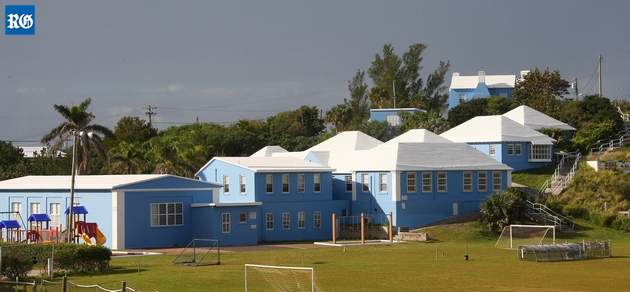
St David's Primary School
See full list of names and locations at the Ministry website.
See full list of names and locations at the Ministry website.
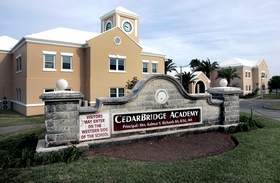
A private institution which receives a government grant through the Bermuda College. It provides a means by which those who have not gained secondary school certification may do so through the General Education Development (GED) program developed in the United States. The Government operates an extensive financial aid scheme to assist students seeking higher education in institutions outside Bermuda. A satisfactory academic performance and demonstration of financial need are two of the principal criteria for the receipt of such aid. In addition, there are Bermuda Government Scholarships based on academic merit and commitment to the teaching profession.
2017. September 7. Bermuda’s first non-segregated school celebrated 120 years of education . The Berkeley Institute, the idea of 11 “founding fathers”, opened its doors on September 6, 1897 — and it has stuck to its original plan to provide a first-class education to any pupil prepared to try their best. New principal Keisha Douglas, the school’s eighth head teacher and herself a former pupil, said: “The founding fathers would be excited to know that we truly remain a senior school for all and it is our vision to be first choice for everybody. We continue along that path with our programming and with our staffing — enticing persons over and realizing that we continue, after 120 years, to produce role-model citizens who go to the highest heights in Bermuda and worldwide.” Top businessmen and a string of Bermuda premiers, including Paula Cox, Ewart Brown, Alex Scott, Dame Jennifer Smith and Dame Pamela Gordon-Banks, have all worn Berkeley’s distinctive green and gold.
Berkeleyite Premiers
Off South Road, Paget. There is also a Bermuda College Faculty Association. Despite the name, it is NOT a university as it does not award any academic degrees. A non-residential junior college by USA standards and non-residential community college by UK standards. Incorporated by the Bermuda College Act 1974, offers opportunities for higher education in liberal arts, business studies, hotel administration and technology. For over 18's, a technical institute, community college, hospitality training center and further education center mostly for adults who have not attended university. The College, the equivalent of a junior college in the USA, is a publicly funded day-time (non-residential) community college institution for the over -18s, providing a two-year university transfer programme which enables qualified students to enter the appropriate first year of a four-year institution in North America. It's two-year diploma has been accepted as the equivalent of "A" levels in the United Kingdom and enables students to enter the first year of selected universities there. The College operates a Faculty of Adult and Continuing Education which enables persons already in the workforce to upgrade their skills. It owns - but no longer operates (it leases) the Coco Reef Hotel (formerly Stonington Beach Hotel). It has a library, open to the public, on a membership fee basis. Bermuda Government owned and operated as a quango. Its Center for Adult and Continuing Education facility offers many courses for adult students, Bermudians and non Bermudians. They include Professional; Hospitality; Computer related, for Macintosh and PC users; Technology; Personal Development; Do It Yourself; Cooking; Recreational Art; and Horticulture. Accredited by the USA's New England Association of Schools and Colleges (NEASC). In 2013 the Bermuda College (BC) arranged via Georgia State University (GSU) to provide on-island baccalaureate degrees to Bermuda residents in the areas of Finance and/or Risk Management and Insurance. The program allows BC students who have earned at least 60 credit hours and who have been accepted into the Robinson College of Business at GSU to take online evening classes at GSU via simulcast to earn the Bachelor of Business Administration degree with specialization in either Finance or Risk Management and Insurance.
2019. October 30. A new fundraising group has a target of $15 million to tackle “critical” upgrades to Bermuda College, the head of the organisation said yesterday. Mark Berry, the chairman of the Bermuda College Foundation, said there was a “significant list of needs” to be tackled at the college. He added: “It’s going to require significant funding to match those needs. Because of their significance, it is not going to be a quick fix. It is going to take time and a lot of effort.” Mr Berry warned: “We have no more time to wait. The time now is critical.” Mr Berry said that the college, now in its 45th year, had the potential to “be what it can be”. But he added: “It needs our help.” Mr Berry said the Government had been a “significant contributor” to the college over the years, but that the “needs have outpaced the revenue stream. Significant modernisation, upgrading and overall improvements are required to take the college to where we have as our vision — a fully funded, state-of-the art Bermuda College.” Mr Berry said that specific needs identified for immediate attention by the foundation included “modernisation and upgrades” to 52 classrooms and labs, and upgrades to IT infrastructure and classroom equipment. Mr Berry added that general upgrades to the school were also needed. He said: “There’s windows that need to be replaced, wiring, plumbing, ceiling tiles. It’s at the point where, really, it’s a time for action.” Mr Berry, the managing director and head of speciality reinsurance at Axa, studied accountancy at Bermuda College in 1979 and 1980. He took a summer job with an insurance company after his course. Mr Berry said: “I got into their accounting department because of my two years at Bermuda College.” He said that Ralph Richardson, a consultant for Bermuda College, had contacted him to take part in the foundation. Mr Berry said that he had accepted the post despite a busy schedule. He explained: “I get a real high. You feel really, really good. It is a meaty project, but it’s worth it. This is a good one.” Mr Berry said the other members of the foundation’s board of directors were “fabulous”. He highlighted the “tireless” work of Garry Madeiros, the deputy chairman. Mr Berry said that the foundation was accountable to its donors. He said: “We will hold the college accountable for delivering. We are advocates for our donors.” Duranda Greene, the president of Bermuda College, floated the idea of a foundation in 2011. The group, established as a separate entity from the college, has the sole task of raising funds on the college’s behalf. Mr Berry said that the “soft launch” of the foundation earlier this year had gone well. He added: “We’ve got a very, very good start. It’s humbling when people commit meaningfully. We are very excited.”
2018. November 24. Courses in fintech, compliance and gaming are on the cards for the Bermuda College as part of a new five-year plan. Duranda Greene, president of the college, unveiled details of its Vision 2023: Delivering Success plan at the Hamilton Rotary Club on Tuesday. Dr Greene said: “Preparation for the plan began in earnest last October and was approved by the board in September. The strategic lens through which the college views its ongoing relevance to our community and, in particular, to our students, is the result of extensive and comprehensive consultation with industry partners.” Other highlights of the plan include work on succession planning and a bid to find replacements for the more than 20 per cent of college employees eligible to retire over the next five years. Dr Greene added that the college also aimed to become a resource hub for intellectual activity and development for the community as well as an eco-friendly campus. She said that it was also planned to re-brand the college, which will include a review of its logo, tagline and colors. The re-brand could include the introduction of a college mascot. Full details of Vision 2023 will be available on the Bermuda College website next week. Dr Greene said that a 2017 government grant of $300,000 to help students get through was “a game-changer”. She added that the Throne Speech announcement that the grant would be increased by $200,000 meant even more students would benefit from a college education. Dr Greene said that a separate grants scheme, the College Promise, designed to reward students from the public education system who have a grade-point average of at least 3.0, would be introduced next year. She added: “Recent studies indicate that by 2020, with new technology and emergent industries, at least 65 per cent of all jobs will require some level of postsecondary education. It is imperative, we believe, and our mandate as a community college, to continue to prepare and equip our citizens to take advantage of these job opportunities.” The college will celebrate its 45th anniversary next year and will be making a special effort to reconnect with college graduates through a series of events.
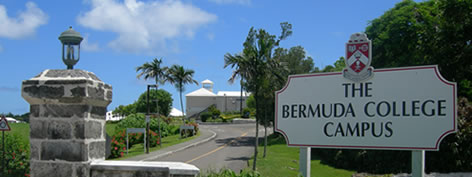
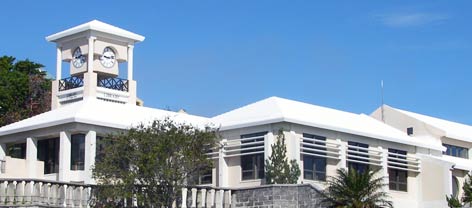
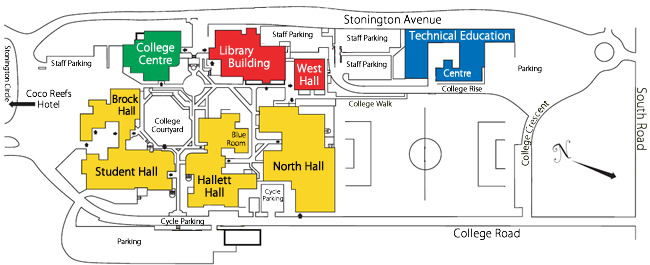
See Bermuda Government Boards.
2016. April 20. Two primary schools in the East End have recorded the island’s best average grades throughout the past four years, according to results from the Cambridge International Examinations.
Checkpoint is an innovative diagnostic test used as a valuable tool by schools as it provides feedback on student’s strengths and weaknesses in key subject areas.. More importantly, parents have a transferable academic record of their child’s progress as they transition through the system from primary to senior school level.” Checkpoints do not include passes or fails. Instead, each subject is assigned a score range of zero to six and the higher the score, the greater the level of readiness as the student transitions to the senior level to sit their IGCSE exam.
The Government's Special-Needs School. See details at the Ministry website. 10 Old Military Road, Devonshire DV 03, Bermuda. Phone: 292-7978, Fax: 296-1106. It caters to those with physical and cognitive challenges. There is a Friends of Hope Academy group and the school’s parent-teacher association.
A Community Education and Development Program, with three terms a year, is sponsored by the Bermuda Government's Ministry of Community and Cultural Affairs and the Ministry of Education. The sites are the Government run Computer Center, Northlands School, Warwick Secondary School, Sandys Secondary School and St. George's Secondary School. Classes meet for two hours and run for 10 weeks. Courses are grouped under the following main headings: Academic Support; Arts and Crafts; Basic Education; Boating; Certificate Courses; Commercial Courses; Computer Education; Consumer Education; Do It Yourself; Family and Personal Development; Food and Home; Health and Beauty; Languages; Music, Dance and Theater; Recreation and Fitness; and Technical Trades.
Primary, since 1990, ages 5-12. Phone (441) 292-8326 or fax 296-1522.
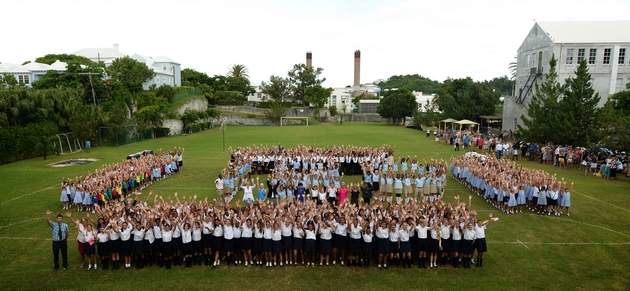
 Founded
in the 1890s. 19 Richmond Road, Pembroke Parish HM 08,
Bermuda. Telephone: (441) 295-6153. Fax: (441) 295-2754. Voice Mail: (441) 291-0049. Educates girls to high international standards. Modeled on the United Kingdom's Cheltenham Ladies College. Included in its syllabus is the International Baccalaureate
(IB) as
preparation for university. It is the IB Centre for Bermuda. Also, it is
British oriented in curriculum and examinations taken by
graduates, but with flexibility added to ensure their smooth transition to North American
universities. Annual fees -
on application. Number of students. 690+. Class size average. 20. Examinations taken
by graduates. GCSE's and SATs. Alumni
Association of the Bermuda High School for Girls. Bermuda High School for Girls Charitable
Trust, registered charity
358. Bermuda High School for Girls Parent Teachers
Association, registered
charity 056.
Founded
in the 1890s. 19 Richmond Road, Pembroke Parish HM 08,
Bermuda. Telephone: (441) 295-6153. Fax: (441) 295-2754. Voice Mail: (441) 291-0049. Educates girls to high international standards. Modeled on the United Kingdom's Cheltenham Ladies College. Included in its syllabus is the International Baccalaureate
(IB) as
preparation for university. It is the IB Centre for Bermuda. Also, it is
British oriented in curriculum and examinations taken by
graduates, but with flexibility added to ensure their smooth transition to North American
universities. Annual fees -
on application. Number of students. 690+. Class size average. 20. Examinations taken
by graduates. GCSE's and SATs. Alumni
Association of the Bermuda High School for Girls. Bermuda High School for Girls Charitable
Trust, registered charity
358. Bermuda High School for Girls Parent Teachers
Association, registered
charity 056.
2018. April 18. A new $11 million-plus high-tech technology centre is to open at Bermuda High School within the next two years, it was revealed last night. The school said its new Innovation Centre would prepare its pupils for careers in science, technology, art and design, and maths, known together as Steam. Jennifer Burland Adams, the school’s director of advancement, said the school had exceeded its $10 million fundraising goal in less than three years. She added: “It’s absolutely vital we look at Steam in two different ways. One is the world needs more people going into science, engineering and technology and they need girls in particular. We also look at a Steam education and the skills you get from that — project-based and inquiry-based education. These are vital and the skills that all companies are looking for in their employees. It’s the skills of collaboration and critical and creative thinking.” Linda Parker, head of school, said: “Women are underrepresented in boardrooms, in corporate leadership and certainly in the fields of technology, engineering and science. At BHS, we play an important role in ensuring that more of our girls consider careers in Steam by sparking a sense of wonder and curiosity as early as possible and then nurturing and challenging students’ interests through our curriculum and inspirational teaching in a state-of-the-art facility.” The 14,000 square foot centre, to be built on part of a car park behind the school on land donated by the Bank of Butterfield will be linked to the existing Butterfield Building, and include five new science labs, a MakerSpace — a high-tech science and engineering workshop — two computer science and robotics labs and learning commons and library, as well as a leadership centre for girls. Renovations will include a Blackbox Theatre and an arts wing, connected to the Innovation Centre, and which will house improved music and visual arts departments with an outdoor “idea hub” linking visual arts with the MakerSpace. Ms Burland Adams said: “Investing in science and technology and the arts, particularly at a girls’ school, really resonated with all of the people with whom we spoke. We know that we are preparing our students for exciting careers that haven’t yet been defined and that the combination of technical competencies, together with excellent problem-solving, collaboration and communication skills, will be key to their success. That is why a strong Seam education is so important and why BHS is leading the way in this endeavor in Bermuda.” The fundraising effort is the largest in the school’s near-125 year history and Ms Burland Adams said it “may be the most successful philanthropic effort in island history”. Ms Burland Adams added she expected to see an increased amount of pupil interest in technology-based careers as a result of the purpose-built centre and “our students taking advantage of international opportunities like camps and competitions because they will be in an environment that will be sparking curiosity and wonder from a very young age.” But she said that the new centre would benefit technology education across the island, not just the school’s own pupils. Ms Burland Adams added: “In Bermuda, I would hope to see the Innovation Centre become the hub for innovation and creativity in Bermuda through camps, workshops, competitions and people renting the space and using it.” The fundraising campaign was spearheaded by chairman Pamela Ferreira and school board chairman Mariette Savoie, along with Ms Parker and Ms Burland Adams. Donations ranged from $20 up to $1.5 million and came from families, graduates, staff, trustees, companies and friends of the school. Corporate supporters who gave leadership gifts included Renaissance Re, Arch, the XL Foundation, Aon, Deloitte, CatCo, Markel, Argus and BF&M.
2014. November 8. The Bermuda High School for Girls (BHS) is now the Island's only school to be accredited by the Council of International Schools. It comes after an evaluation of the school's ethos, faculty and governance by the Council, a global non-profit with more than 400 schools included around the world.
info@portugueseBDA.com. 2020 tuition is $300. Portuguese number about 15% in Bermuda, The school has helped hundreds of children learn Portuguese since it was launched as an after-school initiative for primary-aged students in the early 1980s. Richard Ambrosio, chairman of the Portuguese Cultural Association of Bermuda. Most fundraising for any year takes place in the spring, but every major function this year was cancelled: the Ag Show, the Kappa Classic, the Santo Cristo Festival, bake sales, a fundraising dinner and a summer football tournament. The school relies on these events to manage cashflow as school tuition covers only 20 to 25 per cent of our operational costs. The March 2020 Covid 19 pandemic coincided with the retirement of Veronica Franco, the school’s teacher of nearly a decade. The search for her replacement unearthed “recruitment issues” which ultimately led the PCA to plan for an online programme with a teacher from Portugal. Sandra Patricio has a master’s degree in language education and has taught Portuguese and English to “preschoolers, primary, middle, high school and even adult learners”.
The Portuguese School was started nearly 40 years ago by the Portuguese Cultural Centre, which merged with the Portuguese Association to become the Portuguese Cultural Association in the early 1990s. Lessons were held at various public schools until about 1993 when they were moved into a classroom rented by the PCA on the ground floor of the Vasco da Gama Club’s Reid Street headquarters. In 1997, the PCA opened a cultural centre in an old building on Laffan Street owned by St Theresa’s Church which the PCA renovated. The Portuguese School’s classes were held in that centre. Over the next few years, the PCA faced a number of challenges and eventually merged with Vasco da Gama Club in 2003. As part of this process, the club assumed responsibility for the running of the Portuguese School and signed a protocol with the Azorean Government to that effect in 2004, whereby the latter provides the school with an annual grant. This has continued to this day and the Azorean Government remains the largest contributor to the school’s operating budget. For a few years the school operated out of Mount Saint Agnes Academy but it returned to Reid Street in 2014 after extensive renovations to the classroom at Vasco da Gama Club were completed.
The Portuguese School delivers its classes in accordance with the Quadro de Referência para o Ensino Português no Estrangeiro, which is the official framework for teaching Portuguese as a foreign language, sponsored by the Instituto Camões — the government of Portugal institution, which promotes the Portuguese language and culture worldwide. This framework and the school’s delivery of instruction are designed to ensure that students leave with a sufficient level of competence to allow them to reintegrate into the Portuguese educational system; many of its students are the children of Portuguese guest workers. Cultural events throughout the academic year usually keep the students active.
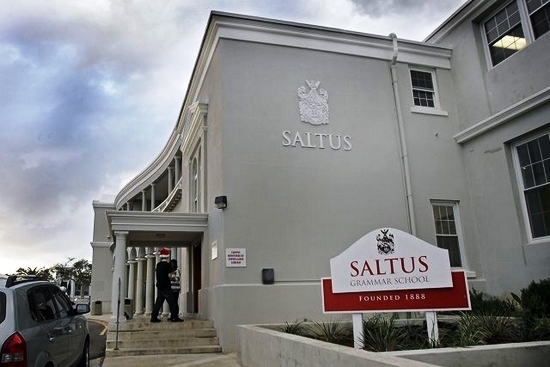
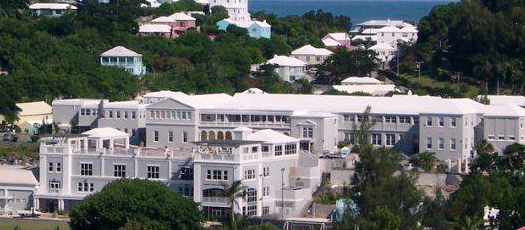
A highly regarded
private school. St. John's Road,
Pembroke Parish. Telephone: (441) 292-6177. Fax: (441) 295-4977.
P. O. Box HM 2224, Hamilton HM JX. A Private, independent day school (with it's
own primary school, Cavendish Hall Preparatory in a separate building in
Devonshire) secular and
co-educational, both British and North American oriented in curriculum and examinations
taken by graduates. A
member of the National Association of Independent Schools (NAIS) in North
America and CESI (Canadian Educational Standards
Institute).
A good private school. Formerly Montessori International Academy. 107 Middle Road, Devonshire DV 06. Telephone: (441) 236-9797 or 236-9789. Fax: (441) 236-9789. A private school, founded 1991, by the Montessori Education Trust. Currently with more than 330 students from 3 years old. Early childhood; lower elementary; upper elementary; middle school (the International Baccalaureate Organization). Secular. The philosophy is based on the teaching methods of Dr. Maria Montessori. With a 5-year Middle School Program, based on the International Baccalaureate Organization Middle Years Program. In June 2006 it become the first outside Canada to receive official accreditation by the Canadian Educational Standards Institute (CESI). The accreditation is the result of a three-year evaluation process that involved extensive site visits and assessments by CESI council members. The waiting list is strong.
Montessori Preparatory School:
38 Lightbourne Lane, Smith's Parish, FL 02. (441) 236-9797 or 236-0332. Fax: (441) 232-3119.
2018. June 21. This school is to start a $6 million expansion programme this summer to widen its curriculum. Somersfield Academy aims to provide the full International Baccalaureate at the school, which was founded as a Montessori school in 1991. Carlos Symonds, principal of the Devonshire school, said that the IB diploma marked a “natural progression” after 14 years of provision at the middle school level. Mr Symonds added: “We are simply maturing as a school and coming of age. “Most importantly, however, we are looking to give our students the choice to complete their final two years here in Bermuda at the school they have come to love.” Mr Symonds said the introduction of the two extra years of the IB programme had been asked for by students as well as parents. He added: “We are looking to provide them with the opportunity to complete their pre-university studies without having to endure a disruptive change of schools.” The construction plan, however, has still to be given planning department approval. The school, which has about 500 pupils, said it expected a gradual increase in enrolment with the two-year IB diploma programme. Mr Symonds said Somersfield would “start with a very small cohort, around 15 students in the first year, which will enable the team to give them the very best attention”. He added: “We’ll work our way up from there. With the two additional years, there will be some growth. However, we are committed to preserving the special culture of our small school as these characteristics are what make our school special.” Somersfield adopted the IB middle school programme in 2005, and Mr Symonds said students were familiar with the diploma. He added the IB was “arguably the most respected international programme”. Mr Symonds said: “While we are always pleased to see our kids excel and demonstrate that they can compete and meet the highest academic standards at the schools to which they transfer locally and globally, given that we do not offer the final two years, we cannot lay full claim to their successes, even though they may have started with us in our Montessori Children’s House at age 3.” He added: “This will change ... and provide us with a true and loyal alumni base.” The new building, to be called the Centre for International Education is expected to open by September next year. Mr Symonds said: “After about 28 years, we will come of age as a school, which is pretty significant along our journey.”

Somersfield addition planned
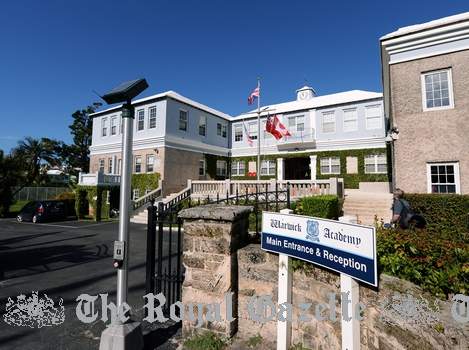
A highly regarded private school. 117 Middle Road, Warwick Parish, PG 01. Telephone: (441) 236-1251 or 236-1251 or 239-1917 (Office). Fax (441) 236-9995. Annual fees on application. There is a large waiting list at every level. It is a secular and co-educational day school. It was the first offshore school in the British Commonwealth, established in 1662 and operated continuously ever since. It was a private primary and secondary school until 1960 when it became a Bermuda Government aided secondary school. It reverted to private school status in 1990. Many graduates go to university.
Warwick Academy. Our first 350 years. Book. 2013. Co-written by long time educator Andrew Dobson and school parent Catherine Kennedy. Commemorative history book. Intended to paint a picture of where the school has been and where it’s headed in the future. Researching Warwick Academy’s past was difficult. Pre-1930s school records had been lost at sea in 1929, after the data had been sent on a boat to be bound in New York, but sank upon its return to Bermuda. Appeals were made to former students and teachers to get their contributions and many responded.
Warwick Academy Association. Registered charity 157
2016. March 8. Special needs education has been prioritized for the coming fiscal year, according to Wayne Scott. The Minister of Education said the department had experienced an increase in requests and demands for Para educators to meet the diverse needs of children in Bermuda’s education system, particularly those on the autism spectrum, students who are deaf or hard of hearing and those in need of specialized vision programmes. Mr Scott said the department aimed to create supportive classroom environments to meet student needs. The department has also highlighted the importance of evaluation and early intervention for children with autism, allocating more than $4 million for learning support. The department funds three education officers for special education and learning support in addition to 40 learning support teachers for preschool, primary and middle school. “The increase in funding is a direct result of assessment materials needed to ensure appropriate diagnosis of students with special needs and the purchase of unique learning system, a special education curriculum, used for autism functional skills and special school programme,” said Mr Scott. An additional $3 million has been allocated for para educators. “Last year the department of education committed to increase the monitoring and supervision of para professionals with more scrutiny applied to the development and review of criteria and paraprofessional placements.” In October, professionals participated in training that “focuses creating environments that support student success by acknowledging that students have unmet needs and latent skills, which can be addressed by staff response and action”. Currently 29 students are supported in the ASD programme at five public primary and middle schools. Opposition member Lovita Foggo said she hoped that somewhere embedded in that figure was an allocation for a permanent commissioner within the department. In light of the hiring freeze it has been filled in the interim and she emphasized that the acting party should remain. She said it sent a message to the public when we fill posts with Bermudians — “We do have the intellect and the skilled Bermudians on-island who are capable of sitting in that position,” she said. Ms Foggo partially commended the new initiative before, while noting the number of Bermudian students who suffer from some degree of autism. “Again we have a five per cent deduction in the budget allocation where there’s actually a need to ensure more is put in place to help these students have success in education. Aspects of the budget were unrealistic to achieve the government’s goals in education, saying areas such as school improvement and scholarships should have been boosted. We need to do everything we need to do to ensure that public education is seen and accepted in the public domain as being the first choice, always.” PLP MP Diallo Rabain, meanwhile, referred to the recent Score report’s findings on the condition of the island’s public schools, saying that the issue was not a new one. He noted that in the 2013 Throne Speech, the OBA identified the issue and stated that a facilities plan would come. In 2013, we knew we had to put money in our schools and upgrade our facilities,” he said. “In 2014, the minister spoke about an RFP. Now, in 2016, we have the Score report talking about the same thing.” Mr Rabain said there was a public perception that private schools were better than public schools, and that more needed to be done to address the issue. He suggested that a certain percentage of the Bermuda scholarships be earmarked for public school students.

Bermuda has NO colleges equivalent to universities. (The Bermuda College, day-school only, no boarders, is the equivalent of a day-school US junior college). A significant number of local preparatory (primary) pupils, or graduates of secondary, high and private schools, and non Bermudian dependents of Bermuda based international industry personnel, attend schools or universities abroad. Most go to the USA and Canada. American universities require Bermudians to take the Scholastic Aptitude Test (SAT). Those who go to the United Kingdom do so primarily - but not exclusively - for law studies.
Attending university in the US, which can cost students $40,000 a year, remains the most expensive option for Bermudians. But they get the highest-rated universities (see below).
Since 2011, many Bermudian and Bermuda-based students or their parents have found Canadian universities to be overall best-value-for-money. Until 2011, the UK offered it this but no more. Since then, university fees have risen significantly in the UK, now exceed £9,000 sterling annually for tuition alone . Bermudian and Bermuda-based youngsters pay the same rate at UK universities as UK nationals but most UK universities have hiked their annual fees to at least the same cost as if not higher than Nova Scotia’s Acadia University, or Dalhousie University.
Universities abroad attended by students from Bermuda are numerous.
Highest-rated universities in the world are:
The most popular Canadian university destinations include Ryerson University, University of Toronto, University of Waterloo, Queen’s University, Western University and Dalhousie University.
Under the Bermuda Government's National Education Guarantee Scheme, since 1994, no Bermudian student with university potential is denied the opportunity for further education due to lack of funds. Only students who are Bermudian by birth (namely, born in Bermuda with at least one parent being Bermudian, or born overseas with at least one parent Bermudian at the time) or by grant of Bermuda Status can apply for funding under this scheme.
Bermudians and/or Bermuda-based students studying at colleges and universities in England (not Scotland) may be advantaged in university fees. Students from British Overseas Territories including Bermuda who study in England are now charged home rate fees for further education and undergraduate or graduate degree courses. Some Bermudians, who further qualify because of grandparents or other close relatives living in the UK and who claim them as a member of their family, and/or who went to state or other funded boarding grammar or other British schools may pay low fees. Compared to the cost of being university-educated in Canada and the USA, it may be much less expensive in the UK, even when university fees were hiked there in 2011 to about £9,000 a year tops for the average UK student in England. However, parents of Bermudian or Bermuda-based children contemplation going to an English university (they generally do not any longer qualify to go for free to a Scottish or Welsh or Northern Irish one) should also bear in mind - for those who have to pay them - the cost of airline fares to and from Bermuda, which are significantly higher than airline fares from the USA or Canada. Also bear in mind that if overall quality of higher education, not cost, is most important, the top five American universities are the world's best and most prestigious. Bermudian university aspirants who can claim UK citizenship have a further realistic option, the opportunity of going to a good European university, say in France of Germany or Holland, for virtually no cost for student tuition (except they still have to pay for room and board and airfares home).
Leading Bermudian banks and law firms and many Bermuda based international companies offer very good scholarships.
Banner.jpg)
Authored,
researched, compiled and website-managed by Keith A. Forbes.
Multi-national © 2020. All Rights Reserved